
Jiaju Tibetan Village, Danba: Five Viewpoints and Where to Sleep (2026)
Tickets 50 yuan for three days, shuttle 35 yuan, private cars allowed in. Which of the five viewpoints to use at which…
Tickets 50 yuan for three days, shuttle 35 yuan, private cars allowed in. Which of the five viewpoints to use at which hour, and why sleeping in the village decides whether you see the dawn mist.
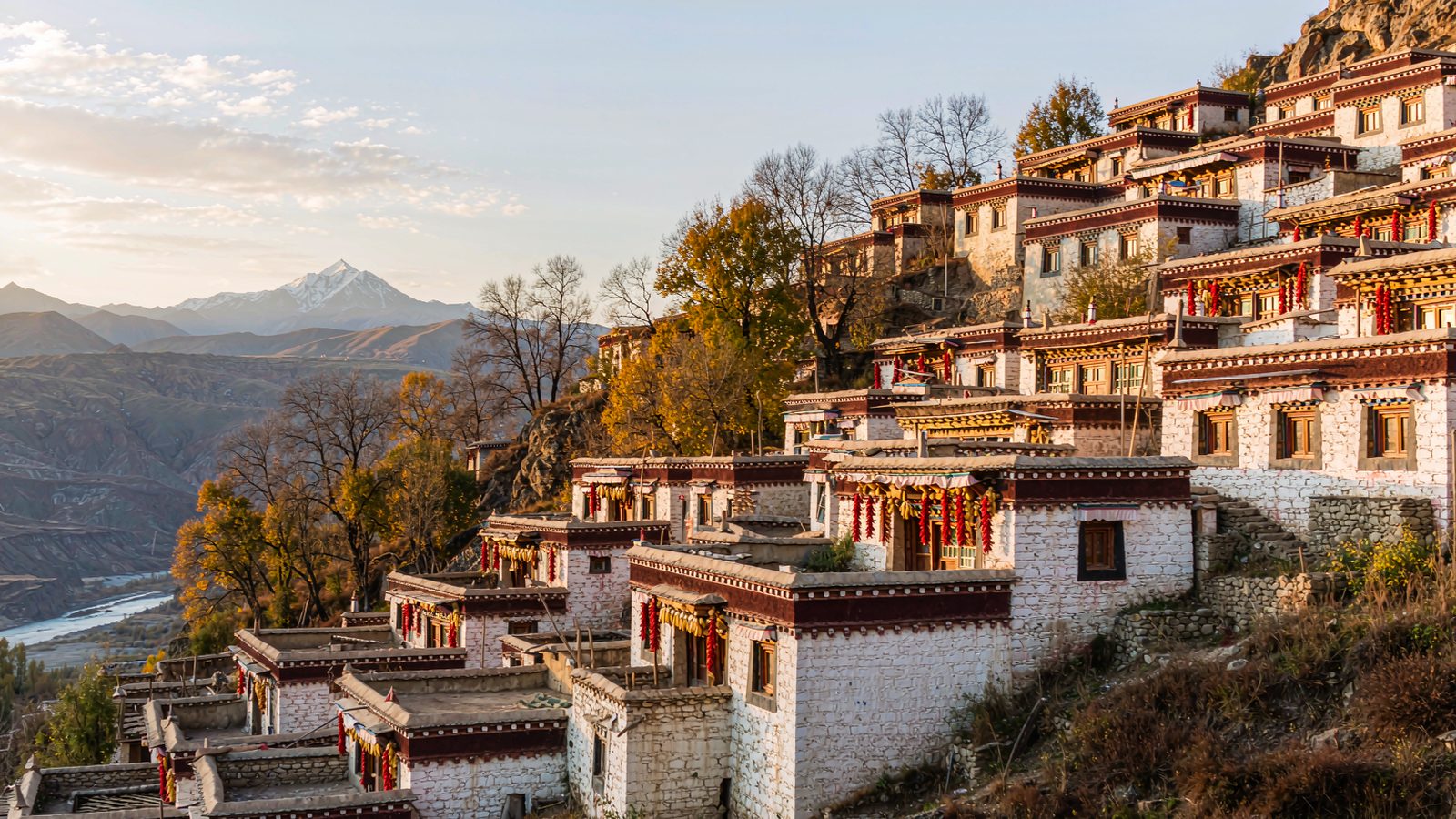
Eight kilometres of switchbacks above Danba county town, the road turns one last time and the hillside opens: white walls, red-brown eaves, flat roofs weighted with white stones, terraces of houses spilling from the floor of the Dajin River valley up towards the Kapama peaks. This is Jiaju. In Tibetan the name means "one hundred households"; today about 140 Jiarong Tibetan families still live here, one house per family, built of stone and timber.
Travel magazines have been generous with Jiaju. It sits at the top of a well-known list of China's most beautiful rural towns, it holds a 4A rating, and at 2,100 to 2,500 metres it is more than a thousand metres lower than Lhasa, so altitude sickness is rarely an issue. All of that is easy to find online. What is harder to find is a straight answer to two practical questions: which of the five viewpoints you should be standing on, and at what hour; and whether you sleep inside the village or down in the county town. Those two decisions separate a photograph from an actual village that people still live in.
Everything below reflects the situation in November 2026. Ticket prices, the shuttle bus and the self-driving rules were checked against current listings. The pear blossom and autumn colour windows get their own section, because those are the only two months of the year when you must book a room a month ahead.
Decision one: sleep in the village or in town
This is the most undervalued decision of the trip. Danba county town (Zhanggu) sits at 1,860 metres with plenty of hotels, easy restaurants and stable prices. Jiaju sits on the mountain at 2,100 to 2,500 metres, quiet at night, with fewer rooms and uneven quality. On paper it looks like a trade-off. In practice there is exactly one difference that matters: whether you can be on a viewpoint before sunrise.
| Guesthouse in the village | Hotel in Danba town | |
|---|---|---|
| To viewpoint No. 1 | 5 to 20 minutes on foot, 3 minutes by car | 8 km of switchbacks, 20 to 25 minutes |
| 7 a.m. mist | Wake up and you are there; breakfast after | Must leave at 6 a.m., on an unlit mountain road |
| Price, low season 2026 | Family guesthouse 150 to 300 yuan; view rooms 380 to 800 yuan | 200 to 400 yuan, better hardware at the same price |
| Food | House meal plan, 50 to 68 yuan per person | Wide choice, 30 to 60 yuan per person |
| Ticket | Discount usually available with a booking | Full price, 50 yuan |
| Best for | Photography, slow travel, families who will not rush | A four-hour stop, or an early departure the next day |
The conclusion is blunt: if you want the morning, you have to sleep in the village. The twenty most valuable minutes at Jiaju come just after sunrise, when mist climbs out of the Dajin valley, kitchen smoke starts rising, and the whole hillside turns from blue-grey to warm white. It happens once a day. Sleeping in town means giving it up.
Three conditions apply, though. First, ask whether a car can reach the door. Lanes inside the village are narrow; at some guesthouses you park on the main road and carry luggage up. Second, confirm a private bathroom and an electric blanket. Nights are 3 to 5 degrees colder than in town, and from November to March an electric blanket is not a luxury. Third, confirm meal times. There is no convenience store in the village; after 8 p.m. you will not find food. Travelling with children or older relatives, book near viewpoint No. 1 to cut out the climbing.
The five viewpoints, and what each is actually for
One paved road links viewpoints 1 to 5, with guardrails and some genuinely steep, tight bends. The mistake is treating them as a checklist. They are time slots, not a collection. Arrive at the wrong hour and you have wasted the drive.
| No. | Position and angle | What it is for | When |
|---|---|---|---|
| 1 | Near the village gate, facing the whole settlement with the Kapama peaks behind | Panorama, morning mist, kitchen smoke, first light on the roofs | 30 minutes around sunrise, roughly 7:00 to 8:00 |
| 2 | Slightly off-axis, screened by trees, fewest visitors | Close-ups of a single house, painted door frames, corn under the eaves | Side light, 9:00 to 10:30 |
| 3 | Central and elevated; frames the village together with the Dajin valley, Yaxiao mountain to the left | Layered rooftops, the river valley, sunset | 16:30 to 18:30, the best all-round spot |
| 4 | Higher, looking deep into the valley | Light and cloud shadows, depth | Afternoon into evening |
| 5 | The top of the village, highest and quietest | Distant Merdor holy mountain, stars, sunset | Sunset to an hour after dark |
If you have one chance, go to No. 3. It stacks three layers into a single frame: white walls and red eaves in front, the Dajin River in the middle, Merdor on the horizon. Most of the images that made Jiaju famous were taken from somewhere near this spot.
With two nights the schedule becomes comfortable: sunset at No. 3 on the first evening, mist at No. 1 before breakfast the next morning, details at No. 2 mid-morning, and Merdor plus stars at No. 5 after dinner. That sequence uses the light in both directions and avoids climbing the same road twice in a day.
An honest note: viewpoint No. 5 is overrated. It is the highest and the emptiest, but the village is so far below that the houses become small squares and the architecture disappears. Its real value is Merdor and the night sky. Conversely, No. 2 is badly underrated: most cars drive straight past, yet the most durable details at Jiaju are close up — sun, moon and star motifs painted above the door, window frames in black, red and white, corn and chillies hung under the eaves, quilts airing on a wall. That is what a living village looks like.
Tickets, shuttle and driving: the 2026 rules
| Item | Price | Notes |
|---|---|---|
| Admission | 50 yuan | Valid for multiple entries within 3 days, with ticket and ID |
| Shuttle bus | 35 yuan return | Links viewpoints 1 to 5; optional |
| Driving in | No extra charge | Vehicles under 7 m; steep road, drive in daylight |
| Parking | About 10 yuan per entry | At the visitor centre and the main viewpoints |
| Student ticket | 25 yuan | Full-time undergraduate and below, with student card |
| Senior ticket | 25 yuan | Age 60 to 64, with ID |
| Children | Free | Under 1.2 m |
Staying in the village usually earns a ticket discount. Show your booking at the ticket office; 40 yuan is the common figure, and some guesthouses quote 30 yuan, roughly sixty percent. Two numbers for one ticket is normal — the discount is settled between the guesthouse and the scenic area, and depends on room type and season. Ask the guesthouse how much the discount is and how it is redeemed when you book, rather than arguing at the window.
Three details that catch people out. First, the ticket is valid three days, but each entry requires ticket and ID, and lost tickets are not replaced. Second, the shuttle is a return ticket, not hop-on hop-off; departures wait until the bus fills, and after 17:00 the wait gets long, so do not rely on it if you are chasing sunset. Third, the area is open 24 hours with no closing time, which does not mean driving up at night is sensible: there are no street lights, the bends are blind, and from November the road can hold black ice. After 8 p.m., stay put.
One aside: Garze prefecture sells a multi-site pass (about 317 yuan, covering a dozen scenic areas). It pays off if you visit western Sichuan two or three times a year; for a single trip it does not.
Getting there from Chengdu: two routes, one hour apart
| Route | Way | Distance and time | Character |
|---|---|---|---|
| South (easier) | Chengdu — Yaan–Kangding expressway — Luding — S211 — Danba | About 340 km, 6 hours | Many tunnels, gradual climb, predictable |
| North (more scenery) | Chengdu — Duwen expressway — Wenchuan — G350 — Siguniangshan — Xiaojin — Danba | About 360 km, 7 hours | Better views, more bends, links to Mt Siguniang |
Both are paved end to end and fine for an ordinary sedan. The northern route lets you stop at Maobiliang for the Siguniang range and stitch "Siguniang — Danba — Jiaju" into one line; the cost is an extra hour, and the Balang Pass area climbs above 3,800 metres, which first-timers will feel. South for reliability, north for scenery. First visit: take the south.
Without a car there are three options. Long-distance bus: Chengdu Chadianzi station to Danba, about 150 yuan, 7 to 8 hours, few departures — book ahead on the provincial bus ticketing site. Direct coach product: platform-sold return transfers between Chengdu and Jiaju cost about 198 yuan, with separate outbound and return departures, good if Jiaju is your only stop. Private car with driver: a seven-seat MPV including driver, fuel and tolls runs 800 to 1,200 yuan per day; split four to six ways that is 150 to 300 yuan per person per day, and for a first trip to western Sichuan it is the least stressful option.
The last eight kilometres matter. From the county town to the Jiaju visitor centre is 20 minutes of switchbacks. There is no public bus; a taxi or shared car costs about 30 yuan per person. Nothing runs back up to the village at night, so if you are staying in the village, go up in daylight. The bends are sharper than they look: sound the horn, keep right, do not overtake on a curve.
Two road notes. S217 between Danba and Wasigou is still being upgraded in sections, with periodic traffic control, so allow slack. In the July–August rainy season there is rockfall along the river; check live road status the day before you leave, which beats any guidebook. Some 2026 posts also mention night-time restrictions on the Yaan–Kangding expressway; confirm with the operator on the day. Either way, mountain roads at night are not worth the risk.
Three ways to structure the visit
Option one, half a day, about four hours. Buy tickets, drive or take the shuttle up, panorama at No. 1, valley view at No. 3, forty minutes walking the lanes, then leave. This works if Jiaju is a stop on a longer loop. The weakness is light: at midday the white walls blow out and the village looks flat.
Option two, one night, recommended. Arrive at 15:00, check in, be at No. 3 by 16:00 for sunset. Dinner is a Tibetan hotpot at the guesthouse; if the sky is clear, walk to No. 5 or the roof after 20:00 for stars. Up at 06:30, at No. 1 before 07:00 for mist and first light, breakfast at 08:30, details at No. 2 at 09:30, down the mountain by 11:00. You collect both of Jiaju's best moments and walk less than three kilometres.
Option three, two nights, adding Zhonglu and Suopo. Day one sunset at Jiaju. Day two: mist at dawn, the village mid-morning, then Zhonglu in the afternoon — about 10 km from town, currently no admission fee, with a white-stupa viewpoint that gives sunrise over a sea of cloud and a wilder, quieter terraced village. Day three morning, Suopo's ancient watchtowers, about 40 minutes from Jiaju: 175 towers remain, the tallest above 50 metres, square, pentagonal and hexagonal in plan, also free. Jiaju is the living village, Zhonglu is cloud and terraces, Suopo is the skeleton of the land of a thousand towers. None of the three repeats another.
When to come: four windows
| Period | What you get | What it costs you |
|---|---|---|
| Mid-March to early April | Pear blossom; Jiaju peaks around 22 March to 8 April, the valley floor first, the upper slopes a few days later | Busiest and most expensive; book a month ahead |
| June to August | Deep green, 22 to 23 degrees by day, a genuine escape from heat | Rainy season, frequent mist, snow peaks are a gamble |
| Late October to mid-November | Autumn colour: white walls, yellow and red leaves, the clearest light of the year | Roughly half the crowds of blossom season, rooms about 30 percent cheaper |
| December to February | The village under snow, almost no visitors | Cold, some guesthouses closed, possible ice on the road |
If you can only pick one, pick late October to mid-November. Not because it is more beautiful, but because of value: the light is the clearest of the year, crowds are half of blossom season, rooms are cheaper, and you do not have to fight for a booking a month out. Blossom season is genuinely irreplaceable — white walls, white pear flowers and a snow ridge stacked in three layers — but you accept queues, traffic and doubled room rates.
One technical point for blossom season: the peak shifts by about a week each year, and lower valley floors open before the mid-slopes. Do not plan from a calendar. A week before you travel, ask your guesthouse what percentage of the trees are in flower. That answer beats any forecast.
Eight rules inside the village
- Do not enter or photograph the prayer room. The top-floor chapel is the most sacred space in the house. A curtain across the door means stay out.
- Ask before photographing people. Especially elders and children. One question is enough; if the answer is no, put the camera down.
- Do not walk into private courtyards. An open gate is not an invitation; most courtyards are living space, not exhibits.
- Do not step on mani stones, do not turn prayer wheels anticlockwise. The stupa cluster above the village is where residents come to pray; walk past quietly.
- There are many dogs. Most are tied, some are not. Do not run, do not stare, do not reach out. Walk past slowly.
- Give way when meeting a car. Lanes fit one vehicle. Backing up to a wider spot for a local driver is the local courtesy.
- Carry your rubbish out. There are no proper bins in the village; take bottles and packaging down with you.
- Do not treat children as props. Sweets, coins and staged photos make it harder for the next visitor.
What to eat
There is no standalone restaurant in the village; you eat where you sleep, at 50 to 68 yuan per person, and you should tell them numbers and dislikes in advance. Tibetan hotpot is the dish to order: a copper pot layered with cured pork leg, yak beef, highland mushrooms and local greens, the broth thickening as it cooks, around 70 yuan per person. Danba cured pork leg is the Jiarong signature, air-dried and sliced cold or stir-fried, and hard to find elsewhere. Highland barley flatbread is crisp outside and soft within, eaten with honey; wild mushroom soup is at its best in September. Snacks run to yak yoghurt, butter tea and tsampa. The county town has more choice — Sichuan restaurants, noodle shops, hotpot — at 30 to 60 yuan per person.
One practical tip: buy water and snacks in town before driving up. There is no shop in the village, and even hot water at night means finding the owner.
Five common mistakes
- "Jiaju is a quick stop, see it and drive down." Then you see only midday light, which means you have not seen Jiaju. Its value is twenty minutes at dawn and twenty at dusk.
- "More viewpoints is better, do all five." The angles overlap and the circuit takes over two hours. No. 1, 3 and 5 are enough; keep No. 2 for details.
- "Two thousand metres means altitude sickness." Jiaju is a thousand metres lower than Lhasa and most people feel nothing. The real issues are ultraviolet light and the day-night temperature swing; sunscreen and a jacket beat an oxygen can.
- "You can drive in, so park anywhere." You can drive in, but lanes take one car. Bad parking blocks the whole road and gets you moved on. Use viewpoint or guesthouse parking.
- "Blossom season is the most beautiful, so March it is." March is beautiful and also the most crowded, most expensive and least stable weather of the year. Late October to mid-November is the smarter choice.
How Jadetour runs this route
Jadetour has worked western Sichuan for years, and we almost never sell Jiaju as a same-day return. The reason is simple: its value is concentrated at sunrise and sunset, and both happen while you would be driving. Our standard shape is Chengdu out on the southern route to Danba on day one, sleeping in the village; dawn mist and the village on day two, Zhonglu in the afternoon, then back to Jiaju or on to Xiaojin; day three linking Mt Siguniang or heading home.
For international guests we provide an English-speaking driver-guide, pre-book guesthouses with private bathrooms and electric blankets, settle the ticket discount at the time of booking, and time the climb to arrive two hours before sunset — not from fear of lateness, but to avoid meeting a car on a blind bend. With older guests or children we prioritise rooms near viewpoint No. 1 to cut the walking.
One thing we will not do: guarantee that you will see the sun hit the peaks. Mountain weather changes three times a day; if cloud comes, it comes. What we can guarantee is the timing window, the position and a fallback plan. The rest is weather, and saying so up front is better than explaining it on the mountain.
If you are planning this stretch, send us your dates, group size, ages and whether you will drive. We will build the schedule hour by hour around the season's blossom and road conditions, and tell you which viewpoints are unreachable on your dates — which is far cheaper than discovering a closure at the gate. Plan a western Sichuan trip
Need help planning this trip?
Tell us your travel dates and group size — we reply within 24 hours.
WhatsApp +86 183 1705 8017 · WeChat 18317058017
More Guides
Chongqing's 8D Terrain: Upper and Lower Towns, Escalators, and How to Beat a Broken Map App
Two-yuan escalators, a 1986 heritage lift and a 30-yuan cableway: how the three vertical levels work, why your map app fails, and three ready routes.
11/10/2026
Heishangu Black Valley: The 13 km Gorge, Cable Car and 2026 Tickets Explained
Since April 2026 the valley is half-open: south gate only, 30 yuan entry. How the 13 km splits into three walks, what the cable car and shuttle cost, and what you cannot reach yet.
11/10/2026
Yading, Sichuan: Milk Lake, Five-Colour Lake and How Many Days You Really Need
Checked November 2026: 146 CNY entry, 120 CNY shuttle, 15,000 daily cap, long route open only to 25 November. Which trail, and how to shape three or four days.
11/09/2026