
Zigong, Sichuan: Dinosaurs, a 1,000-Metre Salt Well and the Lantern Fair (2026 Guide)
The dinosaur museum reopened on 28 July 2026: 40 yuan, real-name booking only. Shenhai Well is 25 yuan and now closes a…
The dinosaur museum reopened on 28 July 2026: 40 yuan, real-name booking only. Shenhai Well is 25 yuan and now closes at 17:00 for winter. No lantern fair in November - the 33rd edition opens January 2027. Trains from Chengdu take 50 minutes.
Zigong is the city that Sichuan tourism keeps forgetting. Ask a first-time visitor about southern Sichuan and you will hear about the Leshan Buddha, the bamboo sea at Yibin, the liquor of Luzhou. Zigong gets skipped, unless it happens to be Chinese New Year and the lantern fair is on.
That is a mistake, because Zigong holds three things nowhere else does: a dinosaur fossil bed laid down 160 million years ago, a hand-dug well that passed one kilometre in 1835 and still produces brine today, and a craft tradition that turns bamboo, wire and silk into city-sized light sculptures.
It is also unusually compact. The dinosaur museum, the old salt well, the salt museum and the lantern museum all sit within fifteen kilometres of each other. Day and a half covers the core. For anyone landing in Chengdu, Zigong is the rare add-on that works at either length: two days is comfortable, one day is still worth it.
Everything below reflects the situation on 13 November 2026. Zigong has changed this year: the dinosaur museum was closed for more than a year of renovation and only reopened on 28 July; the 32nd lantern fair has finished; the 33rd opens in January 2027. A great deal of what is online is two years out of date, and following it will cost you a wasted morning.
1. Is it worth the trip?
Yes, but it depends who you are.
If you are travelling with children, especially a six-to-twelve-year-old with a dinosaur phase, Zigong is top tier in China and has no substitute. The Zigong Dinosaur Museum is built on the excavation site itself at Dashanpu. The fossils were not carted into a city building; the building was put over the rock layer where the animals died. There are only three museums of this kind in the world: here, Dinosaur National Monument in Utah, and Dinosaur Provincial Park in Alberta.
If you care about technology and craft history, Shenhai Well and the Salt Industry History Museum will surprise you. In 1835, workers here drove a shaft 1,001.42 metres deep using bamboo cables, hemp rope, timber and human muscle - deeper than Western steam-powered rigs were reaching at the time. The well still yields brine. The salt is still boiled in pans over natural gas from the same bore. This is not a re-enactment; it is a working workshop.
If what you want is a spectacular night skyline, timing decides everything. During the lantern fair, roughly January into the second quarter of the year, Zigong has one of the best nights in China. In November the Chinese Lantern World site is shut. What remains is the Lantern Museum and scattered light installations around town. Say this to your clients before they book, not after they arrive.
If you want the polished old-town atmosphere of Lijiang or Wuzhen, Zigong will not deliver it. Xianshi is plain. The flagstones are uneven, the old houses are still lived in, the shop signs were not designed by anyone. Its virtue is authenticity, not beauty.
2. Getting there: 50 minutes from Chengdu, and a direct train from the airport
High-speed rail is the only sensible option
Chengdu East to Zigong runs more than forty services a day. The fastest is 50 minutes; second class costs between 53 and 99 yuan depending on the train, with most in the 69 to 98 range. At that frequency you can buy on the day, more like a commuter line than an intercity trip.
Zigong Station sits in Xianshi, Yantan District, about ten kilometres from the city centre. A taxi to the dinosaur museum takes roughly 25 minutes and costs about 35 yuan. To Xianshi Old Town it is only 3.7 kilometres - ten minutes, 15 yuan. That geography is a gift: you can stop at the old town on the way in from the station, leave bags at the visitor centre, and continue to the city afterwards.
From the airport, a connection most people miss
Chengdu Tianfu International Airport (TFU) has a railway station in the basement. Direct trains run from Tianfu Airport to Zigong in about 38 to 40 minutes. In theory you can land, clear immigration, collect bags and be in Zigong within two hours without entering Chengdu at all. For an international arrival in the afternoon this is the best plan available: downstairs to the platform, dinner in Zigong.
From Chongqing, Chongqing West to Zigong takes about 1 hour 20 minutes, with fewer departures but a workable routing if you are entering via Chongqing and leaving via Chengdu. Chongqing Jiangbei Airport has no direct rail link to Zigong; you must transfer at Chongqing West or Chongqing North.
By car
From Chengdu take the Rongzun Expressway, about 200 kilometres, two to two and a half hours, tolls around 80 yuan. City traffic in Zigong is simple and navigation to the sights is accurate. The one complication is the lantern season around Spring Festival, when roads around the lantern site are subject to temporary controls and one-way flow, and you must park in designated lots and take a shuttle.
Inside the city, use taxis or ride-hailing. The longest hop between sights, dinosaur museum to Shenhai Well, is twenty minutes and around twenty yuan. Split four ways it beats the bus, and the time saved buys you another exhibition hall.
3. The dinosaur museum: reopened 28 July 2026, and the rules changed
The single most important fact
The museum closed in May 2025 for a renovation costing about 210 million yuan and lasting more than a year. It reopened to the public on 28 July 2026. The renovation kept the building's famous "primeval era, a heap of boulders" silhouette, but reinforced the structure, replaced the metal roof, refaced the exterior and completely rebuilt the main exhibition, Fantastic Jurassic World.
Two halls are open: the Dinosaur Relic Hall and the Dinosaur Exploration Hall. Two warnings, and they are the ones people trip over. The Science Hall (Hall 3) is still under construction and closed. The on-site car park is also being rebuilt and is unavailable, so do not drive up expecting to park. Construction noise is possible; prepare children for it.
Hours and closing days
- Open 08:30 to 17:30. Ticket sales stop at 16:45, entry stops at 17:00.
- During Golden Week the museum stays open until 18:00, subject to the day's notice.
- Closed on the first Monday of every month, public holidays excepted. This rule still appears on the official site after reopening, so check a calendar before you fix dates: 7 December and 4 January, for example, are closed.
- Visitors under 16 must be accompanied by a guardian throughout.
Tickets and booking, as of November 2026
- Full price 40 yuan for adults.
- Concession 20 yuan: students aged 18 and over in full-time programmes up to bachelor level (adult education, in-service and online courses excluded); seniors aged 60 to 64 on national statutory holidays.
- Free: under-18s, seniors 65 and over, disabled visitors, active servicemen, veterans and the families of martyrs and deceased servicemen, and serving, retired or disabled firefighters plus fire academy cadets.
- Anyone claiming a concession or free ticket must present the original supporting document at the gate.
Entry is managed by quota, booking and staggered slots: 35,000 visitors a day maximum, 5,500 at any one moment. Booking is real-name, one ticket per person, through the museum website, Ctrip and other online platforms. Entry is by the original ID document used to book, or the booking QR code.
Groups of ten or more must call 0813-5801235 at least three days ahead; guiding enquiries go to 0813-5807227. There is staffed guiding at the visitor centre, self-guided audio at the right of the entrance, and self-service lockers at the visitor centre. Use the lockers; do not wheel a suitcase through the fossil halls.
How to spend three hours well
The Relic Hall is the reason you came, and the order matters. Start at the fossil bed: a wall of rock with dozens of skeletons packed into it, crossing, overlapping, all facing roughly the same way. The point of that wall is that these animals died together and died quickly. That is the scientific value of Dashanpu, and it is what separates this museum from a hall of mounted casts. Understand the wall and everything after it means something.
Then the skeleton hall. Three names worth holding on to. Omeisaurus tianfuensis, a long-necked sauropod whose head, lifted, reaches three storeys. Gasosaurus constructus, a medium theropod named, studied and mounted here. Huayangosaurus taibaii, one of the earliest known stegosaurs, with the shoulder spines it carried in life. A twenty-metre Omeisaurus stands four-square in the middle of the hall; standing at its feet and looking up is the memory most visitors take home.
The Exploration Hall is hands-on and explanatory, good for children and good for answering the extinction question properly. It has its own narrative and is not an annex. Allow 90 minutes for the Relic Hall, 45 for the Exploration Hall; with the connecting bridge, security and bag drop, three hours is comfortable and two and a half is rushed.
Photography: the skeleton hall mixes overhead and side lighting, and phone auto white balance drifts yellow. Set it near 4000K and it will look like what you saw. Press the lens close to display glass to kill reflections, but never use flash - it is prohibited.
4. Shenhai Well: a kilometre-deep well that still makes salt
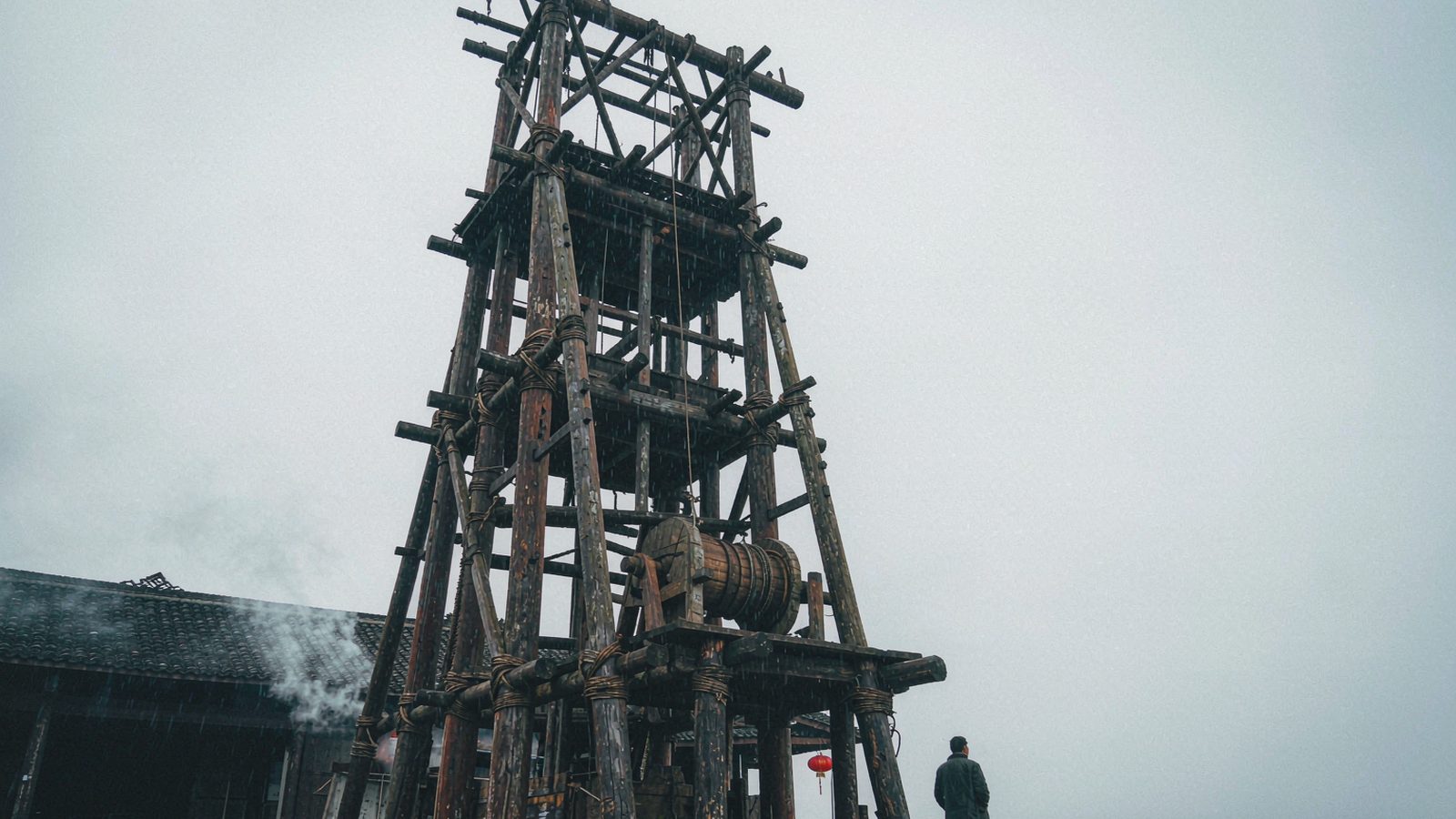
Twenty minutes from the dinosaur museum towards town, a timber tower twenty-odd metres tall appears at the roadside. That is a tianche, the derrick that became the symbol of Zigong salt. Underneath it is Shenhai Well.
Why it matters
Drilling began in 1823 and finished in 1835 - thirteen years - reaching 1,001.42 metres. It was the world's first hand-dug well past one kilometre. The word that matters is hand-dug: no steam engine, no electric motor. Men worked a lever rig, lifted brine with bamboo cables on a wooden winch. American steam rigs would not reach that depth for decades.
More importantly, this is not a ruin. It is a working workshop. The bore still yields natural gas and black brine; the pans in the boiling house still run on that gas; the men still follow the Qing-era sequence of lifting, sunning, boiling, raking, washing and packing. Stand at the boiling-house door and the steam and brine smell hit you together. There is nothing else like it in China.
Practical details
- Tickets 25 yuan, concession 13 yuan.
- Free: minors, active servicemen, civilian military staff, cadets, veterans, families of martyrs and deceased servicemen, visitors 65 and over, disabled visitors, journalists and licensed tour guides, all with documents.
- Seasonal hours: February to October 08:30-17:30; November to January 08:30-17:00. This catches people out. Plan a November visit on the summer timetable and the last half hour evaporates.
- The site is small: 1 to 1.5 hours normally, two hours if you follow a guide properly.
What to look at, and it is not just the wellhead
Most visitors photograph the derrick, glance at the wellhead and leave thinking "was that it?". The problem is that the wellhead is the size of a bowl. A thousand-metre shaft with an opening under eleven centimetres across tells you nothing without explanation.
Take it in order. First the drilling shed, where the lever-action percussion rig shows you how rock was broken a kilometre down with timber. Then the winch house, with its drum and bamboo rope. Finally the boiling house, where brine becomes salt. Only after that circuit do you understand how a town could grow rich on salt for three centuries, and how its merchants could afford to build a guild hall like the Xiqin Assembly Hall.
If a brine-lifting demonstration is running, stop for it. The moment the bamboo bucket clears the wellhead and the brine pours into the channel is the clearest picture of pre-industrial engineering you will see. Hand-packed well salt is sold on site for about ten yuan a bag, a better souvenir than anything in an airport shop.
5. The Salt Industry History Museum: the building is the exhibit
The museum occupies the Xiqin Assembly Hall, built in the Qianlong era with money pooled by Shaanxi salt merchants, and listed as a national key cultural relic. Visitors come for salt history and are ambushed by the architecture: an all-timber opera stage, stacked bracket sets, carved panels crowded with figures and stories, a pair of century-old stone lions in the courtyard.
It is the only specialist well-salt museum in China, and a Grade One national museum. The collection centres on the full tool kit of percussion drilling - the physical version of the technology at Shenhai Well - alongside Qing-era well-shaft drawings, merchant contracts and records of the traditional beef-drying craft. Coming here after Shenhai Well is the right order: field first, theory second.
Practical details
- Tickets 33 yuan; students and seniors 60 to 64 on statutory holidays 17 yuan; seniors 60 to 64 free on ordinary days.
- 08:30-17:30, last ticket and entry at 17:00. Extended to 18:00 during Spring Festival, Labour Day and National Day, with entry until 17:30.
- Real-name ticketing. Scan your ID card, the e-social-security QR code or your booking QR code at the gate; no exchange of paper needed.
- Guiding fees: Chinese, 200 yuan per session for up to ten people, plus 20 yuan per extra person. English, 300 yuan per session for up to ten, plus 30 yuan per extra person.
Our advice for a small foreign group of four to six: the 300 yuan English tour is worth it. The hall's architectural detail and salt technology are unreadable without explanation, and English signage is limited. That money buys more than two extra tickets would.
The museum is on Jiefang Road. Five minutes on foot brings you to Ziliujing Old Street and the Fuxi River - free, flagstones and Republican-era houses, good for a twenty-minute decompression. Traces of old wellheads, salt wharves and warehouses remain along the street.
6. The lantern fair: get the dates right, there is none in November
This is the section that matters most. The Zigong lantern fair is not a permanent attraction. It is a seasonal festival: it opens in January, runs into the second quarter, then closes so the lanterns can be dismantled and the next edition designed and built.
The 32nd edition opened on 23 January 2026 under the theme "Painting China in Light, Building the Future", with ten thematic zones, eleven oversized installations and more than two hundred smaller ones, including a 210-metre kunpeng and a 600-drone formation display. Pricing was tiered:
- Off-peak, 24 January to 14 February and from 4 March to closing: adults 118 yuan, Zigong and Neijiang residents 98, students and seniors 65 to 69 80, veterans 70.
- Spring Festival, 15 February to 3 March: adults 168, students and seniors 98.
- Closed on New Year's Eve, 16 February.
- Hours: off-peak 17:00-22:30, extended to 23:00 on Fridays and Saturdays; festival period 16:00-23:30, and 16:00-23:00 after 24 February. Lights on at 18:00.
The 33rd edition: confirmed by officials at the Global Panda Partners conference on 3 November 2026 and at a briefing on 6 November. It opens in January 2027 under the theme "Auspicious Lanterns, Beauty Shared", organised in four sections: Spring Beneath the Lanterns, Dreaming of the East, Drama Among Us, and All Beauty Together. Exact dates and prices are not yet published; on recent form, ticketing opens in mid to late December.
What to see outside the season
The China Lantern Museum, inside Lantern Park. It is the only museum anywhere devoted to lantern culture, free but requiring a reservation, open 09:00-17:30 with last entry at 17:00. The route runs from Han pottery lamps and Tang silk lanterns to modern sound-and-light installations, and the most interesting cases are the lanterns built from porcelain, medicine bottles and silkworm cocoons. You leave understanding that the craft is not about bulbs: it is framing, pasting and painting. Sources disagree on whether it closes on Mondays, so confirm in the mini-programme before you go.
There are scattered installations around town and a permanent light display on Ziliujing Old Street, enough for an evening walk. Nanhu Park ran a free autumn lantern garden event in 2026, but it closed on 8 November; do not follow old posts to it.
If you are coming specifically for the fair
- Everything is real-name. Booking requires ID number and name, and you carry the original document to the gate. During the festival peak, 15 to 23 February, adults are limited to one ticket per ID per day.
- Free entry still needs a booking. Children under 1.3 metres, visitors 70 and over, guiding tour leaders, firefighters, disabled visitors with a grade one or two certificate plus one companion, journalists, active and disabled servicemen, families of martyrs, holders of provincial talent cards, and Taiwan compatriots holding a Taiwan Compatriot Permit all need a free-entry code from the official WeChat account or mini-programme first.
- Spring Festival runs two sessions a day. From 15 to 23 February, session one is 17:00-20:30 and session two 21:00-23:30, each with the full show and drone display. Session two tickets are released around 20:00 on the day. With children or older travellers, take session one; do not gamble on the late slot.
7. Xianshi Old Town: a salt port 3.7 kilometres from the station
This may be the thousand-year-old town closest to a high-speed rail station anywhere in China - 3.7 kilometres from Zigong Station, ten minutes and 15 yuan by taxi, fifteen minutes on the shuttle bus. Free, no booking.
It dates from the Sui dynasty, more than 1,400 years, and grew rich on the salt wharves of the Fuxi River; it calls itself China's first salt-transport town. The layout survives remarkably intact: four streets, five temples, one ancestral hall, three wharves. Nanhua Palace was built by Guangdong salt merchants, TianShang Palace by merchants from Fujian, and Jinqiao Temple still holds a Qing opera stage. These are genuine old buildings, not a rebuilt commercial street.
What makes it good is that people live there. Blacksmiths, cotton carders and straw-sandal makers still work the street. Tea in the old teahouse costs 10 to 15 yuan a bowl, and local men sit in bamboo chairs playing cards. A bowl of douhua rice with chilli dip is fifteen yuan and is the most everyday meal in Zigong.
Three specifics: Jinqiao Temple, 5 yuan to climb the tower, is the best viewpoint over the tiled roofs and the river bend; Chen Family Hall, 10 yuan, is a Qing mansion whose courtyard light is worth photographing; the three wharves face west and are best around 17:30 when the river takes the sunset.
Schedule it as your arrival stop. Leave bags at the visitor centre, wander two hours, eat a bowl of douhua, then take a taxi into the city for the museums. That saves an hour over going into town first and doubling back, and in the morning the old town is nearly empty with soft light.
8. Fantawild Dinosaur Kingdom: a full day for children
If the museum is the real thing, Fantawild is the ride version, and the two do not compete; they pair. It is the only dinosaur-themed Fantawild park, with nine large indoor technology attractions and thirty outdoor rides.
- Tickets: adults 280 yuan; children 1.1 to 1.4 metres and seniors 65 and over 199; under 1.1 metres free; two-day ticket 480.
- Hours: seasonal. Commonly 10:00-17:00 on weekdays and 10:00-19:00 at weekends, extended with a night session on public holidays. Check the Fantawild app on the day.
- Access: 15 minutes and about 15 yuan by taxi from Zigong Station; underground parking 10 yuan per four hours.
Three must-dos. Soaring, a suspended dome-screen flight over a prehistoric forest from a pterosaur's point of view - go at opening, or queue 60 minutes. Dinosaur Valley Rapids, a 28-metre splash ride; ponchos rent for 15 yuan. Fly the Blue Sky, a live-action show with effects and limited daily slots, bookable in the app on entry.
With small children, do Valley Exploration (a boat ride past dinosaur models) and the Boonie Bears theatre. Teenagers head for Crossing the Volcano (suspended coaster) and Dinosaur Crisis (4D ride-and-shoot). Skip Journey to the Centre with a child afraid of the dark; the sets are very dim.
An honest note: at 280 yuan this is not cheap, and if nobody in the group is under twelve, spend the day at Shenhai Well and the salt museum instead.
9. What to eat: salt-merchant cuisine is not just hot Sichuan food
"Eat in Sichuan, flavour in Zigong" is a saying Sichuan people accept. The local school is called yanbang cuisine, salt-gang cooking, and its signature is seven qualities: numbing, hot, fresh, fragrant, tender, crisp and clean-finishing. It differs from Chengdu cooking, which prizes layered subtlety. Zigong wants fierce heat, heavy seasoning, cooked to order, because it was food for salt workers who needed rice, sweat and stamina.
Four things you must eat
- Cold rabbit (leng chi tu). The city's signature. Rabbit diced small and slowly fried with quantities of dried chilli, Sichuan pepper, ginger and garlic until the moisture is gone, then eaten cold. Good versions are dry-fragrant, not oil-soaked: crisp chilli, firm meat, more flavour with each chew. Vacuum packs travel; they are nothing like the fresh pan.
- Fire-edge beef (huobianzi niurou). Beef sliced thin as paper, dried over charcoal and dressed with chilli oil and spice. It began as salt-field rations: durable, salt-replacing. Numbing comes first, beef second.
- Fresh-pot rabbit (xian guo tu). Rabbit cooked to order with fresh green chillies and young ginger in a generous broth. This is the host's dish. You can ask for less heat, but "mild" in Zigong is still medium-hot for a visitor.
- Fushun douhua. Silken tofu from Fushun county, too soft for chopsticks, served with a ciba-chilli dip. It is the one thing in town you can eat without heat, and the safe order with children.
Also worth ordering: poached beef Zigong style, the "three tenders" of liver, kidney and tripe cooked in seconds, small-fried chicken, and scallion crucian carp.
Three practical rules for ordering
First, state your heat level explicitly, and ask for no chilli rather than mild. In Zigong, mild means less chilli, not no chilli. Second, with children or older guests, order douhua rice and steamed egg and do not tough it out. Third, do not order Chengdu quantities: portions are large and built for rice, so three dishes feed four people, and five will leave half the table untouched.
Do not skip breakfast: douhua with rice noodles around Dengganba (eight to ten yuan, sour and hot), and Changsheng noodles in clear chicken broth, the go-to for anyone avoiding heat.
10. Three itineraries you can copy
One day, from Chengdu, core only
07:00 depart Chengdu East; 07:55 arrive Zigong; 25-minute taxi to the dinosaur museum; 08:30 entry with a ticket booked the day before; 90 minutes in the Relic Hall, 45 in the Exploration Hall; 11:30 leave; 20 minutes to Shenhai Well; 12:00 douhua lunch nearby; 13:00 Shenhai Well for an hour, watching brine lifted and boiled; 14:30 the salt museum for an hour; 16:00 walk Ziliujing Old Street; 17:00 taxi to the station; 18:00 train back.
Three sites, tight but not frantic. The single risk is the museum ticket. At weekends and on holidays you must book ahead; without a ticket the whole day collapses.
Two days, recommended, with the old town
Day one: morning train, bags to the old town visitor centre, two hours in Xianshi, douhua for lunch, afternoon taxi into the city, 1.5 hours at the salt museum, tea at the Wangye Temple or on Ziliujing Old Street, fresh-pot rabbit for dinner. Day two: 08:30 at the dinosaur museum for three hours, lunch, 1.5 hours at Shenhai Well, 16:00 the free Lantern Museum, departure.
The advantage is that it separates the two kinds of looking: day one is people and city, day two is prehistory and industry. Neither day exhausts you.
Three days, adding Rongxian or Fantawild
Choose one for day three. With children, Fantawild for the full day. Without, Rongxian Great Buddha: a Tang dynasty cliff carving 36.67 metres tall, the largest stone Buddha of Shakyamuni in the world, 10 yuan admission, open 08:30-18:00 with last entry 17:30, about 40 minutes by car. Its oddity is the roofless main hall, so the Buddha rises straight through the building to the hilltop - a composition you will not see elsewhere. It is quiet and nearly empty, a different world from Leshan.
If you can only add half a day, choose Rongxian over Fantawild. You can find a Fantawild in many cities. There is one Rongxian Buddha.
11. Ten mistakes people actually make
- Expecting a lantern fair in November. There is none. The 32nd has closed; the 33rd opens in January 2027.
- Arriving at the dinosaur museum without a booking. Real-name, one ticket per person, 35,000 a day.
- Landing on the first Monday of the month. Closed, public holidays excepted.
- Using summer hours at Shenhai Well in November. November to January closes at 17:00, not 17:30.
- Driving to the dinosaur museum expecting the car park. It is under reconstruction and closed.
- Hunting for Science Hall 3. Still a building site.
- Assuming Zigong Station is downtown. It is in Xianshi, Yantan District, twenty-odd minutes out.
- Leaving the museum for lunch and coming back. The ticket admits you once.
- Saying "mild" when ordering. In Zigong that means normal. Ask for no chilli.
- Treating Zigong as a stopover from Chengdu. It deserves two days. Squeezed into half a day, all anyone remembers is the rushing.
12. Plain advice for overseas visitors
Documents. Every site is real-name. Foreign visitors book with passport details and present the passport at a manual verification lane. The dinosaur museum's online platforms are built mainly around Chinese ID cards; if you cannot find a passport option, do not improvise at the gate. Call 0813-5801235 three days ahead, or have your ground handler book on your behalf.
English guiding. The Salt Industry History Museum offers a proper English tour at 300 yuan for up to ten people, and it is the one place in Zigong that explains well-salt technology systematically. Book it. The dinosaur museum has been adding English signage, but the label text is dense; brief your group beforehand or pair a Chinese guide with an interpreter.
Heat. Zigong's chilli is fresh-hot plus numbing, more direct than Chengdu. For a first yanbang meal with foreign guests, order cold rabbit with reduced chilli, douhua, steamed egg and a green vegetable, get rice on the table, then add one or two bold dishes for people to try. Do not open with fresh-pot rabbit.
Pace. The three museums involve real walking; the dinosaur museum's two halls are linked by a bridge, roughly three kilometres in total. For older travellers, build in a sit-down tea between venues - the teahouses at Wangye Temple or on Ziliujing Old Street charge about ten yuan a bowl and are far kinder than a bench in a lobby.
Visas. Entry rules change; rely on the latest notice from the embassy or consulate and official channels. Jadetour does not process visa applications and makes no promise about outcomes. What we do is arrange the itinerary, tickets, guiding and transport so that on the day you only need to show a document.
Zigong does not overwhelm you at first sight. Its qualities take a little time: five minutes standing in front of a wall of fossil bone, a moment in the steam of the boiling house, an hour in an old teahouse listening to someone explain why the salt boats never stopped. Do those three things and you will probably agree with our judgement. This city has been undervalued for a long time.
(Ticket prices, opening hours and event details verified on 13 November 2026. Policies at the dinosaur museum are still being adjusted after reopening, and the 33rd lantern fair has not published its details. Before travelling, confirm with each site's official account. All prices are in RMB.)
Need help planning this trip?
Tell us your travel dates and group size — we reply within 24 hours.
WhatsApp +86 183 1705 8017 · WeChat 18317058017
More Guides
Zhangjiajie in Four Days: Forest Park, Tianmen Mountain and Fenghuang (2026)
November 2026 prices: Wulingyuan four-day pass CNY 228 to 240, Tianmen CNY 278, Fenghuang combo CNY 128. The order, the lodges, the bookings, the luggage and the wet-weather plan.
11/13/2026
Sanxingdui Museum 2026: Ticketing, Three Halls and the Objects That Matter
Tickets are 72 yuan, released at 20:00 five days ahead, none sold on site. Under-18s enter free but still need a booking. The right order for the three halls, what the star objects really are, and nine mistakes to avoid.
11/12/2026
Huanglong Without the Suffering: Altitude, Cable Car, Five-Colour Pool (2026)
Admission 170 yuan in high season, cable car 80 up and 40 down, closed 16 December to 31 March. A four-hour plan: ride up, walk down, plus altitude advice and booking rules.
11/12/2026