
Langzhong Ancient Town: Feng Shui, Three Kingdoms and the Birth of Chinese New Year (2026)
The streets are free around the clock; the 110-yuan pass lasts three days. Reading the feng shui from Jinping Hill, plu…
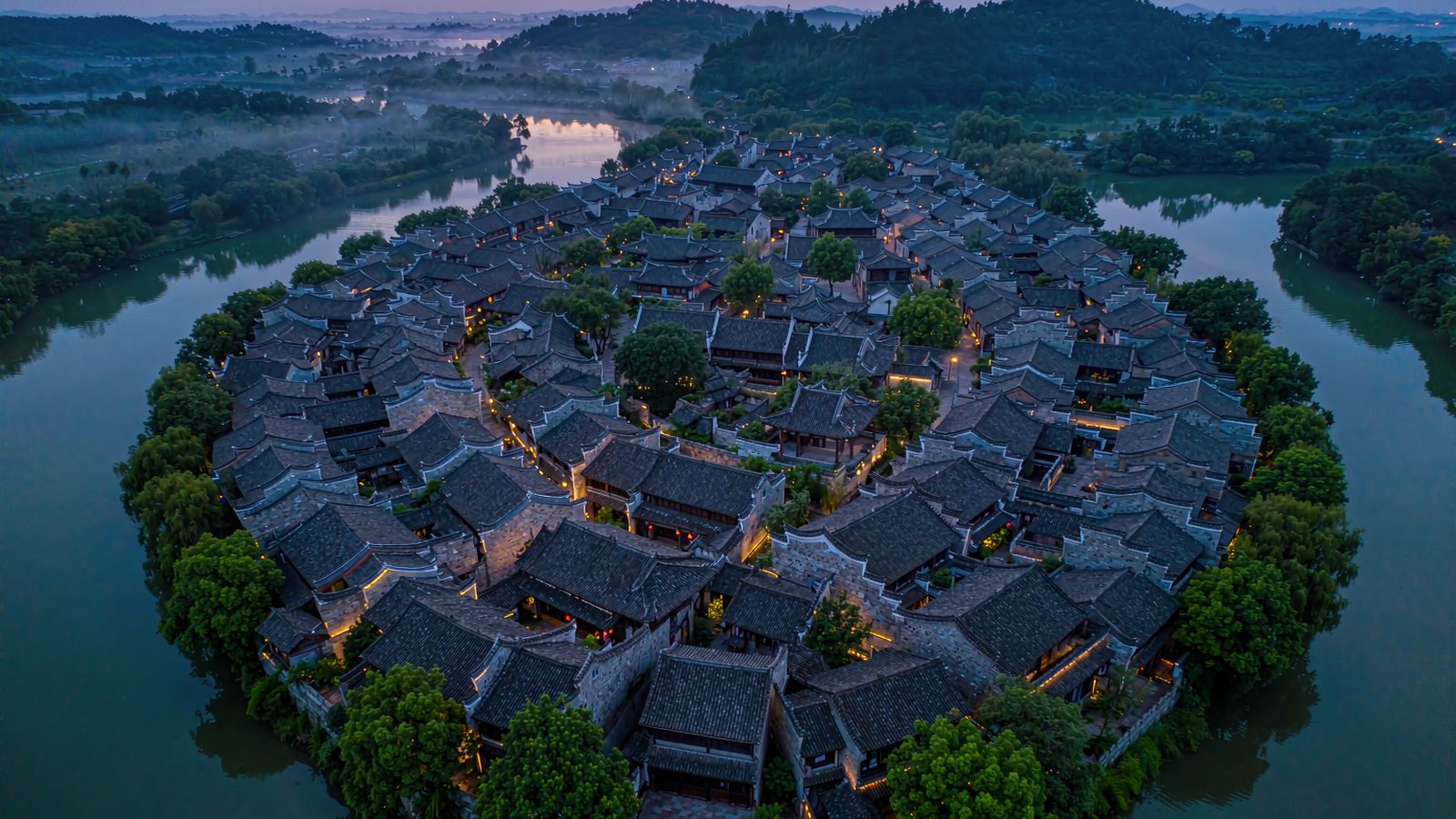
The streets are free around the clock; the 110-yuan pass lasts three days. Reading the feng shui from Jinping Hill, plus the Zhang Fei shrine, the exam hall and real rail times.
Langzhong is the least famous of China's four great ancient towns, and that is precisely why it still works. It sits in Nanchong, Sichuan, with the Jialing River wrapping it on three sides. The city has been continuously inhabited for more than 2,300 years and has never changed its name. Lijiang, Pingyao and Huizhou get the crowds; Langzhong gets the locals.
Most visitors treat it as a day trip from Chengdu. They arrive around noon, walk one commercial street selling beef and vinegar, and leave by four. That itinerary misses the point entirely. Langzhong has three layers: its feng shui layout, its Three Kingdoms and imperial examination history, and its claim to being the birthplace of Chinese New Year. None of those layers sits behind a ticket gate. They sit in the geography. Prices, opening hours, rail promotions and flight schedules below reflect the situation as of November 2026.
1. Where Langzhong actually sits
Of the four great ancient towns, Lijiang was a Naxi chieftain's seat, Pingyao was a Qing banking centre, Huizhou was a prefectural capital, and Langzhong was a dual military and administrative hub on the northern rim of the Sichuan Basin. It governed the Ba region at the end of the Eastern Han, and Zhang Fei held it for seven years. In the early Qing, when Chengdu lay in ruins, the provincial governor's office moved here and Langzhong served as acting provincial capital for nearly two decades.
That origin explains the street plan. Langzhong was not laid out for commerce, with wide trading streets. It was laid out for garrisons and government offices, as a grid. And unlike a museum town, it is still lived in: people wash vegetables at their doorsteps in the morning and carry bowls through the lanes at noon. What you are walking through is not a set. It is housing that is still in use.
2. Reading the feng shui without the mysticism
The Jialing makes a broad S-curve here, so water wraps the west, south and east sides while Mount Panlong anchors the north. In traditional terms this is a jade belt around the waist: water as boundary, mountain as backing. The axis of the town runs through Zhongtian Tower, from which four main streets radiate like a cross on a board. Walk south from the tower and you face Jinping Hill across the river, the classic "desk mountain" that sits squarely in front of the city.
| What to see | Where to stand | What it reveals |
|---|---|---|
| The full outline and the three-sided river | Summit of Jinping Hill or Baita Hill | The S-curve and the city boundary in one view |
| The radial street grid | Third floor of Zhongtian Tower | Four main streets fanning out below you |
| River, rooftops and mountains layered | Fourth-floor gallery of Huaguang Tower | Tiled roofs inside, water beyond, hills furthest |
| The axis aligned to the desk mountain | South from Zhongtian Tower, or north from Jinping | How precisely the axis was sited |
Do it in the reverse order from what feels natural: climb Jinping first for the overview, then enter the town and walk the axis. Once you have the aerial view, every lane you enter afterwards clicks into place. Do it the other way round and a full day of walking still feels random. Jinping is across the river; a taxi to the Jiangnan bridgehead and up takes about twenty minutes. The hilltop has a statue of Luo Xiahong and a shrine to Du Fu. Admission is around 20 yuan and is often waived during promotional periods.
One more site worth naming: Prince Teng's Pavilion on the northern edge of town. Most people assume the famous one in Nanchang, but Li Yuanying, Prince Teng of the Tang, was enfeoffed first at Tengzhou and later at Langzhou, and Langzhong built its own. It stands halfway up Yutai Hill, admission is free, the river view from the upper floor is good, and almost nobody goes.
3. The 110-yuan pass: worth it or not
Start with the fact that decides everything else: the old town streets are free and open 24 hours. You can enter, wander, eat and sleep here without buying anything. Only the gates of a handful of courtyards are ticketed. So the real question is not whether to pay, but whether you want to go inside.
| Ticket or site | Price | Notes |
|---|---|---|
| Old Town Pass | 110 yuan (about 100 to 109 online) | Covers the Zhang Fei Shrine, the Qing Examination Hall, the Confucian Temple, the North Sichuan Circuit Office, Zhongtian Tower and Huaguang Tower; valid three days with re-entry |
| Zhang Fei Shrine (Han Huanhou Ci) | 50 yuan | The single most expensive site and the emotional core |
| Qing Dynasty Examination Hall | 50 yuan | The largest and best-preserved provincial examination compound in China |
| Confucian Temple | 30 yuan | Red walls, plus traditional archery and pitch-pot games |
| Zhongtian Tower | 15 yuan | The geomantic centre of the town, roughly 25 metres tall |
| Huaguang Tower | 15 yuan | Tallest wooden tower in north Sichuan, four gallery levels |
| North Sichuan Circuit Office | Included in the pass | Seat of the highest Ming and Qing authority in the region |
| Jinping Hill | About 20 yuan | Best overview of the town; often free in promotional periods |
| Tiangong Yuan | 30 yuan, or 40 with the combo | About 29 km out; feng shui theme; needs half a day |
| Baoning Vinegar Museum | 38 yuan (seniors 20) | Full brewing process with tasting at the end |
| Jialing River cruise | Day 55 / night 65 / flagship 93 | 08:30 to 21:00; night sailings depart after 19:00 |
Do the arithmetic: buying the shrine, examination hall, Confucian temple, Zhongtian Tower and Huaguang Tower separately comes to 160 yuan. The pass pays for itself the moment you plan to enter three courtyards or more, and its three-day validity means you can come back the next morning instead of sprinting through everything in one afternoon. If you only want the streets, a teahouse and the evening lights, you need no ticket at all.
Discounts need a caveat, because published terms differ between channels. The mainstream version: children under six or under 1.2 metres free; free for visitors over 65, active and retired military, firefighters, police and disabled visitors with ID; free for ages 60 to 64 outside public holidays and half price during them; half price for full-time students with a student card. Some channels state free from 60, others only from 70. Bring your passport or ID and settle it at the window rather than prepaying full price online.
4. Six courtyards without doubling back
The core is about 1.5 square kilometres and entirely walkable. Sites are 10 to 20 minutes apart, and a full day runs 15,000 to 20,000 steps. Wear flat shoes; the flagstones are treacherous in rain.
Suggested order: enter at Zhuangyuan Arch, then the Circuit Office, the Confucian Temple, the Examination Hall, Zhongtian Tower, the Zhang Fei Shrine, and exit at Huaguang Tower. The logic runs from government to examination to market centre to tomb-shrine to riverbank, always southward, finishing at the water just as the light turns.
The Zhang Fei Shrine deserves real time. Zhang Fei held Langzhong for seven years and is buried here. The surviving structures are mostly Ming and Qing: gate, the Enemy-of-Ten-Thousand Tower, the main hall, the tomb pavilion. Inside the hall stands a seated figure of Zhang Fei in civil robes, with his iron whip and serpent spear displayed to either side. The burial mound behind is oval, 42 metres north to south, 25 wide and 8 high; his head was taken away after his murder, so the body interred here is headless. That detail lands harder on site than in any guidebook.
The Examination Hall is the other underrated stop. It is the largest and most complete Qing provincial examination compound in the country, restored in 2007 into five exhibition zones and 29 halls. There are 24 examination cells, roughly 1.16 square metres each, where candidates sat for nine days and six nights without leaving. The displays include the actual crib sheets confiscated from candidates: characters hidden in shoe soles, answers copied onto undergarments. Objects like these teach the system far better than any wall panel. Langzhong produced 116 imperial scholars, four of them top laureates, which is why it is called a heartland of Sichuan letters.
Zhongtian Tower is the geographic centre: three storeys, about 25 metres, with a figure of Fuxi on the second floor. Tradition credits its siting to the Tang geomancers Yuan Tiangang and Li Chunfeng, who had earlier chosen Wu Zetian's tomb and retired here to die. From the third floor the radial street pattern is instantly legible, which makes this the fastest way to understand the town. After dark it becomes the centre of the night scene.
Huaguang Tower at the southeast corner has four gallery levels and is the tallest wooden structure in north Sichuan, named for the Taoist fire deity and built to ward off fire. The 360-degree view from the top level, tiles inside and river outside, makes it the right place to finish.
The Confucian Temple is the best-known photo stop, though the red walls are best in side light. Its axis runs through a screen wall, a semicircular pond, the Lingxing Gate, the apricot altar, the halberd gate and the Dacheng Hall. Children can try pitch-pot, archery and an early form of golf here, which buys you half an hour.
5. The birthplace of Chinese New Year
Langzhong's strongest card is not the old town. It is Chinese New Year. Luo Xiahong, a native of Langzhong in the Western Han, helped compile the Taichu Calendar, the first to incorporate the 24 solar terms and, crucially, to fix the first month as the start of the year. Before that, the start of the year moved around. After him, the date of the festival was settled. He is known as the Old Man of Spring Festival, and Langzhong was officially named a Home of Chinese Spring Festival Culture in 2010.
In December 2024, "Spring Festival, social practices of the Chinese people in celebration of the traditional new year" was inscribed on UNESCO's Representative List of the Intangible Cultural Heritage of Humanity. In the nomination film, Langzhong and its customs appeared more often than any other county-level city. That is checkable in the official record, not a marketing line.
Two things about the local festival are worth knowing. First, it is long: from the eighth day of the twelfth lunar month to the second day of the second month, over fifty days and nearly a hundred folk activities. Second, it is still practised: straw dragon dances, the spring herald's recitation, door god painting, the "hundred diseases walk". These are not a programme staged for visitors; they are how people here keep the festival. Door gods in Langzhong are painted onto the door rather than pasted, a difference you can see on any old courtyard gate.
For the 2026 Year of the Horse, the city ran 39 days of programming and more than 200 performances, with 102,500 visitors on New Year's Eve alone. Remember that number: coming at Spring Festival shows you Langzhong at its most complete and its most crowded. Shift your dates if you can; if you cannot, book accommodation two months out.
6. Baoning vinegar, the least vinegary of the four great vinegars
Baoning is one of China's four great vinegars, alongside Shanxi aged, Zhenjiang aromatic and Fujian Yongchun. Its distinction is the starter: more than seventy Chinese medicinal herbs are used to make the qu, so the aroma carries a herbal note and a sweet finish rather than pure acidity. The colour is reddish brown, the sourness is soft, and locals drink it straight.
To understand it, visit the Baoning Vinegar Museum at 63 Gongyuan Road (38 yuan, 20 for seniors), which walks the full brewing process and ends with a tasting. Vinegar workshops are everywhere in town and most offer free samples, so taste before you buy. Buy from established names; shops right at the entrances charge a clear premium.
The local "four wonders" are worth listing together: Zhang Fei beef, cured dark outside and red within, eaten cold; Bai Tang Zheng Mo, a steamed bun that won a silver medal at the 1912 Panama-Pacific exposition and carries a stamped seal often called China's earliest anti-counterfeiting mark; Baoning vinegar; and Baoning pressed wine, a golden, mildly sweet fermented rice wine. Street food includes Langzhong beef noodles, where a hot minced-beef sauce is poured over cold noodles, plus Sichuan north noodles, stove-oven flatbread and tea-soup with fried dough twists. The food streets are Bei Jie, Wumiao Jie and Yanshikou Jie.
7. Getting there: rail, air, road
| Mode | Route and time | Into the old town |
|---|---|---|
| High-speed rail (best) | Chengdu East to Langzhong from 2h14, second class about 87 to 96 yuan; Chongqing North from 2h06, about 79 to 92 yuan | Taxi 10 minutes, 10 to 15 yuan; buses 5, 10 and 15 for 2 yuan |
| Air | Langzhong Gucheng Airport (LZG) in Hexi, about 10 km from the old town | Taxi about 20 minutes; airport shuttle 3 yuan, about 50 minutes |
| Self-drive | Chengdu via the Chengnan and Guangnan expressways, 2.5 to 3 hours; Chongqing about 2.5 hours | Car park outside the walls about 20 yuan per day; no vehicles inside |
| Coach | Direct services from Chengdu's Liangjiaxiang, Zhaojuesi and Xinnanmen stations | Change to a city bus at the coach station |
Langzhong station sits on the Lanzhou-Chongqing line with 29 trains a day and over 8,000 passengers daily, direct to Chengdu, Chongqing, Xi'an, Guiyang, Lanzhou and Taiyuan. For international visitors this is genuinely convenient: from Xi'an or Chongqing you do not need to route back through Chengdu.
Watch the air schedule. The 2026-27 winter season runs from 25 October 2026 to 27 March 2027, serving Beijing Capital, Shanghai Pudong, Guangzhou Baiyun, Shenzhen Bao'an and Haikou Meilan, mostly on Monday, Wednesday, Friday and Sunday. The Langzhong-Haikou nonstop is new from 25 October 2026, a night flight arriving after midnight. Shanghai and Haikou departures are both late evening, so do not book them if you need to be in Chengdu the next morning.
8. A rail perk that expires at the end of 2026
This one has a deadline, so it is worth separating out. Under a rail-and-tourism agreement between the Chengdu railway bureau and Langzhong's cultural tourism authority, travellers arriving by train can exchange their ticket and ID at the old town visitor centre within one week of arrival for a combined ticket covering sites plus a show, along with agreed rates at partner hotels and guesthouses. The programme runs to the end of 2026.
The site portion covers the Zhang Fei Shrine, the Examination Hall, the Confucian Temple, the Circuit Office, Zhongtian Tower and Huaguang Tower. The show is a choice between two evening productions. Two conditions matter: the ticket and ID must belong to the traveller, and the exchange happens in person at the visitor centre, within a week, not online. Arrivals by air have a separate 50 percent discount on the old town pass, again confirmed on site.
On the shows: both are evening performances, one at the Luo Xiahong Theatre and one at the Huaguang Tower wharf, and a third open-air production runs at 20:00 in Nanjinguan for 148 yuan and up. Do not try to see more than one a night. A single show followed by a walk along the river beats rushing between venues.
9. A two-day plan that does not rush
| Time | Plan | Note |
|---|---|---|
| Day 1, 10:00 | Arrive, taxi in, drop bags | Ask at the visitor centre about the rail ticket offer first |
| Day 1, 11:00 | Enter at Zhuangyuan Arch; Circuit Office, Confucian Temple | Red walls take side light best before noon |
| Day 1, 12:30 | Lunch on Bei Jie or Wumiao Jie | Beef noodles, cold jelly noodles, flatbread |
| Day 1, 14:00 | Examination Hall | Allow an hour; do not just walk the axis |
| Day 1, 15:30 | Zhongtian Tower, third floor | Best light for reading the grid |
| Day 1, 16:30 | Zhang Fei Shrine, including the mound | Quietest in the last 90 minutes |
| Day 1, 18:00 | Huaguang Tower for the river and sunset | The upper gallery is the closing shot |
| Day 1, 19:30 | Dinner, riverside walk or a show | One production is at the tower wharf |
| Day 2, 08:30 | Cross the river to Jinping Hill | Overview first, town second |
| Day 2, 10:30 | Baita Hill, Zhuangyuan Cave, the Great Buddha Temple | Walk down in one line, no backtracking |
| Day 2, 14:00 | Vinegar museum, or Tiangong Yuan | Tiangong Yuan is 29 km out and needs half a day |
| Day 2, 17:00 | Collect bags, depart | Check the last train times |
With one day only, cut everything on day two and move Jinping to the morning of day one: hill at 08:30, town by 10:00, six courtyards through the afternoon, Huaguang Tower at dusk. It works, but you will not sit down for tea. With three days, give Tiangong Yuan a day of its own; the geomancers' shrine with its 33-metre compass and the Prophecy Garden is a different subject entirely.
10. Where to sleep, and five common mistakes
Accommodation splits into three tiers. Courtyard guesthouses inside the walls at 200 to 400 yuan put you in the middle of the evening lanes, though old buildings have thin walls and often no lift. River-view hotels at 300 to 600 yuan are newer with better views. Chain hotels outside at 120 to 200 yuan are quiet, easy to park at and a fifteen-minute walk in. Peak season and Spring Festival push rates up sharply; booking two months ahead is normal.
Five mistakes worth naming:
- Assuming you need a ticket to get in. The streets are free and open around the clock. Only courtyards are ticketed.
- Assuming the pass is single-day. It is valid three days with re-entry, though each site admits you once.
- Only walking the main street. The main street is shops; the lanes are life. Shuangzhazi, Bixiang and Baihua'an lanes are far quieter.
- Thinking the Zhang Fei Shrine is one hall. It is a compound of shrine, tomb and tower, and most people turn back at the main hall before reaching the mound.
- Treating Langzhong as a Chengdu day trip. With two hours each way, a day trip leaves four hours on the ground, which means the main street only. Stay a night.
One more caution that is not a mistake so much as a trap: street touts offering "free" costume photography usually charge for negatives, retouching or props. Confirm what is included first. At the station, use a licensed taxi or a ride-hailing app rather than accepting a private car touting for business.
11. How Jadetour handles Langzhong
We build Langzhong into a Chengdu-plus-north-Sichuan route rather than treating it as an afternoon out of Chengdu. The standard shape is train from Chengdu direct to Langzhong, one night in a courtyard guesthouse, Jinping Hill the next morning, then either back to Chengdu or onward north to Guangyuan. That gives a three-day route real layers: Chengdu's street life, Langzhong's urban logic, Guangyuan's Shu Road.
For international guests we usually add three things. We buy the old town pass in advance against passport details, which avoids handwritten registration at the window. We concentrate the guided time on the Zhang Fei Shrine and the Examination Hall, because those two carry the most information per square metre and the rest is faster on your own. We schedule the show for the first night, so the early start the next morning still works.
One thing to be clear about: Langzhong during Spring Festival is not a place for a casual stop. At 100,000 visitors a day, rooms open two months out and the main street moves at crowd speed. If you want a quiet old town, November to December and March to April are the windows. If you want the full festival, accept the crowds and give it three days.
To plan this properly, tell us your travel month, party size, ages, and any knee or heart concerns. Langzhong itself sits low, but Jinping and Baita involve stairs, and that segment can be swapped for a river cruise. Send us your dates and we will return an itinerary built on the actual flight and train schedules for that season. Plan your north Sichuan route with us
Need help planning this trip?
Tell us your travel dates and group size — we reply within 24 hours.
WhatsApp +86 183 1705 8017 · WeChat 18317058017
More Guides
Flower Lake and the First Bend of the Yellow River, Zoige: Best Months, Sunset Spots and a Two-Day Route (2026)
Flower Lake costs 105 yuan including the shuttle and closes for the season on 14 November. The First Bend ticket is 105 yuan with the uphill escalator; summit 3,610 m, sunset 18:06.
11/14/2026
Dazu Rock Carvings: Baodingshan or Beishan, Tickets and Whether You Need a Guide (2026)
November 2026 prices: Baodingshan CNY 115, Beishan CNY 70, combo CNY 140 with shuttle. How to read the 830-handed Guanyin, the 31-metre reclining Buddha and Cave 136.
11/14/2026
Zigong, Sichuan: Dinosaurs, a 1,000-Metre Salt Well and the Lantern Fair (2026 Guide)
The dinosaur museum reopened on 28 July 2026: 40 yuan, real-name booking only. Shenhai Well is 25 yuan and now closes at 17:00 for winter. No lantern fair in November - the 33rd edition opens January 2027. Trains from Chengdu take 50 minutes.
11/13/2026