
Yading, Sichuan: Milk Lake, Five-Colour Lake and How Many Days You Really Need
Checked November 2026: 146 CNY entry, 120 CNY shuttle, 15,000 daily cap, long route open only to 25 November. Which tra…
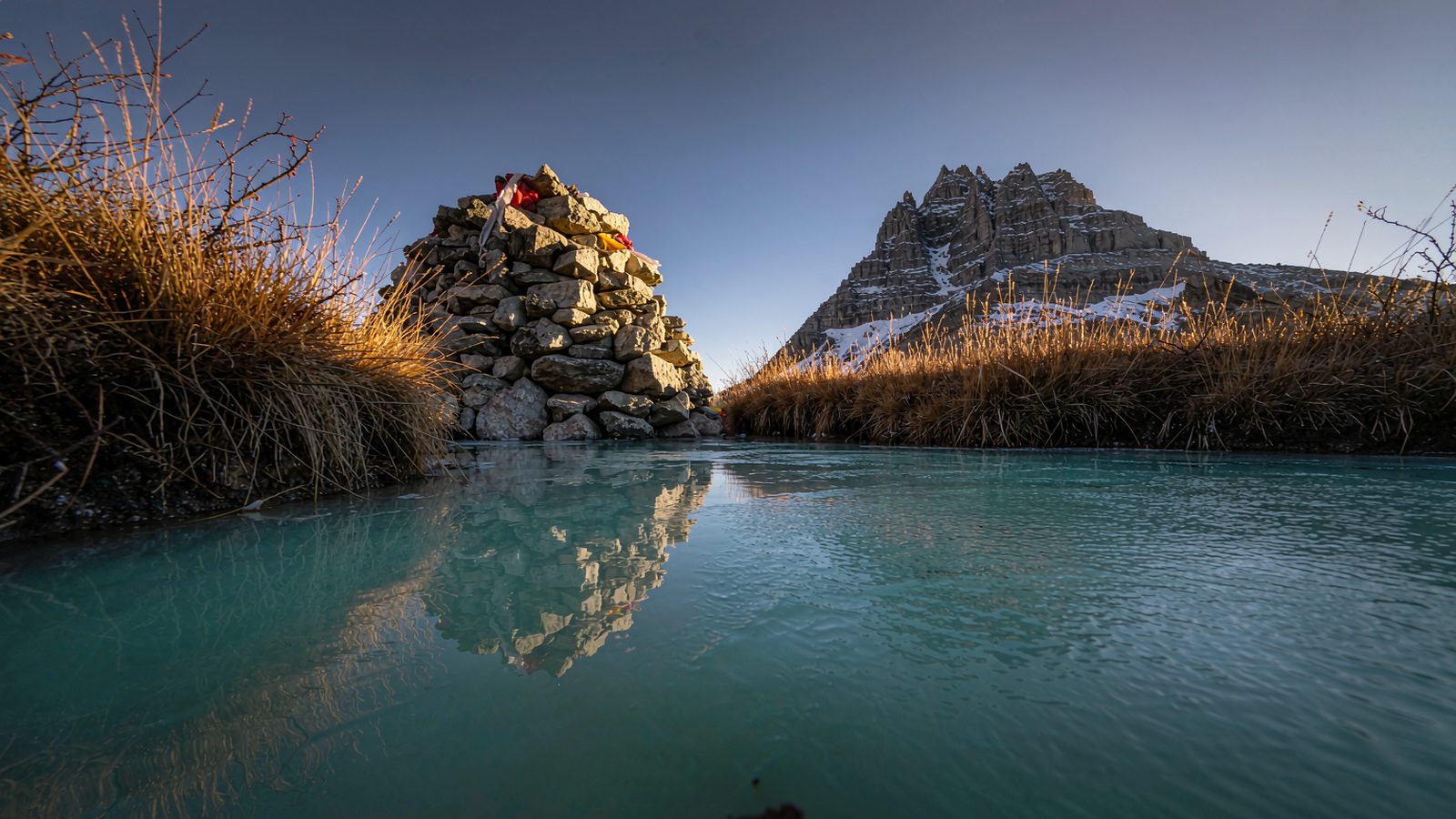
Checked November 2026: 146 CNY entry, 120 CNY shuttle, 15,000 daily cap, long route open only to 25 November. Which trail, and how to shape three or four days.
The thing that defeats most visitors to Yading is not the scenery. It is the altitude and the distance, in that order.
The short trail takes two hours and you are still chatty on the bus back. The long trail takes eight, and you will not want to take your boots off at the hotel. The two trails start only six kilometres apart, but they are separated by 500 metres of elevation gain, a boulder-strewn slope above 4,180 metres, an afternoon that can turn from sun to snow in twenty minutes, and a ten-kilometre round trip that no vehicle can shorten.
So this is not a "must-see, once-in-a-lifetime" piece. It is an attempt to answer three practical questions: which trail your body can actually handle, how to sequence three or four days, and what the ticket and access situation looks like in early November 2026. Ticket prices, shuttle times and opening windows were checked in the first week of November 2026 against the scenic area's official site and the management company's notices. Mountain policy changes with the weather, so check the official WeChat account again before you travel.
Three trails, not one attraction
Yading is a single valley. From the visitor centre at the mouth of the valley, shuttle buses and electric carts move people to different trailheads, and from there the routes split three ways. Most visitors who say they "did Yading" have only completed the first one.
| Route | Actual walking | Distance / time | Max altitude | Suited to |
|---|---|---|---|---|
| Short route | Zhaguanbeng to Chonggu Monastery to Pearl Lake (Zhuomala Lake) | About 3 km / 2–3 hours | 4,100 m | Everyone, especially day one, elderly and children |
| Middle route | Chonggu Monastery to Luorong Pasture to Gongga Lake | About 8 km / 4–5 hours | 4,180 m | Moderate fitness, wants a close view of Jambeyang |
| Long route | Luorong Pasture to Sheshen Cliff to Milk Lake to Five-Colour Lake | About 10–12 km / 6–9 hours | 4,700 m | Regular exercisers with no altitude symptoms |
The short route is badly undersold. It is boardwalk and gentle slope the whole way, and the finish at Pearl Lake is the most reliable place to photograph Chenresig reflected in still water. On a clear morning the lake is essentially a mirror. If you are travelling with parents, with children, or you have just landed and have not acclimatised, this is a far better use of day one than forcing the long route.
The long route does not need hype either. Milk Lake and Five-Colour Lake stay with people precisely because they have to be earned. There is no cable car and no road. The final two kilometres are a continuous boulder climb, and walking three steps then resting one is normal. If you want that image, this is the price.
The middle route has become the compromise of choice in the past two years: electric cart to Luorong Pasture, then a walk across the pasture to Gongga Lake and back. You face Jambeyang the whole way, you get roughly seventy percent of the scenery, and you spend a third of the energy. On our own trips this is the route we recommend most often.
What tickets actually cost in November 2026
First, the point most people get wrong: the nationwide free-admission window that ran from 1 August to 31 October 2026 has ended. From 1 November the normal charge applies again. You are paying to enter this month.
| Item | November 2026 | Notes |
|---|---|---|
| Entrance ticket | 146 CNY per person through 19 November; 120 CNY from 20 November (low season) | Valid two days, re-entry allowed |
| Shuttle bus | Visitor centre to Zhaguanbeng, 120 CNY return | Compulsory; about one hour of switchbacks. Free under 1.1 m, half price (60 CNY) for 1.1–1.3 m |
| Electric cart | Chonggu Monastery to Luorong Pasture, 80 CNY return | Strongly advised if you are walking the long route |
| Horse convoy | Luorong Pasture to Gongga Lake, 200–300 CNY one way | Operates 08:00–14:00, limited places, bought on site |
| Reservation | Real-name booking, daily cap of 15,000 | Official WeChat account or mini-program, or a reputable OTA. No ticket window on site |
One 2026-specific complication is worth flagging. After the scenic area was ordered to rectify its transport pricing on 29 May 2026, the shuttle bus and electric cart fees were suspended, and the official line is that this runs to 31 December. In practice that means you may not pay the extra 200 CNY for transport in November. But it is a temporary measure that can change at short notice. Budget as if you will pay; if it is waived, treat it as a bonus rather than planning around it.
Another detail many people miss: the entrance ticket is valid for two days. Doing the short route on day one and the long route on day two is the most sensible way to split the physical load in this park. You show your original ticket and the photo taken of you at the gate the next day, pay 60 CNY for another shuttle bus ticket, and you are back in. If you are staying in Shangri-La Town, one ticket effectively buys you two days.
On concessions: free entrance for visitors aged 70 and over, serving military, and disabled visitors with ID; free for children under six or under 1.2 m; half price for ages 60–64 outside public holidays. From 10 June to 31 August each year, students sitting the senior high and university entrance exams get free entrance with their exam pass and ID. All of these still require a reservation in advance; turning up with a document at the gate is not enough.
The real barrier is altitude, not distance
The altitude ladder at Yading runs like this: Shangri-La Town (formerly Riwa) at 2,900 m, Yading Village at 3,900–4,000 m, Zhaguanbeng just over 4,000 m, Chonggu Monastery at 3,880 m, Pearl Lake at 4,100 m, Luorong Pasture at 4,180 m, Milk Lake at 4,600 m, Five-Colour Lake at 4,700 m. The three sacred peaks are Chenresig at 6,032 m and Jambeyang and Chanadorje at 5,958 m each, and they are above you the entire time.
The numbers look gentle. The problem is gaining 1,800 metres in a single day. Flying in is the fastest option, but Daocheng Yading Airport sits at 4,411 m, the highest civil airport in the world. You take off from Chengdu at around 500 m and one hour later you are standing at 4,411 m. That is the most abrupt altitude jump available anywhere in China. Headache, insomnia and a racing pulse on arrival day are the normal response, not an unlucky one.
That is why our itinerary always looks the same: no park on arrival day, one night in Shangri-La Town at 2,900 m, enter the valley the next morning. That night is not wasted time; it is what you buy the next three days with. Conversely, if you have two days, plan to fly, and intend to force the long route, you are not making an itinerary decision, you are making a probability bet.
Practical details: no alcohol the night before, no long hot baths, no late nights; slow your movements and your speech on the way up; buy oxygen canisters in town where they are cheaper than inside the park, one per person is enough; rhodiola needs a week of lead time to mean anything, taking it after landing is mostly reassurance. If someone starts vomiting repeatedly, cannot walk a straight line, or becomes confused, do not push on. Get them down to Zhaguanbeng and onto a bus. That is not weakness, it is the only correct response.
Three days: fly in, do the long route
Three days is the practical minimum for a fly-in trip. It suits travellers with limited time, reasonable fitness and a clear goal. The rule is one objective per day.
| Day | Plan | Key point |
|---|---|---|
| 1 | Fly Chengdu or Chongqing to Daocheng, drive to Shangri-La Town, rest in the afternoon | No sightseeing. Sleep early. Buy snacks and supplies |
| 2 | Enter at 07:00, shuttle to Zhaguanbeng, cart to Luorong Pasture, long route to Milk Lake and Five-Colour Lake, return the same way | Take the first bus. Turn around at 14:00 wherever you are |
| 3 | Short route to Pearl Lake in the morning, leave the valley at midday, fly out in the afternoon | Two-day ticket; pay 60 CNY for the second day's shuttle |
Day two needs to be planned to the hour. Ticket sales start at 07:00, the first shuttle leaves at 07:10, the ride to Zhaguanbeng takes about an hour, the cart to Luorong Pasture takes twenty minutes, so you are walking at roughly 08:40. The long route is 10–12 km round trip, which at moderate pace is six to nine hours, putting you back at Luorong Pasture between 15:00 and 17:30. The last cart back from Luorong Pasture to Chonggu Monastery leaves at 18:00, and the last shuttle from Zhaguanbeng to the visitor centre leaves at 19:00. Those two times are hard boundaries. Miss one and the rest of your evening unravels.
So the useful advice is not what time to start, but what time to give up. Set 14:00 as your turnaround. If you have not reached Milk Lake by then, skip Five-Colour Lake and head back. Five-Colour Lake is another 100 metres of elevation and about forty minutes beyond Milk Lake, and it is where a great many people burn their margin and end up descending in the dark.
Four days: two different shapes
Four days is the comfortable length, and there are two quite different ways to use it.
Option A: fly in, split the trails across two days. Day one arrival and rest, day two long route, day three short route plus Chonggu Monastery, day four depart. This splits the physical load and works well for families travelling with someone over 60: the older members take the day-three short route while the younger ones do the long route on day two, and nobody holds anybody back. The downsides are airfare and the fact that you are still landing at 4,411 m.
Option B: drive in and climb slowly. From Chengdu on G318 via Ya'an, Kangding, Xinduqiao and Litang to Daocheng, roughly 780 km, spread over two driving days with an overnight at Xinduqiao (3,300 m) or Yajiang (2,600 m). Enter the valley on day three for the short route, day four for the long route or the return. Altitude problems are markedly less likely, and Xinduqiao, Haizi Mountain and the red marsh grass at Sangdui are attractions in their own right. The cost is two extra days in a vehicle, and G318 has a lot of bends; in rain or snow the driving risk is real, so self-driving is not advisable without mountain experience.
If you have four days and want both trails, choose B. Gradual acclimatisation means your condition on day three will be noticeably better than a fly-in traveller's on day two, and no amount of money buys that.
Getting there: three options, three price tags
Daocheng Yading Airport, at 4,411 m, is the highest civil airport in the world. The normal November 2026 schedule looks roughly like this:
| Route | Flight | Times | Frequency |
|---|---|---|---|
| Chengdu Tianfu to Daocheng Yading | CA2561 | 07:25–08:40 | Daily |
| Chengdu Tianfu to Daocheng Yading | 3U6693 | 09:00–10:00 | Daily |
| Chengdu Shuangliu to Daocheng Yading | 3U8641 | 13:15–14:10 | Daily |
| Chongqing Jiangbei to Daocheng Yading | 3U8031 | 07:40–09:00 | Mon, Wed, Fri, Sun |
| Chongqing Jiangbei to Daocheng Yading | 3U8031 | 13:55–15:15 | Tue, Thu, Sat |
Confirm times with the airline; winter schedules shift. Morning flights are not only about saving time. High-altitude afternoons are windy, and morning departures are markedly more punctual, especially in November. The airport is about 1.5 hours by road from Shangri-La Town, and about 50 km or one hour from Daocheng county town. Airport buses are timed to flights and may become shared vans when passenger numbers are low, so arrange a pickup through your hotel or operator in advance.
Overland, there are long-distance buses from Chengdu's Xinnanmen station direct to Daocheng, 18–20 hours with an overnight stop. Cheap, but punishing; not a first choice. Driving G318 takes two days, overnighting at Xinduqiao or Yajiang, and suits people with high-altitude mountain driving experience. A private car with driver is the middle path: for four people the per-head cost approaches a plane ticket, but the altitude gain is gradual and you can stop whenever you like.
Daocheng county town is still 80 km and about 1.5 hours from the park gate. Staying there means three hours of driving every day, and you will not make the first shuttle. Unless you are simply passing through, it does not add up.
Where to sleep: town, village or county seat
| Base | Altitude | To visitor centre | Pros | Cons |
|---|---|---|---|---|
| Shangri-La Town (Riwa) | 2,900 m | About 10 minutes | Low enough to sleep, restaurants and shops, plenty of choice | No mountain view; early start needed |
| Yading Village | 3,900–4,000 m | Inside the park, shuttle stops here | Sacred peaks from the window, saves the morning drive, good for night skies | High enough that the first night is often poor; simple rooms; peak-season prices |
| Daocheng county town | 3,700 m | About 1.5 hours / 80 km | Slightly lower, cheaper, more food options | Three hours of daily transfer; first bus effectively impossible |
The conclusion is straightforward. First visit, travelling with elders or children, or arriving by air: stay in Shangri-La Town. Second visit, well acclimatised, aiming for alpenglow and stars: stay in Yading Village. The county town makes sense in exactly one case, which is arriving late by road and needing a night before entering the valley.
In peak season, from late September to late October, good rooms in Shangri-La Town sell out a month ahead, and Yading Village earlier still. November is comparatively quiet and prices drop, though weekends still spike.
Is November worth it?
November is the dividing line at Yading. In the first half you can still catch the tail of autumn: the larches have not fully dropped, the meadows are gold, the peaks are visible most days, and midday temperatures can climb above 10°C. From mid-month the snow season arrives, meadows whiten, lakes begin to freeze, temperatures fall to between -7 and 6°C, gusts of five to six on the Beaufort scale are common, and there is black ice on the road.
The harder constraint is this: the Jinguang Challenge Route, the section from Gongga Lake up to Milk Lake and Five-Colour Lake, is open in 2026 from 15 April to 25 November. From 26 November the park moves to low-season operation: the horse convoy stops, ticket sales shorten to 08:20–15:50, shuttle buses run 08:30–16:00 and carts 10:00–16:00, and the long route is effectively closed. In other words, if you want the long route this year, you have until 25 November, and even then it depends on the day's weather and trail conditions; heavy snow can close it at short notice.
So early November is the last stretch where the autumn-colour window and the long-route window overlap, and the value is genuinely good: the ticket is still 146 CNY but accommodation is cheaper, crowds are thinner, and the light is low and warm. Come in the second half of the month and you should switch your objective to the short route and snow scenery. That is still excellent, but do not arrive expecting to stand at Five-Colour Lake.
The true best season remains late September to late October, when autumn forest, golden meadows and snow peaks appear in the same frame and the weather is relatively stable. The price is crowds, room rates and reservation difficulty. July and August bring green pastures and wildflowers, but also the rainy season, when cloud hides the peaks more often than not.
What to pack
- Three layers. Quick-drying base (never cotton, which chills you once wet), fleece or light down mid-layer, windproof and waterproof shell. In November the wind chill at altitude makes it feel 5–8°C colder than the thermometer says.
- Boots. Stiff-soled hiking boots. The long route is loose rock, and trainers roll ankles on the descent. Do not bring new boots; wear them for a week first.
- Sun protection. UV at this altitude is several times the lowland norm. Hat, sunglasses, SPF50+ sunscreen and lip balm, all four. You can burn on an overcast day.
- Fuel. At least 1.5 litres of water, chocolate or energy gels, some salty snacks. There is no resupply on the long route; Luorong Pasture has hot water and simple meals at a premium.
- Also. Trekking poles (knees on the descent; strongly advised for the long route), a power bank (cold drains batteries), 200–300 CNY in cash (mobile payment stalls where signal is weak), and your usual medication.
Leave behind: large suitcases (you carry everything inside the park), drones (restricted, permits required), and a crate of oxygen (buy as needed in town).
Four photo positions that work
Pearl Lake. The standard reflection shot of Chenresig. Between 09:00 and 11:00 the light is angled and the water is calmest. Any wind breaks the reflection, so wait for the lull.
Luorong Pasture. Facing Jambeyang, with meadow, stream and yaks. In the afternoon the backlight makes the grass glow, and this is the least effortful "golden mountain" shot in the park because you do not have to climb for it.
Milk Lake. You have to reach the shore to see the milky turquoise. From the slope above it looks like an ordinary alpine lake. It is windy at the water's edge, so keep layers on and do not jump between wet rocks.
Five-Colour Lake. You need to climb the small rise above the lake to see the colour banding. Overhead noon light flattens it; before 10:00 and after 15:00 are best.
Six mistakes people keep making
First, assuming the free-ticket policy is still running. The 1 August to 31 October waiver ended. From November it is 146 CNY. And the waiver only ever covered the entrance ticket; shuttle, cart and horses were never free.
Second, expecting to buy on site. The park has closed its ticket windows and moved to real-name reservations with a 15,000 daily cap. Without a booking you will be turned away. In peak season and around public holidays book three to seven days ahead; for National Day, two weeks is not excessive.
Third, planning both trails in one day. It is not physically possible. The result is half of each, plus a dose of altitude sickness.
Fourth, ignoring the last vehicles. The cart stops running out of the valley at 18:00 and the shuttle at 19:00, and neither waits for anyone.
Fifth, being unprepared for the afternoon change. Morning and afternoon at altitude are two different parks. After 14:00, wind, fog and snow are all normal. A rain shell beats an umbrella.
Sixth, using Daocheng county town as a base. Eighty kilometres, ninety minutes each way, three hours a day, no chance of the first bus and no chance of the best light.
A blunt word about altitude sickness
Every year people are carried off the trail at Yading, and in most cases it is not bad luck but bad judgement. Three non-negotiables: do not enter the valley on arrival day; do not chase progress on the long route, and turn around at 14:00; and if someone becomes confused, vomits repeatedly, or has a resting heart rate above 120, descend immediately rather than waiting to see how the next ten minutes go.
One more honest statement: Yading is not for everyone. People with serious cardiac or pulmonary conditions, recent surgery, pregnancy, or children under six face risks that clearly outweigh the rewards. Choosing a lower-altitude destination instead is not a compromise. A travel agency cannot make that judgement for you, but it should say it plainly.
How we can help
Jadetour handles inbound travel in Chongqing and Sichuan, and Yading is one of the western Sichuan segments we run regularly. What we do is straightforward: airport transfers timed to your flight, trail allocation matched to fitness, rooms in Shangri-La Town or Yading Village, licensed guides and private vehicles, and an acclimatisation night built into the schedule rather than squeezed out of it.
What we do not do: we do not promise visa outcomes, we do not sell "guaranteed alpenglow" departures, and we do not market the long route as suitable for everyone. Nobody can guarantee mountain weather or how a body will respond. What can be managed is pace and contingency.
If you are planning western Sichuan for this November or next spring, send us four things: dates, number of travellers, age range, and whether anyone has high-altitude experience. We will come back with a schedule that has a timeline, which is a good deal less work than assembling one from scattered blog posts.
Need help planning this trip?
Tell us your travel dates and group size — we reply within 24 hours.
WhatsApp +86 183 1705 8017 · WeChat 18317058017
Destinations in this guide
Related Tours
Sichuan & Chongqing 9 Days 8 Nights · Jiuzhaigou Grand Tour
5-10 Days
Mountains of Ba, Waters of Shu · Chengdu, Jiuzhaigou & Wulong 9 Days (Jiuzhaigou + Huanglong + Wulong Karst + Furong Cave + Wujiang Gallery + Mountain City Nights)
5-10 Days
Chengdu & Chongqing 8 Days · A Journey of Ethnicity and Culture
5-10 Days
More Guides
Shunan Bamboo Sea: How to Plan 7,000 Hectares of Bamboo, Cable Car and 2026 Tickets
CNY 100 in peak season, 60 in winter, a 55 yuan shuttle valid three days and a 50 yuan cable car. Which route to take and why drivers must book ahead.
11/09/2026
Fenghuang Ancient Town: Night-View Spots, River Cruises and Where to Sleep
The old town is free; only nine sights charge. A 51-minute train from Zhangjiajie, a 20-minute blue hour and which stretch of riverbank is actually quiet.
11/08/2026
Leshan Giant Buddha: Cruise or Cliff Stairway, and How to Beat the Three-Hour Queue
Mountain ticket 80 yuan, cruise 70 — two routes that barely overlap. Tickets, time slots, the 8,000-a-day stairway quota and how to avoid the queue.
11/08/2026