
Heishangu Black Valley: The 13 km Gorge, Cable Car and 2026 Tickets Explained
Since April 2026 the valley is half-open: south gate only, 30 yuan entry. How the 13 km splits into three walks, what t…
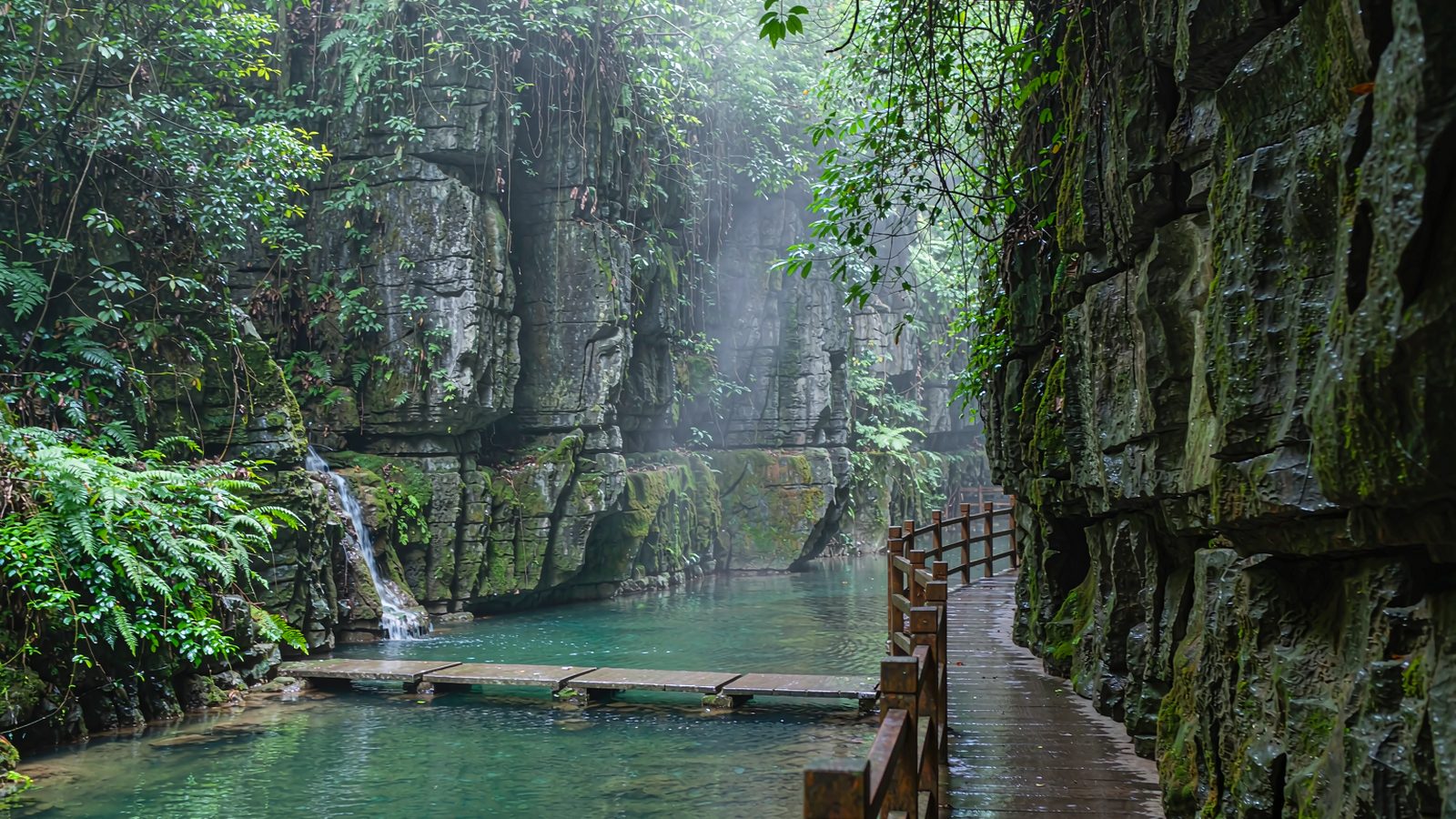
Since April 2026 the valley is half-open: south gate only, 30 yuan entry. How the 13 km splits into three walks, what the cable car and shuttle cost, and what you cannot reach yet.
About 110 kilometres south of downtown Chongqing, the mountains split open. The crack runs for 13 kilometres, narrows to less than two metres at its tightest point, and at the bottom you can touch Chongqing rock with one hand and Guizhou rock with the other. This is Heishangu, the Black Valley, in Wansheng. Forest cover is 97 percent, negative oxygen ions peak at 110,000 per cubic centimetre, and summer temperatures inside the gorge run five to eight degrees cooler than the city, averaging 23 degrees in July. It is ninety minutes from downtown, which is exactly why it fills up every summer.
But in 2026 the valley does not work the way most online guides describe. On 30 April 2026 the north gate area closed for a major upgrade, and the park moved to a half-open arrangement: entry and exit only at the south gate, access limited to the section between the south gate and Lingbo Terrace, and the ticket dropped to 30 yuan. Guests who arrive with a three-year-old itinerary for the full 13-kilometre traverse discover at the gate that it cannot be done. So let us start with the operating status, then cover routing, costs and which stops are worth your time.
First, which section is actually open
As of 10 November 2026 the park is still operating under the half-open notice issued on 28 April, and no announcement has been made about a full reopening. The comparison looks like this:
| Item | Half-open period (from 30 April 2026) | Full park (normal operation) |
|---|---|---|
| Entry and exit | South gate in, south gate out | South in and north out, or the reverse |
| Accessible route | South gate to Lingbo Terrace, roughly one kilometre of descent plus a stretch of valley floor | The full 13 kilometres |
| Admission | 30 yuan per person, flat | 85 yuan peak season, 60 yuan low season |
| Cable car | 30 yuan, same price one way or return | 30 yuan one way |
| Shuttle | Suspended, the six-kilometre road section is closed | 30 yuan one way |
| Time needed | 1.5 to 3 hours | 4 to 7 hours |
In plain terms: what you get right now is a taste of the valley floor, not a traverse. The upside is that it is cheap and easy, good with children and older parents, and the summer canyoning route, 1.5 kilometres with a 100-metre drop and two to three hours of scrambling, sits inside this same open section. The trade-off is that the signature sights, Feiyu Falls, the Chongqing-Guizhou boundary bridge, the floating walkways and the Liyu Gorge slot, only come back when the north gate works are finished.
The park enquiry line is 023-48279999 and the official account is Wansheng Lvtou. One phone call the day before you go is worth more than any guidebook, because construction schedules move and notices do not propagate to every booking platform.
Thirteen kilometres is really three different walks
Most visitors assume the valley is one flat path, then misjudge their own stamina. It is three segments, and each one behaves differently.
- Segment one, south gate to Lingbo Terrace, about one kilometre, all downhill. Take the cable car, roughly five minutes, or walk it in thirty to forty minutes. This is a vertical descent with tight, permanently damp steps. Bad knees should take the cable car.
- Segment two, Lingbo Terrace to the shuttle terminus, about six kilometres, walking only. This is the heart of the valley: boardwalks pinned to the stream, one suspension bridge after another, and the Dragon Pool, Feiyu Falls, the boundary bridge and Liyu Gorge all along it. No vehicles, no shortcuts. If you run out of legs, you turn around.
- Segment three, shuttle terminus to the north gate, about six kilometres of service road. The scenery is ordinary. Take the shuttle for 30 yuan, about thirty minutes, or walk it and add ninety minutes to two hours.
The greatest height difference between floor and ridge is 1,200 metres. The average summer temperature of 23 degrees explains both the cool and the damp: the boardwalks never dry out, a thin film of moss coats stone and timber, and ordinary flat-soled trainers will slide. This is not a suggestion.
Tickets and who pays less in 2026
| Item | Price | Notes |
|---|---|---|
| Admission, peak season 1 March to 31 October | 85 yuan | Flat 30 yuan during the half-open period |
| Admission, low season 1 November to end February | 60 yuan | Flat 30 yuan during the half-open period |
| Concession ticket | 42 yuan peak, 30 yuan low | Age 6 to 18, full-time students up to bachelor level, age 60 to 64 |
| Cable car | 30 yuan one way | One way and return both 30 yuan while half-open |
| Valley shuttle | 30 yuan one way | About six kilometres, runs only when the full park is open |
| Visitor centre to south or north gate | 15 yuan, or 5 yuan | The south gate is far, the north gate is close, do not mix them up |
| Parking | 5 to 10 yuan per day | Available at the Bajiao visitor centre and the south gate |
Free admission: visitors aged 65 and over, children under 1.2 metres or under six, serving military personnel, disabled visitors, licensed tour guides leading a group, and accredited journalists. Half price: ages 6 to 18, full-time students up to bachelor level, and visitors aged 60 to 64. Bring the original document. Photos and photocopies are refused.
Two temporary schemes in November 2026 are worth checking against your dates. From 5 to 30 November, primary and secondary school students from Chongqing districts enter free with proof, accompanied by up to two family members, staggered by district. From 6 to 10 November, exhibitors and visitors to the ninth China Intangible Cultural Heritage Expo enter free with credentials. These programmes change every year, so do not assume last year's rules still apply.
Route one: how to do the half-open valley
Check in at the south gate, take the cable car down, walk to the Dragon Cave and Dragon Pool waterfall, follow the stream to Lingbo Terrace, then retrace your steps. Allow 1.5 to 3 hours. This is the version for families, for older travellers, and for anyone who simply wants to be cool for an afternoon.
A sensible rhythm: arrive between 09:00 and 09:30, when the crowd is thin and the mist has not lifted. Five minutes down by cable car, then the Dragon Cave, where spring water pushes out of the rock and the air three metres from the mouth is noticeably cold even in August. Continue to the Dragon Pool waterfall, roughly eighty metres high, whose spray soaks clothing ten metres away in the wet season. Finish at Lingbo Terrace, sit by the stream and put your feet in for ten minutes; this stretch is live water, clear to the bottom. Groups start arriving after eleven and the boardwalk backs up, so go early.
With children, watch for the Francois langur. It is a national first-class protected species and the valley is one of its few remaining habitats, most often seen at dawn and dusk. Do not feed them, do not approach, do not use flash. Feeding destroys their foraging behaviour and reliably starts bag-snatching incidents.
Route two: south in, north out, once the park fully reopens
This is the correct way to walk Heishangu and the route locals recommend: enter at the south gate, exit at the north gate, downhill the whole way.
- Check in at the south gate and take the cable car to Lingbo Terrace, 30 yuan, five minutes. Walk down instead if you want to save it, thirty to forty minutes.
- From Lingbo Terrace, six kilometres of boardwalk and floating bridges, taken slowly over three to four hours. Dragon Pool, Feiyu Falls, the boundary bridge, the Deng'erhuang floating bridge, Chanming Gorge and Yutiao Gorge come one after another.
- At the shuttle terminus, ride to the north gate, 30 yuan, about thirty minutes, or keep walking the remaining six kilometres.
- Exit at the north gate and take the connection bus back to the Bajiao visitor centre, 5 yuan.
Total four to five hours, of which about seven kilometres is on foot. The whole logic sits in the word downhill. Reversed, it becomes six kilometres of climbing steps, roughly double the effort, and plenty of people give up halfway.
Route three: north in, south out, for hikers only
Only for fit walkers who can be inside the gate by 08:30. Enter at the north gate, cover six kilometres of service road, ride if you like, then six kilometres of boardwalk, then the final climb of about one kilometre to the south gate, cable car optional. Six to seven hours in total, and you must reach the south gate before three in the afternoon or the shuttle and cable car may already have stopped.
Honestly, unless hiking is the point of your day, skip it. The scenery is identical to route two; you have simply swapped descent for ascent.
Which stops deserve your time
- Feiyu Falls. The most impressive waterfall in the valley, over one hundred metres of drop and up to five tonnes of water per second in the wet season. On clear days between ten and eleven in the morning, rainbows form in the spray below. This is the one stop worth waiting for light.
- The Chongqing-Guizhou boundary bridge. The narrowest point of the gorge, under two metres wide, with a line down the middle dividing the two provinces. There is usually a queue for photographs, so shoot as you arrive rather than waiting for an empty frame.
- The floating bridges. Deng'erhuang is the famous one, swaying over live water. Children love it, and it is also where phones go into the river. A wrist strap beats a waterproof pouch.
- Liyu Gorge, the slot. Look up and there is only a strip of sky, with ferns coating both walls. In summer it runs two or three degrees cooler than the valley mouth, a natural place to rest.
- Dragon Pool. About six metres deep and close to a thousand square metres of green water. Good photographs, no swimming.
Getting there, four options
| Method | Route | Time and cost |
|---|---|---|
| Self-drive, easiest | Downtown via G75 Lanzhou-Haikou expressway, then Qijiang-Wansheng expressway, exit at Wansheng onto the Black Valley loop road, navigate to Bajiao visitor centre | 95 to 110 kilometres, 1.5 hours, parking 5 to 10 yuan per day |
| Coach plus bus | Sikilong or Chenjiaping coach station to Wansheng bus station, then bus 106 or 409 to Bajiao, then the park shuttle | Coach 25 to 38 yuan, 1.5 hours; city bus 4.5 yuan; park shuttle 5 to 15 yuan |
| High-speed rail plus taxi | Chongqing West to Qijiang East, 25 minutes, second class 22 to 24 yuan, then taxi about 40 to 50 minutes | Best if you have no car but dislike long coach rides |
| Tourist express coach | Sikilong direct to the south gate | About 45 yuan one way, few departures, book ahead on the platform |
Three mistakes to avoid. First, the south and north gates are eight kilometres apart, and going to the wrong one costs you forty minutes. Second, the last coach from Wansheng back to the city leaves around 17:30 and the last bus from the north gate around 18:30, which sets a hard limit on any day trip. Third, last entry is 15:00, or 15:30 in peak season, so an afternoon arrival gets you no further than the car park.
What to bring, what not to do
Bring grippy shoes, trail runners or canyon sandals, not flat white sneakers; a light jacket, since the valley runs five to eight degrees cooler and you chill quickly once you stop moving; and insect repellent, because the valley floor breeds mosquitoes in summer, especially towards evening. Optional: a rain shell, a waterproof phone pouch, and a spare pair of socks. Umbrellas are awkward on the boardwalks; a shell is better.
Do not enter the stream after heavy rain. Flash floods arrive faster than most people expect and the park closes the water sections without much notice. Do not walk onto undeveloped gravel flats; every year there are rescues of visitors who climbed a railing looking for a secret spot. Mobile signal is weak on the valley floor, so save offline maps and screenshots of your return departures before you go in.
Eating, sleeping and what else is nearby
Food: black mountain bamboo shoot stewed with free-range chicken is the local signature, sweet shoots and a clear broth. Cured mountain pork with garlic sprouts, spring-water tofu pudding, pickled chilli loach and bamboo-tube rice are all worth ordering. The Yuzigang eel, a district-level intangible cultural heritage dish, is killed and cooked to order, numbing and fragrant, and worth a detour on its own. Food inside the park is expensive and mediocre, so eat in Bajiao town or Heishan town after you come out.
Sleeping: Bajiao town has the densest cluster of guesthouses and farm stays, generally 150 to 400 yuan a room on weekdays. The Black Valley Resort Hotel is a step up and better for older travellers. In summer, book weekend and holiday rooms two weeks ahead.
Nearby: Wansheng Stone Forest, 50 yuan or 25 concession, about thirty minutes away, the oldest stone forest in China with scale-like rock textures. Aotaoji, 168 yuan, is built around high-altitude rides and not for anyone afraid of heights. Banliao Golden Beach suits families who want water, and Mushroom Town is a children's park. The standard two-day pairing is the valley on day one with a night in Bajiao, then the stone forest on the morning of day two before heading back.
How we put this route together
Jadetour has run this corner of Chongqing for years, and we rarely sell Heishangu on its own. It usually sits inside a four to six day itinerary with Wulong, Dazu and downtown Chongqing, because its real value is what it does after several days of cities and heritage sites: one full day of gorge, water and forest. For overseas guests we provide an English-speaking driver and guide, buy admission, cable car and shuttle tickets a day ahead, and time the entry to miss the 09:30 group wave.
One caveat worth stating plainly: while the park is half-open we do not sell Heishangu as a full-day outing. It takes one to three hours, and stretching it to a day leaves a hole. The sensible pairing is the valley in the morning and the stone forest in the afternoon, or the reverse. Once the north gate works finish and the 13-kilometre traverse returns, we will schedule it as a full day again.
If you are planning this part of Chongqing, send us your dates, party size, age mix and whether you will have a car. We will build the day to the hour around the current opening status and the actual bus times, and mark which viewpoints are unreachable while the park is half-open. That is considerably cheaper than finding out at the gate. Plan a Chongqing itinerary.
Need help planning this trip?
Tell us your travel dates and group size — we reply within 24 hours.
WhatsApp +86 183 1705 8017 · WeChat 18317058017
Destinations in this guide

Related Tours

More Guides
Yading, Sichuan: Milk Lake, Five-Colour Lake and How Many Days You Really Need
Checked November 2026: 146 CNY entry, 120 CNY shuttle, 15,000 daily cap, long route open only to 25 November. Which trail, and how to shape three or four days.
11/09/2026
Shunan Bamboo Sea: How to Plan 7,000 Hectares of Bamboo, Cable Car and 2026 Tickets
CNY 100 in peak season, 60 in winter, a 55 yuan shuttle valid three days and a 50 yuan cable car. Which route to take and why drivers must book ahead.
11/09/2026
Fenghuang Ancient Town: Night-View Spots, River Cruises and Where to Sleep
The old town is free; only nine sights charge. A 51-minute train from Zhangjiajie, a 20-minute blue hour and which stretch of riverbank is actually quiet.
11/08/2026