
Chongqing's 8D Terrain: Upper and Lower Towns, Escalators, and How to Beat a Broken Map App
Two-yuan escalators, a 1986 heritage lift and a 30-yuan cableway: how the three vertical levels work, why your map app…
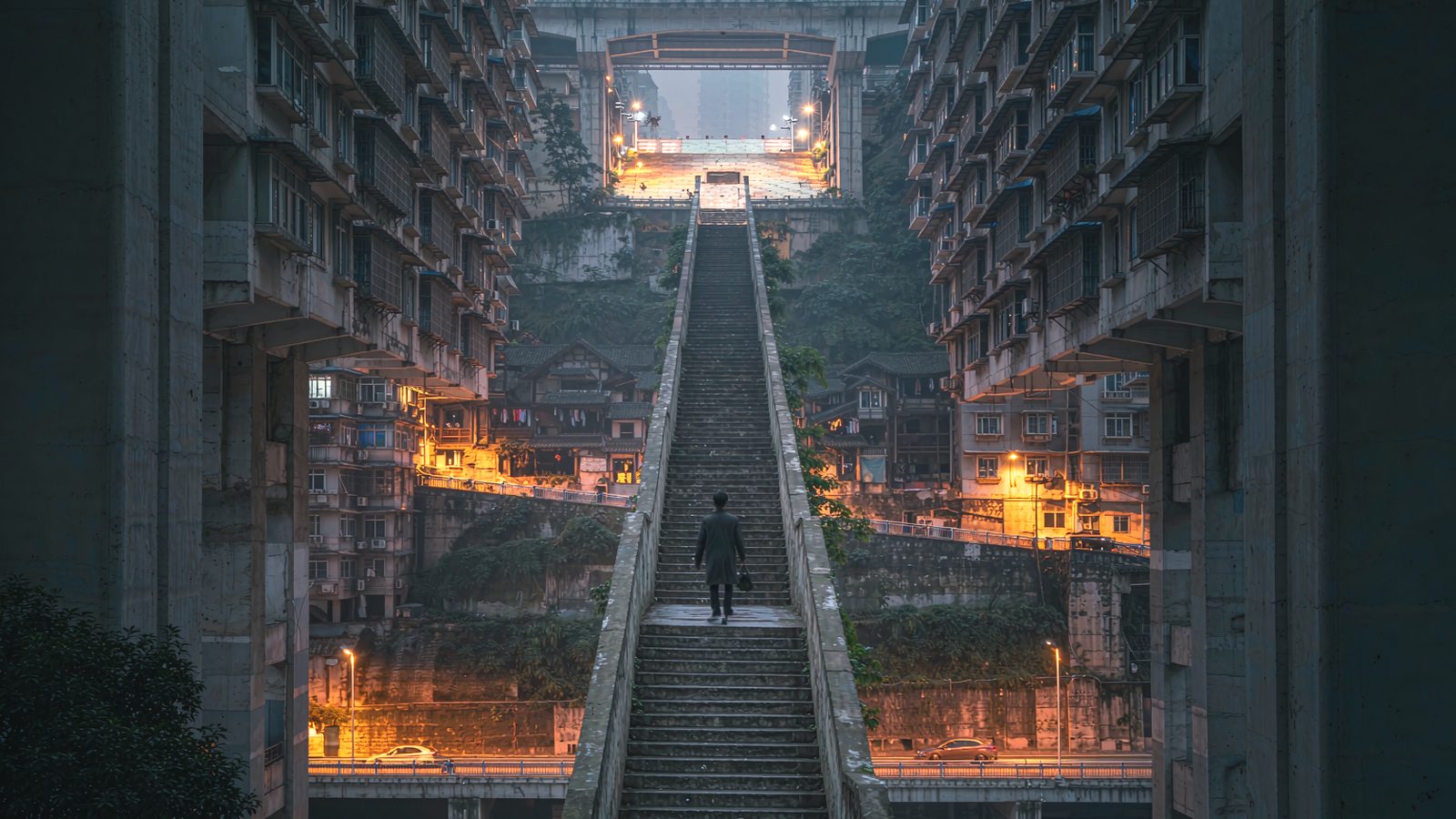
Two-yuan escalators, a 1986 heritage lift and a 30-yuan cableway: how the three vertical levels work, why your map app fails, and three ready routes.
In Chongqing, your map app says "walk 200 metres". What it means is: climb eight floors, cross two pedestrian bridges, walk through the 15th-floor lobby of an apartment block, and arrive at a spot that is 40 metres directly below where you started.
This is not a joke. From the river surface to the ridge of the Yuzhong peninsula, the height difference is close to 100 metres — roughly thirty storeys. The city is not spread across a flat plane; it is stacked on three levels. So the real question for a first-time visitor is never "where do I go", it is "which level am I on".
This guide skips the bucket list. It is about one thing only: how to see what you came to see with the least climbing. Prices and opening hours were checked in November 2026; still worth a glance at official channels before you set out.
1. Replace the map in your head: Chongqing has levels, not a grid
In a flat city, two streets crossing means an intersection. Here, two streets can sit directly on top of each other, thirty metres apart vertically, and never meet.
The Yuzhong peninsula has three rough bands:
- River level: Jiabin Road, Changbin Road, Nanbin Road. Cars run here, the wind is strong, and every upward-looking photograph of the skyline is taken from this band.
- Middle band: old lanes, stilt houses, air-raid shelters and stairways on the slope. Floors 2 to 10 of Hongyadong, the middle of Shibati, the open corridors of Baixiangju.
- Ridge level: Cangbai Road, Minzu Road, Zhongshan Yi Road, Zhongxing Road, Pipa Shan Main Street. This is street level as locals live it — where the malls and most metro stations are.
Once those three bands click, the "8D city" stops being magic:
- Hongyadong: the 11th floor opens onto Cangbai Road, full of traffic. The 1st floor opens onto Jiabin Road, also full of traffic. Nine floors in between are joined by lifts and stairs. There is no gate; entering on any level counts as entering.
- Shibati: the upper entrance is on the Jiaochangkou side at ridge level, the lower exit is on Xiangshuiqiao Street near the river. One neighbourhood, with the Jiefangbei skyline at one end and the Yangtze at the other.
- Baixiangju: a 24-storey residential block with no lifts and three entrances on three streets at three different heights. Walk out on the 15th floor and you are on street level for a different road.
- Kuixinglou: you think you are standing on a ground-floor plaza. Look over the edge: you are 22 floors up.
So when asking for directions here, "which entrance, which level" beats "which street". Locals say "go down through the upper entrance", not "follow such-and-such road for 500 metres".
2. Three vertical transport options that turn 100 metres into two yuan
Chongqing worked out long ago that if you cannot climb it, you buy the vertical distance. These three are the ones visitors should actually use:
| Facility | Connects | Fare | Hours | Ride time |
|---|---|---|---|---|
| Huangguan Escalator | Lianglukou (ridge) to Caiyuanba (river) | CNY 2 one way | 08:00–20:00 public holidays to 21:00 | 2 min 30 s |
| Kaixuan Road Elevator | Jiaochangkou (ridge) to Kaixuan Road (lower town) | CNY 2 CNY 1 with local transit card | approx. 06:30–22:00 | about 1 min |
| Yangtze River Cableway | Xinhua Road, Yuzhong, to Shangxinjie, Nan'an | CNY 30 one way CNY 50 return | 08:00–22:00 public holidays 07:30–23:00 | about 4–5 min |
All three together cost under CNY 40 and save you half a day of stairs. With children or older travellers, these three decide whether the trip feels comfortable or punishing.
3. Huangguan Escalator: 112 metres, two and a half minutes, two yuan
Opened on 18 February 1996. Length 112 metres, vertical rise 52.7 metres, incline 30 degrees, speed 0.75 metres per second, ride time 2 minutes 30 seconds. It is the second-longest single-span outdoor escalator in Asia and locals call it China's number one mountain-climbing stairway. CNY 2 one way; transit card, QR code and cash all work.
It sits at Lianglukou, straight out of Exit 3 at Lianglukou station on metro lines 1 and 3. The up and down entrances are in different places and you have to loop over a footbridge to reach them; the underpass has no crossings, so follow the signs rather than jaywalking.
One 2026 change you must know: the bottom of the escalator connects to Chongqing Railway Station at Caiyuanba, and that station is no longer a station. Passenger services stopped in June 2022, the landmark Huatie Hotel was demolished by controlled explosion on 25 May 2025, full reconstruction began on 25 December 2025 and is scheduled for completion on 25 December 2028. In 2026, riding to the bottom lands you at hoardings, tower cranes and the river — not a ticket hall.
So use it correctly: treat it as a two-and-a-half-minute vertical viewpoint, not as a transport hub. Go down, look at the river and the Caiyuanba bridge, then pay another CNY 2 to ride back up. Do not climb the neighbouring Jianxingpo grand stairway instead — it is long, steep, over three hundred steps, and in summer your shirt will be soaked by the top.
For photographs: stand on the right going down for the best sense of depth; shoot upward from the bottom to feel the 52.7-metre drop. If you dislike heights, stand on the inside, hold the handrail, and do not turn around mid-ride.
4. Kaixuan Road Elevator: a 1986 lift that became a heritage building
Built in February 1986, it was China's first urban passenger elevator, solving the commute of tens of thousands of people between the upper and lower town. It rises about 38 metres, the equivalent of eleven floors, and the ride takes under a minute. CNY 2, or CNY 1 with the local transit card. It now appears on Chongqing's register of protected historic buildings — an old lift that still carries passengers every day and is also a listed artefact, which is rare anywhere.
It sits between Jiaochangkou and Kaixuan Road, about 300 metres on foot from Exit 5 at Jiaochangkou station on line 1. Hours are roughly 06:30–22:00, confirmed on site.
Its real value is the return trip. Shibati, Baixiang Street, Huguang Guild Hall and Houci Street all sit in the lower town. Walking back up to Jiefangbei means several hundred steps; this lift puts you in Jiaochangkou in a minute, right in the shopping district. Between 07:00 and 09:00 it is full of commuters with shopping bags and work clothes — avoid that window if you want an empty car, and do not block the doorway.
5. Yangtze River Cableway: four minutes across, but book two days ahead
Opened on 24 October 1987. Span 1166 metres, cabin capacity 65 plus one, CNY 30 one way and CNY 50 return. Summer hours, 1 March to 30 November, are 08:00–22:00; on public holidays 07:30–23:00.
The important part: it is reservation-only, bookings open at most two days ahead, and same-day tickets are neither refundable nor changeable. On holidays the morning slots often sell out. Book through the official cableway account.
- North station: 151 Xinhua Road, Yuzhong — the Jiefangbei and Xiaoshizi side.
- South station: 4 Shangxinjie, Nan'an — opposite the Longmenhao sub-district office.
Field-tested advice: the north station queue is far longer than the south. Ride it backwards — board at the south station in Shangxinjie and travel to Xinhua Road. The line is often half as long, and from the Nan'an side the Yuzhong skyline comes at you head-on. Your ticket carries a boarding number: under 300, arrive ten minutes before your slot; over 300, arrive thirty minutes before. Do not stand in the sun any earlier than you need to.
High wind and heavy fog cause temporary suspensions, especially in the fog season from November to February. Check the official account's service notices before you go; they beat any guide.
6. The metro: Chongqing's most reliable horizontal transport
Fares are distance-based, starting at CNY 2: 0–4 km costs 2, 4–8 km costs 3, then one yuan per band, capped at CNY 10 for 55–75 km. For visitors, almost every trip falls in the 2 to 4 yuan range.
Memorise five anchor stations and you will not get lost on the peninsula:
| Station | Lines | What it unlocks |
|---|---|---|
| Jiaochangkou | 1 and 2 | Upper entrance of Shibati, Kaixuan Road Elevator, south side of Jiefangbei |
| Xiaoshizi | 1 and 6 | Hongyadong 11th floor, Huguang Guild Hall, cableway north station |
| Linjiangmen | 2 | West side of Hongyadong, Kuixinglou |
| Lianglukou | 1 and 3 | Huangguan Escalator, Chongqing Station (under reconstruction) |
| Qixinggang | 1 | Shancheng Lane, entering at Lingshi Lane — all downhill |
Two more worth a deliberate ride: Liziba on line 2, where the train passes through a residential building, with a free viewing platform; and Hongtudi on line 10, about 94 metres below ground, where leaving the platform means a chain of escalators — the other face of a city that also builds downward.
Line 2 is an attraction in itself. It is a straddle-type monorail, and the stretch from Fotuguan to Daping runs on elevated track along the Jialing River. Sit in the front row of the first car; the view beats most paid observation decks. The moment at Liziba lasts about two seconds, so start recording before the train arrives.
7. Five rules for when your navigation app fails
- Use the app to set the destination, not the route. The blue walking line regularly cuts through buildings, stairways and even the river. Look at what it asks you to cross before trusting it.
- Work out your level first. River band, middle band, ridge band. Once that is settled, all that remains is up or down.
- Always start high and walk down. Shibati, Shancheng Lane and Hongyadong each have an upper entrance and a lower one. Pick the upper one and the whole route is downhill; pick the lower one and you climb stairs for an hour. This is the single most valuable rule in Chongqing.
- Give taxi drivers a level and a gate, not a name. "Hongyadong, 11th floor, Cangbai Road entrance." "Shibati, upper entrance at the city balcony." "Baixiangju, west gate." Say only "Hongyadong" and the driver stops on Jiabin Road at the bottom while you stand ten floors above him.
- 200 metres as the crow flies is not 200 metres on foot. When you see a straight-line distance, convert it in your head into vertical gain plus detours. On this peninsula, 200 metres straight often means 800 metres of walking and six flights.
8. Three ready-made routes
Route A: cutting through both towns, about 3.5 to 4 hours, 4 km on foot
Lianglukou station, ride the Huangguan Escalator down (CNY 2), walk the Caiyuanba riverbank for the bridge and the construction site, ride back up (CNY 2), taxi ten minutes to Shancheng Lane at 234 Zhongxing Road, follow the cliff walkway, Renzhitang, Houlu, exit at Zhongxing Road, walk ten minutes to the Shibati upper entrance at the city balcony, descend all the way, finish at Jiaochangkou station.
What makes this route work: first you see how the city stands on a cliff, then you walk through how people live on it. Shancheng Lane entered from the high side at Lingshi Lane or Zhongxing Road is entirely downhill and the gentlest old lane on the peninsula.
Route B: the vertical landmarks, about 4 to 5 hours, mostly by metro
Liziba train-through-building platform (free), line 2 to Linjiangmen, Kuixinglou where the 22nd floor is ground level, ten minutes on foot to Hongyadong's 11th floor, internal lift down to the 1st floor for the upward shot, Qiansimen Bridge, finish at Xiaoshizi station.
Time it so you enter Hongyadong around 18:00. Lights come on at 19:30 and stay until 23:00, a schedule adjusted on 15 April 2026. Shoot the full view from the bridge afterwards. Inside Hongyadong is a shopping street; the best pictures are always outside — down from Qiansimen Bridge, across the river from the Jiangbeizui riverbank, or straight up from Jiabin Road at the bottom.
Route C: across the river, about 2.5 to 3 hours
Xiaoshizi, walk to Baixiangju at Wanglongmen — a 24-storey walk-up where the cableway passes through the gap between buildings — walk to the cableway north station, cross, south station, Longmenhao Old Street or Xiahaoli, then return by cableway or taxi.
Baixiangju is a residential building, not a sight: come and go quietly, keep the corridors clear, do not knock on doors, and do not set up a tripod in someone's doorway.
9. Weather, stamina and shoes
- Rain: bluestone paving and stone steps become genuinely slippery. The Shancheng Lane cliff walkway, the main Shibati stairway and the Jianxingpo steps all need slow, careful footing after rain. Wear grip, flat soles.
- Fog: November to February is fog season. The cableway may suspend and viewpoints go grey. Shift the plan towards lanes and indoor sights.
- Heat: July and August hit 38 to 40 degrees in the city centre and the stairways have almost no shade. Put outdoor sections before 09:00 or after 18:00, and spend midday in museums, malls or a hotpot restaurant inside an air-raid shelter.
- Steps: Shibati and Shancheng Lane are not suitable for pushchairs or wheelchairs. With older travellers, plan one up-and-down section per day and connect the rest by metro or taxi.
10. Practical warnings
- People at Hongyadong sell a "CNY 10 fast track". It is fake. Every lift in the complex is free; the so-called fast track is the ordinary lift.
- Hongyadong caps instantaneous visitors at about 16,000 and daily arrivals at 200,000. On holidays you must register with your real name on the official Hongyadong account, up to five days ahead, choosing the 18:00–22:00 evening slot. On weekdays you can usually walk in.
- The Huangguan Escalator is over in two and a half minutes. Do not allocate an hour to it; fold it into the Lianglukou–Caiyuanba leg.
- Cableway tickets for the same day cannot be refunded, so fix your date before booking.
- Metro ticket machines take cash and QR payment. If your phone is not set up for Chinese payment apps, carrying small notes for a single ticket is the safest option.
- "Mild spicy" in Chongqing is medium for most visitors. Ordering a split pot is not a loss of face; locals do it too.
11. The one-table summary
| What you want | How to do it | Cost |
|---|---|---|
| Ride the city's steepest escalator | Line 1 or 3 to Lianglukou, Exit 3, go down | CNY 2 |
| Get from lower town to Jiefangbei without stairs | Line 1 to Jiaochangkou, Exit 5, Kaixuan Road Elevator | CNY 2 |
| Cross the Yangtze in the air | Cableway south station towards north | CNY 30 |
| Watch a train pass through a building | Line 2 to Liziba, viewing platform | Free |
| See the old upper and lower towns | Qixinggang Exit 1, Shancheng Lane, then Shibati | Free |
| See the stilt-house night view | Xiaoshizi, Hongyadong 11th floor, down to 1st, Qiansimen Bridge | Free |
12. A last word
Chongqing's strangeness is not in any single sight. It is in stepping out of a building on the 15th floor and finding a street running past the door; in riding a lift down eleven storeys and coming out into traffic. The city has turned height — something most of us never think about — into an everyday fact.
Once you understand the levels, 8D collapses back into 2D: fix your altitude, choose up or down, and only then look at street names. The rest is legs and a two-yuan lift.
Jadetour builds custom itineraries and private car trips in Chongqing and Sichuan, and can reorder a route to favour downhill over uphill, with same-day weather and cableway status checked for you. The escalator, elevator and cableway tickets mentioned here are bought on site or through official channels; we do not resell them and we add no markup.
Need help planning this trip?
Tell us your travel dates and group size — we reply within 24 hours.
WhatsApp +86 183 1705 8017 · WeChat 18317058017
Destinations in this guide

Related Tours

More Guides
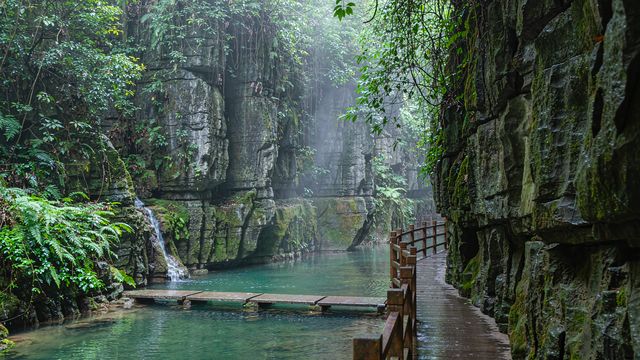
Heishangu Black Valley: The 13 km Gorge, Cable Car and 2026 Tickets Explained
Since April 2026 the valley is half-open: south gate only, 30 yuan entry. How the 13 km splits into three walks, what the cable car and shuttle cost, and what you cannot reach yet.
11/10/2026
Yading, Sichuan: Milk Lake, Five-Colour Lake and How Many Days You Really Need
Checked November 2026: 146 CNY entry, 120 CNY shuttle, 15,000 daily cap, long route open only to 25 November. Which trail, and how to shape three or four days.
11/09/2026
Shunan Bamboo Sea: How to Plan 7,000 Hectares of Bamboo, Cable Car and 2026 Tickets
CNY 100 in peak season, 60 in winter, a 55 yuan shuttle valid three days and a 50 yuan cable car. Which route to take and why drivers must book ahead.
11/09/2026