
How to Order Chongqing Jianghu Food: Laziji, Maoxuewang and Shuizhuyu for Four (2026)
Is laziji priced by weight or by plate, how many people share one basin of maoxuewang, and why fish is weighed alive: a…
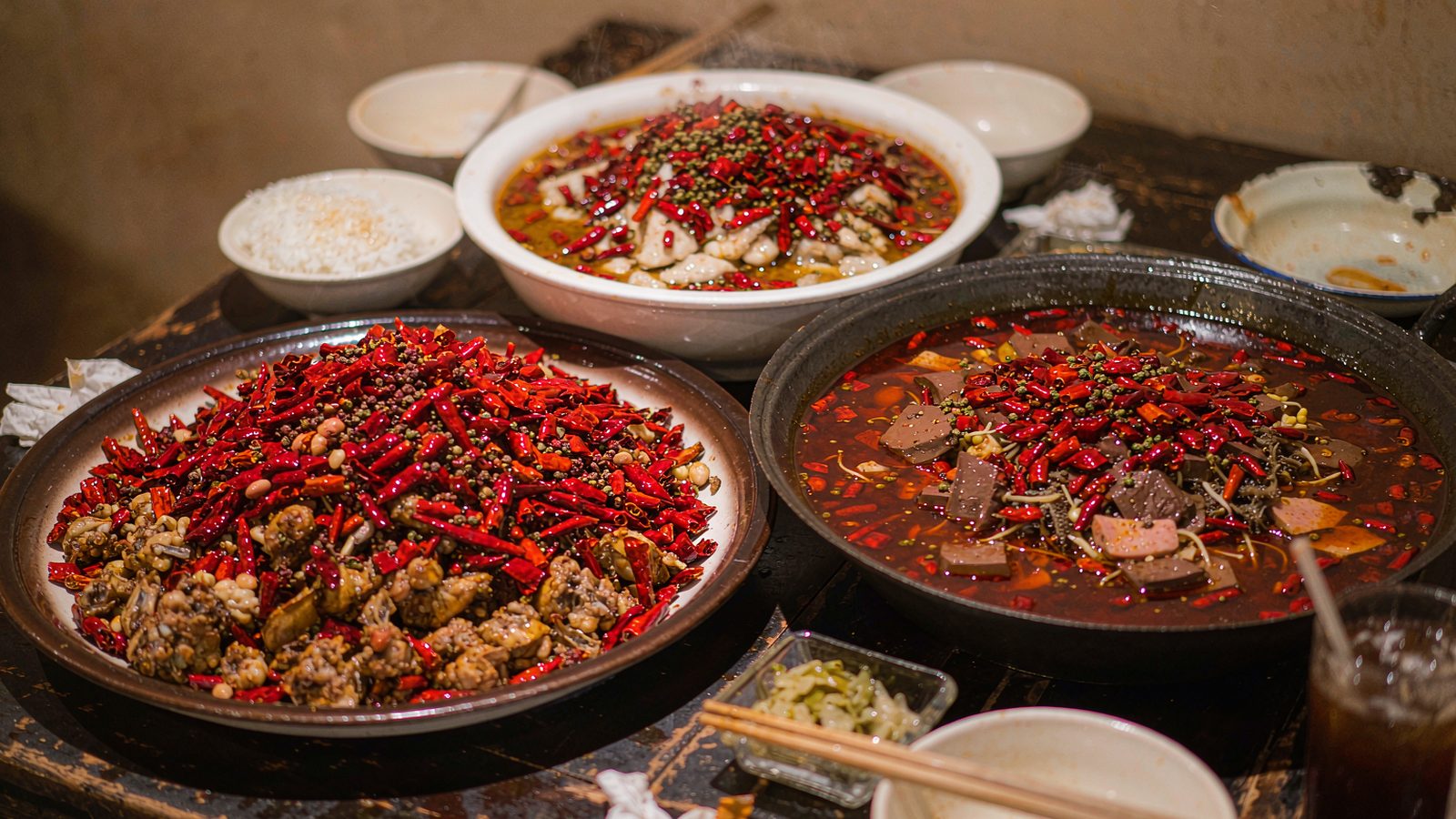
Is laziji priced by weight or by plate, how many people share one basin of maoxuewang, and why fish is weighed alive: a four-dish template with 2026 prices and heat requests.
Ask a Chongqing family where to eat on a Saturday and they will rarely say hotpot. Hotpot is what you do with close friends at 10 pm; the serious sit-down meal happens at a jianghu cai restaurant — a plain room with laminated tables, fluorescent light and a menu on the wall. The order is almost fixed: a plate of laziji (chicken buried in dried chillies), a basin of maoxuewang (duck blood and tripe in chilli broth), and a large bowl of shuizhuyu (fish poached in oil). Rice by the head, beer by the crate. This guide explains what those three dishes actually are, how many to order for four people, what they cost in 2026, how the weighing works, and how to ask for less heat without ending up with something bland.
1. Jianghu cuisine is not a dish — it is a whole way of eating
The term jianghu cai literally means "rivers-and-lakes cooking", and it is not an official culinary school. It is what Chongqing people call the food that came out of the river docks, back alleys and residential ground floors: served in basins rather than plates, heavy on oil, chilli and Sichuan pepper, rough in technique, indifferent to presentation. Its opposite is not Sichuan cuisine; its opposite is banquet food. Jianghu food was never meant to look good. It was meant to fill you up, stand up to cheap liquor, and keep a labourer going for another six hours.
The setting explains the style. A century ago Chongqing was the largest river port in southwest China. Porters, trackers and stevedores worked twelve-hour shifts and were paid by the day. Their meals had to be fast, salty and calorie-dense. Offcuts the butcher could not sell, the cheapest fish in the river, a lot of dried chilli, a lot of oil — one pot, and the smell of offal disappeared. That is why a jianghu dish today still arrives in a portion meant for four.
You can identify a jianghu restaurant in three looks: does the menu carry laziji, maoxuewang and shuizhuyu; are dishes served in basins and deep plates; is rice charged per head and refillable. Three out of three and you are in the right place. A polished restaurant that arranges vegetables into flowers is in a different business.
One more distinction worth keeping straight: hotpot, xiaomian (small noodles) and jianghu food are the three legs of everyday eating here. Hotpot is do-it-yourself, xiaomian is eaten alone, jianghu food is a group sitting down to order. They do not replace each other, which is why a local can eat noodles at noon and hotpot at midnight and still book a jianghu table for the meal in between.
2. Laziji: chicken you have to hunt for, priced by weight
Laziji is the signature, and the most misunderstood. It took its present form around 1986 on Geleshan, the hill west of the city, using free-range chicken cut — bone in — into pieces the size of a thumbnail, marinated, deep-fried until the crust is crisp, then tossed over high heat with a mountain of dried chillies, Sichuan pepper, ginger and garlic. The chillies outvolume the chicken by roughly five to one. What arrives is a red mound. The chicken is inside it.
Here is the thing first-timers get wrong: the whole dried chillies are not food. Their job is to perfume the oil and drive heat into the chicken. Locals push the chillies aside with chopsticks and pick out the chicken; nobody bites a dried chilli. Do that and you will cough, conclude the dish is inedible, and miss the point — the chicken itself is only moderately hot.
Geleshan is the birthplace and the most expensive way to eat it. The old houses along the Sandaoti stone steps price by raw chicken weight, roughly CNY 35–55 per jin (500 g). A whole chicken yields only 200–500 g of edible meat once cut and fried, which is why a "small portion" can quote at CNY 98 or CNY 180 without anyone being cheated — the difference is the size of the bird. Downtown restaurants usually price per plate, CNY 48–88 for two to three people. Both are fair. Before ordering, ask one question: "Is this by portion or by weight, and roughly how much chicken is in it?" That single question removes all confusion.
Two habits worth copying. First, eat the chicken first and the garnishes afterwards — the fried peanuts and garlic slices at the bottom have soaked up the oil and are the best part. Second, order white rice. Laziji is a dry-fried dish; eaten alone it makes you thirsty, and over rice it makes sense. For relief, iced sour plum drink or chilled soy milk works better than water.
3. Maoxuewang: from a dockworker's offal soup to a municipal heritage dish
Maoxuewang is older and even more working-class in origin. In the 1940s Ciqikou, on the Jialing River, was a busy wharf. A local butcher named Wang slaughtered pigs daily; the blood, lungs and intestines had almost no resale value. His wife, Wang Zhangshi, set up a stall by the road, simmered a broth of pork bones and pig head with ginger and Sichuan pepper, cooked the offal in it, and sold it with white peas to the dock crews. One day she dropped fresh pig blood straight into the boiling pot and found it stayed silky no matter how long it cooked. The dish was fixed from that moment.
The "mao" in the name is not a surname. In the local dialect it means rough, casual, unrefined — the same word used for someone who works sloppily. "Xue" is blood curd, "wang" is the local word for a block of blood. Restaurant versions later added beef tripe, aorta and luncheon meat, with soybean sprouts as the bed, which is the eight-ingredient basin you see today. In 2009 the technique was listed as a municipal intangible cultural heritage item, a long way from a dockworker's cheap lunch.
Accept one thing before ordering: it is a shared basin, not an individual soup. Two or three people order the small basin; four or more, the large. Downtown restaurants charge CNY 60–120; inside Ciqikou old town, tourist traffic pushes it to CNY 80–150, though simpler versions at CNY 30–60 also exist.
Eat it in the right order. Ladle out the blood curd first, while it is hot — it firms up as it cools. The tripe and aorta are crisp and go rubbery if left soaking, so fish them out and eat immediately. The luncheon meat and bean sprouts absorb the chilli oil and are the hidden stars; do not fixate on the blood. And do not drink the broth. It is oil and fermented bean paste, fine for spooning over rice, far too salty as soup.
4. Shuizhuyu: the name lies, the oil is the point
Shuizhuyu means "water-boiled fish", which is misleading: the fish sits in a layer of red oil. It evolved from Chongqing hotpot fish. Fillets — grass carp or bighead carp normally, snakehead at better places — are velveted in starch, slipped into a broth of fermented bean paste and aromatics just long enough to set, then topped with dried chillies and Sichuan pepper and finished with a ladle of smoking oil poured over the top. That hiss is the whole dish. Two signs of a good version: the fillets stay whole, and the oil is clear rather than cloudy.
Almost everywhere in Chongqing this dish is sold by weight and killed to order. Market rates in November 2026 run about CNY 38–48 per jin for grass carp and CNY 48–58 per jin for bighead carp at restaurant level; a single portion using a 2–3 jin fish quotes at CNY 58–98, which is normal. One detail visitors miss: the weight charged is live weight, not the weight of the fillets. A 3-jin grass carp yields roughly 1.2–1.5 jin of usable fillet after scaling, gutting and boning. So "by weight" is not a trick, but you should compare fish species and yield, not the price per kilo at a supermarket.
Three requests a kitchen will almost always accept: "kill it fresh and show me the scale", "less oil", and "normal or half Sichuan pepper". Local style is generous with oil, and visitors often find the last half of the bowl is pure oil; asking for less oil up front reduces the finishing pour without hurting the flavour. The bean sprouts, lettuce stems and tofu skin underneath are edible and are usually the most refreshing part of the dish.
5. How to order for four people: the four-dish template
Portions are large. Four people need four dishes; five means leftovers. The principle is one large main + one medium meat + one vegetable + one soup or cold dish. Do not order three chilli-oil dishes in a row or your palate will shut down by the third bite.
| Slot | What to order | Typical price (CNY) | Why |
|---|---|---|---|
| Main, large basin | Shuizhuyu or laziji (both if six or more) | 68–98 | The centrepiece, eaten with rice |
| Second meat | Maoxuewang, braised chicken pot, green pepper rabbit, twice-cooked pork | 58–98 | Changes the texture away from dry-fried |
| Vegetable | Dry-fried green beans, garlic loofah, seasonal greens | 18–28 | Resets the palate |
| Soup or cold dish | Tomato egg soup, chicken-blood soup, smashed cucumber | 15–30 | An exit for anyone who cannot take heat |
| Staple | Steamed rice, per head, refillable | 2–3 per person | Not optional |
For two people, one meat, one vegetable, rice is enough: a plate of laziji or a half-order of fish, plus greens. Three people: one basin of fish, one vegetable, one cold dish. Only at six or more does it make sense to order both the fish and the chicken — and at that point swap the maoxuewang for a braised chicken pot, which turns into a small hotpot once you add broth and vegetables halfway through.
One practical tip: do not order everything at once. Jianghu kitchens are fast. Order the main and the vegetable, look at what is left after ten minutes, then add. Locals host exactly this way, and nobody considers it stingy.
6. Prices and pricing methods in 2026
There are three pricing methods on a jianghu menu. Understand them and nothing surprises you.
- Per portion. The menu says "laziji, CNY 68 per plate". Clear, order it.
- Per weight. Used for fish, chicken and rabbit. Restaurant rates in 2026: grass carp CNY 38–48 per jin, bighead carp CNY 48–58, raw chicken CNY 35–55. Ask for the scale to be shown and the total price stated before cooking — in 2026 Chongqing's market regulator explicitly requires this "transparent weighing".
- Market price. Seafood and premium river fish. By regulation the day's actual price must be displayed prominently; if it is not, ask, and if the answer is vague, eat elsewhere.
Per-head spending falls into three bands. Neighbourhood jianghu restaurants: CNY 30–50, the everyday version. Established places with a decade of reputation: CNY 60–90. The retro-styled chains near Jiefangbei: around CNY 90, where you pay for décor and consistency. The old Geleshan houses run CNY 100–120 per head because chicken is weighed, which is normal rather than a tourist trap.
Two charges visitors often assume are scams are actually regulated. Seat fees, tea fees and paid tableware: several districts issued notices in 2026 (Nan'an in March, Beibei in a trade advisory) requiring restaurants to offer free tableware and free tea; where a charge applies it must be marked and disclosed in advance, never added without consent, and never forced if the customer declines. So the sealed cutlery set (CNY 1–2) and the napkin pack (CNY 1–2) are optional — you may say "no, please give me the free tableware". Takeaway boxes at CNY 1–2 are a normal charge.
7. Heat, allergies and oil: what to actually say
Chongqing's "mild" is not the mild you know, but the kitchen is cooking to order and will adjust. The trick is to be specific.
| What you want | Say this | What you get |
|---|---|---|
| A little heat only | Wei la, chillies halved | Aromatic and numbing, but survivable |
| No chilli at all | No chilli, no Sichuan pepper | They can do it, but expect salty-savoury, not the original |
| Less oil | Shao you — less oil | Half the finishing pour; very noticeable in the fish |
| No numbing | Less or no Sichuan pepper | Heat unchanged, numbness largely gone |
| No offal | Swap maoxuewang for twice-cooked pork | Maoxuewang is offal by definition; it cannot be reworked |
| No MSG | No MSG, no chicken powder | Most kitchens will comply |
Two useful words: "da bao" (takeaway) and "jia fan" (more rice). Portions are big enough that two people ordering two dishes will have leftovers; a box costs a yuan or two and makes a decent late-night snack. Rice is charged per head and generally refillable — just ask.
For drinks, the local pairing is iced sour plum juice, chilled soy milk, or a local lager. If you want your stomach to cooperate, a bowl of bingfen (iced jelly, CNY 8–12) works better than fizzy drinks: cold plus sugar knocks the heat down fast.
8. Where to eat: four areas, four budgets
Geleshan — the laziji birthplace, CNY 100–120 per head. The old houses cluster along the Sandaoti stone path, most with "Geleshan laziji" on the sign. You come here for the sense of origin: chicken weighed, fried to order, chillies piled high. Take metro line 1 to Lieshimu station, change to bus 227 to Senlin Lukou, then walk uphill; by car, navigate to the Geleshan visitor centre car park. On the way you can visit the Bai Mansion and Zhazidong prison sites — free, but book ahead on the Chongqing Hongyan official account.
Ciqikou — the maoxuewang birthplace, CNY 60–90 per head. Nearly every restaurant on the main street serves it, at tourist prices (CNY 80–150 a basin), but you are eating it where it was invented. The old town itself is free; a bag of chen mahua (fried dough twists) is about CNY 15. From the Ciqikou wharf a river ferry (about CNY 30) runs to Hongyadong, one of the best-value river views in the city.
Jiefangbei and Jiaochangkou — downtown, CNY 60–90 per head. Dense with old restaurants where you can order all three dishes in one sitting; the practical choice if your schedule is tight. The trade-off is crowds — arrive before 11:30 or after 13:30.
Nanping, Yangjiaping and Guanyinqiao neighbourhood places — CNY 30–50 per head. Ground-floor units under residential blocks, menus painted on the wall, local families at the tables. The cooking is often as good as the famous names at half the price. The drawbacks are no English menu and a lot of noise. If you want to see what Chongqing actually eats on a Tuesday, this is it.
9. A half-day route: Geleshan plus Ciqikou
With one afternoon, the most efficient route links the birthplace of laziji with the birthplace of maoxuewang.
- 11:00 Metro line 1 to Lieshimu, bus 227 up to Geleshan. Visit the Bai Mansion and Zhazidong first (free, book ahead, about an hour).
- 12:30 Lunch on laziji along Sandaoti: half a chicken by weight, one vegetable, two bowls of rice — roughly CNY 150–200 for two.
- 14:30 Descend and take a bus or taxi (about 20 minutes) to Ciqikou old town. Walk the main street, look into Baolun Temple, sit down for a covered-bowl tea.
- 17:00 Order a small basin of maoxuewang as an early dinner, or take the river ferry to Hongyadong for the night view.
The route never doubles back, and it puts two of the three dishes in their original setting. Save the fish for another day downtown — it is everywhere and not worth a special trip.
10. Five mistakes visitors make
- Eating the chillies. In laziji the dried chillies are aromatics. Bite one and you will cough through the meal; hunt for the chicken instead.
- Ordering per person. Jianghu dishes are built for sharing. Four people, four dishes. Six people, six. Not one each.
- Not asking whether it is by weight or by portion. Fish and chicken are weighed. Ask to see the scale and hear the total before it is cooked — this is a stated 2026 requirement, not a special favour.
- Assuming "mild" means no heat. It still numbs. If you want none, say "no chilli, no Sichuan pepper" explicitly.
- Ignoring rice and drinks. They are not sideshows; they are what makes the meal work. Sour plum juice and iced jelly beat ice water.
A note on timing: lunch service generally runs 11:00–14:00 and dinner 17:00–21:30, with some places staying open through the afternoon. On weekends and public holidays, call ahead — especially at Ciqikou and Geleshan. Travelling with children or older relatives? Say "mild, less oil, cook the vegetables soft" when you order and the kitchen will almost always accommodate.
If you would rather have these meals built into a full Chongqing–Wulong–Dazu itinerary, or need a plan sized to your group, budget and dietary limits, see our tailor-made tours. If you only want to confirm a restaurant's location and hours, contact us and we will answer with what is true on the day.
Need help planning this trip?
Tell us your travel dates and group size — we reply within 24 hours.
WhatsApp +86 183 1705 8017 · WeChat 18317058017
Destinations in this guide

Related Tours


More Guides
Dujiangyan and Mount Qingcheng in One Day: What to Read at Fish Mouth, Front or Back Mountain (2026)
Dujiangyan is CNY 80, Qingcheng Front Mountain CNY 80, the Back Mountain CNY 20. Since 2026 both run real-name time slots. Enter at Gate 6 and walk downhill, with a working one-day timetable.
11/15/2026
Langzhong Ancient Town: Feng Shui, Three Kingdoms and the Birth of Chinese New Year (2026)
The streets are free around the clock; the 110-yuan pass lasts three days. Reading the feng shui from Jinping Hill, plus the Zhang Fei shrine, the exam hall and real rail times.
11/15/2026
Flower Lake and the First Bend of the Yellow River, Zoige: Best Months, Sunset Spots and a Two-Day Route (2026)
Flower Lake costs 105 yuan including the shuttle and closes for the season on 14 November. The First Bend ticket is 105 yuan with the uphill escalator; summit 3,610 m, sunset 18:06.
11/14/2026