
Wulong Three Natural Bridges: What the Ticket Covers, How Long the Walk Takes (2026)
A 40 yuan ticket will not get you to the valley floor: the 125 yuan pass adds the shuttle and the cliff lift. Bridge di…
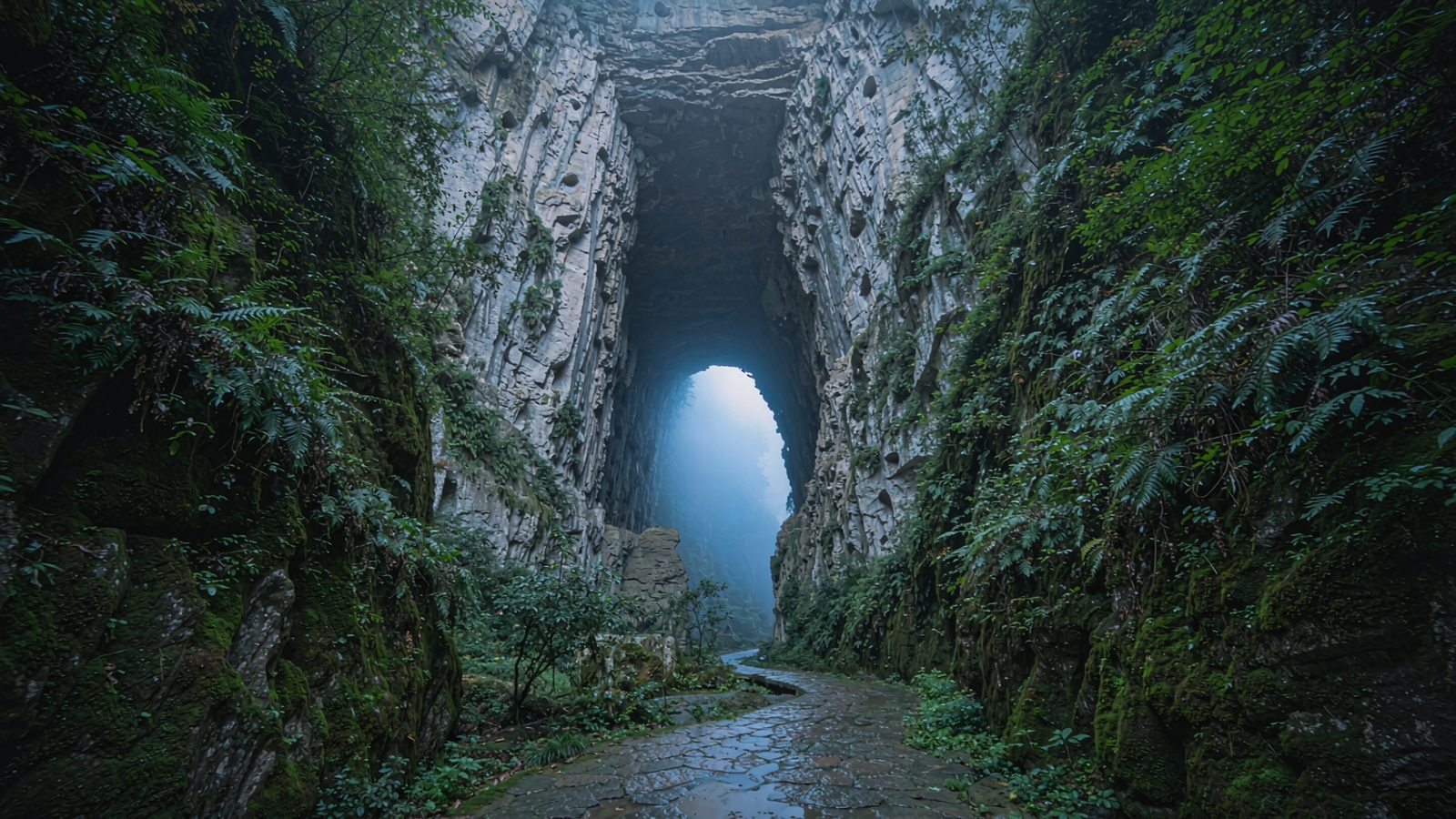
A 40 yuan ticket will not get you to the valley floor: the 125 yuan pass adds the shuttle and the cliff lift. Bridge dimensions, a 2.5-hour route, rail links and six common mistakes.
Most visitors first see Wulong in two photographs: three stone arches spanning the sky above a collapsed valley, and a small tiled courtyard house sitting alone beneath a cliff. Booking is where it gets confusing. Online you will find three prices for the same place, plus conflicting claims about whether the lift is included and how long the walk really takes. This guide answers only those questions, using the rates in force in November 2026.
The short version: the Three Natural Bridges is not a viewpoint you photograph and leave. It is a one-way, downhill walking route of roughly 2.5 kilometres along a valley floor, and a normal visit takes two and a half to three hours. High-speed rail from Chongqing East to Wulong South takes as little as 35 minutes, but the station-to-gate leg adds another 40 to 60 minutes. Door to gate is about two hours, not 35 minutes. Miscalculate that and the whole day collapses.
1. What "three bridges, two pits" actually means
The site sits in Xiannvshan town, Wulong district, Chongqing. It is a national 5A scenic area and a core part of the South China Karst UNESCO World Heritage property inscribed in 2007, alongside Furong Cave and the Houping tiankeng. These are not three hills that happen to look like bridges. An underground river dissolved the limestone, sections of the cave roof collapsed to form sinkholes, and the spans that did not collapse now stand across the gorge as natural arches.
That is why the bridges and the pits are two faces of one process. The three arches run in a line, with two collapsed pits between them, so the walk is a sequence of bridge, pit, bridge, pit, bridge. Three arches of this size within about a kilometre is the reason the site is described as the largest chain of natural bridges in Asia.
Measured by geological survey rather than tourism copy, the dimensions are:
| Bridge | Deck height | Deck thickness | Mean arch height | Arch span | Deck width | What to look for |
|---|---|---|---|---|---|---|
| Tianlong (Heavenly Dragon) | 235 m | 150 m | 96 m | 20-75 m | 147 m | Caves inside caves beneath the arch; the courtyard inn sits in its pit |
| Qinglong (Azure Dragon) | 281 m | 168 m | 103 m | 13-58 m | 124 m | Tallest deck of the three, a world record for a karst natural bridge; rainbows after rain |
| Heilong (Black Dragon) | 223 m | 107 m | 116 m | 16-49 m | 193 m | Highest arch and widest deck; four hanging springs on the roof |
One detail is routinely misreported. Older articles claim Tianlong is 200 metres high with a 300 metre span, and Qinglong 350 metres high with a 400 metre span. Those figures are loose press estimates. Deck height and arch span are different measurements: one is the drop from the top of the bridge to the valley floor, the other is the width of the opening. Mixing them makes the numbers look contradictory when they are simply measuring different things.
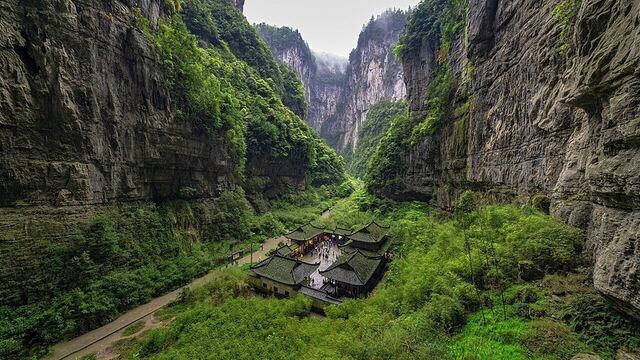
Two cultural stops matter. Tianfu Post Station, the Tang-style courtyard on the valley floor, was built in 2006 as a set for Zhang Yimou's film Curse of the Golden Flower and later kept. There is a small post office inside where you can stamp and mail a card. The Qinglong span appears in Transformers: Age of Extinction, and props from the film remain on site. Neither costs extra.
2. The three prices: 40, 125 and 155 yuan
All three exist, and they buy different things:
- 40 yuan is the low-season gate ticket only (1 November to 28 February). It gets you into the scenic area, not down to the valley floor.
- 125 yuan is the low-season package: 40 gate + 40 shuttle + 45 cliff lift. This is what most independent travellers should buy.
- 155 yuan is the same package in high season (1 March to 31 October): 70 gate + 40 shuttle + 45 lift.
In other words, the seasonal difference sits entirely in the gate ticket (40 versus 70), while the 85 yuan of internal transport is unchanged all year. That explains the flood of numbers you see on booking sites: 95, 105, 120, 135, 155. They are shuttle-only versions, low-season rates, concession rates and combo passes, and comparing them directly is meaningless.
| Ticket | Who qualifies | Low season (Nov 1-Feb 28) | High season (Mar 1-Oct 31) | Notes |
|---|---|---|---|---|
| Adult package | 18-59, no concession card | 125 yuan | 155 yuan | Gate + shuttle + cliff lift |
| Concession package | Age 7-18; full-time students; age 60-64 | 105 yuan | 120 yuan | Half-price gate, full 85 yuan transport; original ID required |
| Gate waived | Age 65+; serving and retired military; disability card; licensed guide, journalist or travel-agency manager; firefighters; designated dependants | 85 yuan | 85 yuan | Pays shuttle 40 + lift 45 only |
| Young children | Age 6 or under, or height 1.2 m or under | Free | Free | ID or household register required |
One misunderstanding comes up constantly. Blogs say "free for visitors over 65," and guests assume they pay nothing. The gate is waived, but the 85 yuan of shuttle and lift is not, because that is internal transport rather than admission. Budget 85 yuan per senior and avoid a surprise at the counter.
Two optional extras can be skipped entirely without affecting the main route: the glass viewing platform at 40 yuan, and the exit electric cart at 15 yuan, which covers about a kilometre of uphill from the valley exit to the shuttle stop. After two or three hours on the walkway, that 15 yuan is usually money well spent.
3. Booking: turn up and buy is no longer realistic
Wulong's core sites now run on real-name advance booking. Three practical points:
- Where. Search the WeChat mini-program Wulong Scenic Area Official Platform, or the official accounts Wulong Scenic Area and Wulong Karst Tourist Area. Ctrip, Meituan and Qunar also sell, but everything ends up in the same real-name database.
- Entry. Chinese visitors tap their ID card at the gate; there is no paper ticket. Foreign visitors who booked with a passport number must carry the physical passport and use the staffed lane. This is the single most common hold-up on inbound tours.
- How far ahead. Same-day booking usually works on weekdays. Add a day for holidays and summer weekends, three days or more for the National Day and Spring Festival periods. The scenic area hotline is 400-023-5666, useful on the morning itself if rain or snow has closed a section.
Opening hours change three times a year, and this catches people out:
| Period | Open | Last entry |
|---|---|---|
| 1-31 May | 08:30-17:00 | 17:00 |
| 1 June-31 August | 08:00-17:00 | 17:00 |
| 1 September-30 April | 08:30-16:30 | 16:30 |
In November the third row applies: open 08:30, last entry 16:30. One hard rule follows from it: do not enter after 15:00. The 2.5-hour figure assumes normal pace with no queueing, no photo stops and no rests. A 15:30 entry means rushing the whole valley and walking out in fading light. There is no night session.
4. The cliff lift: the only real bottleneck, and how to beat it
The route is strictly one-way: shuttle from the visitor centre to the entrance, then the Tianlong spiral lift drops about 80 metres to the valley floor, then the walkway passes Tianlong, Qinglong and Heilong in order, then the exit. Almost all queueing happens at that lift. The valley walkway rarely jams, because everyone moves at a similar pace and nobody can turn back.
The lift is slow because capacity per cycle is limited and every visitor has to descend through the same doorway. From 09:00 in high season and holidays, 20 to 30 minutes is normal; National Day and summer weekends can exceed 40. Three tactics, in order of effectiveness:
- Take the first slot. Arrive at the entrance before 08:30 and you are usually down within five minutes. The cost is leaving Chongqing before 06:00, or staying in Xiannvshan town the night before.
- Go after 14:00. The second quiet window, but you must accept a shorter valley stay, because last entry is 16:30.
- Put the gorge second. Bridges first, Longshuixia Gorge after. Reversing the order puts you at the lift exactly when coach groups arrive.
Can you skip the lift and walk down? Yes, there is a walking path, but it adds 30 to 40 minutes at the start and the steps are steep with little shade. Unless you came specifically to hike, pay the 45 yuan: you still have 2.5 kilometres of valley ahead, and that is where your legs should go.
One thing to know before you commit: there is no lift back up. The only way out is the exit, and turning around means climbing back to the entrance. Anyone with knee problems should strap a support before entering, not gamble. Pushchairs and wheelchairs are effectively impossible on this route: dense steps plus permanently damp stone. Families with small children or elderly parents need that stated plainly before booking.
5. How long the walk really takes
| Leg | Time | Notes |
|---|---|---|
| Visitor centre to entrance (shuttle) | 10-15 min | Includes waiting; longer in high season |
| Entrance, lift, valley floor | 10-40 min | Ride is 2 minutes; the rest is queue |
| Tianlong Bridge, Tianfu Post Station, Tianlong pit | 40-50 min | The inn facade is the busiest photo spot |
| Qinglong Bridge, Shenying pit | 30-40 min | People stop to find the eagle-shaped cliff |
| Heilong Bridge, four springs, exit | 40-50 min | Wettest and slippiest section |
| Exit to shuttle stop | 15 min walking, or 5 min by cart (15 yuan) | About 1 km uphill |
Total: about two hours of pure walking, two and a half with photos and rests, three with queueing. That is one site. Add Longshuixia Gorge, a separate scenic area at 105 yuan including shuttle and lift with 1.5 to 2 hours of walking, and you are over six hours on site. With transfers on both ends, a same-day return from Chongqing becomes very tight.
Three physical realities, all learned on site:
- Temperature. The valley floor is sheltered and shaded, three to five degrees cooler than the rim. Pleasant in summer, cold from November to February, when a light down or fleece is needed.
- Slippery stone. Flagstones plus constant seepage mean proper grip is mandatory. Canvas shoes, leather soles and long skirts are all bad choices.
- No supplies. There is almost nothing to buy at the bottom. Eat at the visitor centre or in Xiannvshan town and carry water. Left luggage at the visitor centre costs 10 to 20 yuan and is worth it: do not carry a suitcase into a one-way downhill valley.
6. Getting there: the 35-minute train is only the first leg
Wulong has two different railway stations, and choosing the wrong one doubles your transfer time. High-speed trains stop at Wulong South; conventional trains stop at Wulong station, the old one near the town centre.
| Mode | Route | Time | Cost, November 2026 |
|---|---|---|---|
| High-speed rail (best) | Chongqing East to Wulong South | 35-38 min fastest, most services 38-57 min | 2nd class 62-89 yuan, 1st class 99-142 yuan |
| High-speed rail (alternative) | Chongqing North or West to Wulong South | About 1-1.5 hours | 2nd class 70-118 yuan |
| High-speed rail (intercity) | Chengdu East to Wulong South | About 2 h 49 min on direct services | Check 12306 for the day |
| Station to gate | Wulong South to Xiannvshan Visitor Centre, shuttle bus | 40-60 min | 10-16 yuan; taxi about 45-65 yuan |
| Station to gate (conventional) | Wulong station to visitor centre, minibus | About 30 min | 10 yuan, roughly every 15 minutes |
| Self-drive | Chongqing to G65 Baomao expressway to visitor centre | 2-2.5 hours, 170-180 km | Tolls 70-95 yuan; parking 20 yuan per day |
| Long-distance bus | Sikilgong hub to Wulong bus station, then shuttle | About 3 hours plus transfer | Per station rate |
Two warnings worth repeating:
- Private cars cannot enter the core zone. Whatever the navigation app suggests, you park at the Xiannvshan Visitor Centre and change to the scenic shuttle. Drivers who try the gate get turned back after half an hour of mountain road.
- Check the return train before you go. There are services from Wulong South back to Chongqing East until around 21:00, but frequency drops in the evening. Leaving at closing time can leave you with one or two options and no adjacent seats in high season. Lock the return ticket first, then work the visit backwards from it.
A lower-effort alternative: a tourist coach from the Jiefangbei area of Chongqing direct to the Xiannvshan Visitor Centre, departing around 07:30, roughly three hours and 70 yuan one way, 130 yuan return. Slower than rail, but no transfers and no driving, which suits anyone who does not want to plan transport.
7. Three ways to shape the day
Option A: bridges only, same-day return. 07:30 train from Chongqing East, 08:10 Wulong South, 08:20 shuttle, 09:10 visitor centre, 09:30 entry, 12:30 exit, lunch in Xiannvshan town, 14:30 back to the station, in Chongqing before 16:00. Unhurried, and the safest choice with children or older parents.
Option B: bridges plus gorge. 07:00 departure, enter before 08:00, out by 11:00, transfer to Longshuixia (about five minutes by road, some sources say 20, check on the day), 11:30 to 13:30 in the gorge, back at the visitor centre by 14:30, home by evening. Over five hours on site; you will reach Chongqing late.
Option C: two days. Arrive the first afternoon, stay in Xiannvshan town (mostly 150-300 yuan a night, 300-600 for comfortable hotels), see Impression Wulong in the evening (standard seat 200 yuan). Next morning take the first slot at the bridges, then Xiannvshan in the afternoon (50 yuan entry, 25 yuan for the little train, optional). This suits travellers treating Wulong as a destination rather than a stopover.
Where to stay is not really a debate: Xiannvshan town. It is closest to the visitor centre, gets you into the 08:30 first slot, and is the transfer hub for the whole district. Wulong town is cheaper but adds 40 to 60 minutes of commuting each day. Resort hotels inside the scenic area suit people seeing the evening show and cost the most.
8. Six mistakes to check before you leave
- "A 40 yuan ticket gets me down to the bridges." It does not. That price stops at the gate; the shuttle and lift are 85 yuan more. Walking down to save it costs 40 extra minutes on steep steps.
- "Over 65 goes free." The gate is waived, the 85 yuan transport is not.
- "The lift is optional." It is part of the standard route and included in the package. Walking the alternative path is not a saving, it is a substitution.
- "The glass platform is a must." It is a separate 40 yuan and skippable if you dislike heights.
- "I can take the lift back up if I am tired." There is no return lift. The route is one-way.
- "A 30 yuan tour is a bargain." The transport and admission costs are fixed and visible. Anything far below cost is recovered through shopping stops and paid add-ons. Legitimate combo tickets never reach that price.
9. Notes for international visitors
Wulong's inbound traffic has changed sharply. According to figures published by the Wulong district culture and tourism commission, the district received 778,900 international visitor arrivals in the first three quarters of 2026, up 81.66 per cent year on year, matching the whole of 2025 (778,800) in nine months. Source countries and regions rose from 10 in 2023 to 70, with Thailand the largest single market at over 100,000 arrivals between January and July alone. English signage, foreign-card payment and service aimed at Southeast Asian guests are all considerably better than a few years ago.
Four things to tell a first-time international visitor:
- Documents. If you booked with a passport number, use the staffed lane and carry the passport itself. Do not leave it in the vehicle.
- Payment. Ticket offices accept mobile payment linked to foreign cards; small stalls at the valley floor may not. Carry a little cash.
- Fitness. 2.5 kilometres of descent and steps, not a flat promenade. Wear trainers or walking shoes.
- Time. Two hours door to gate from central Chongqing. A day trip works, but only for one site combination.
What Jadetour usually does is slot Wulong into a Chongqing itinerary: work backwards from your flight or train arrival, arrange a vehicle from Chongqing to the Xiannvshan Visitor Centre, provide a Chinese or English-speaking escort, book the bridges and the gorge into time slots that avoid coach-group peaks, and decide whether you sleep in Xiannvshan town or return to the city. Tickets and internal transport are fixed by the scenic area and we do not mark them up; what we save you is queueing, wrong transfers and missed return trains. If you want a timetable built around your dates, send your travel dates and party size through the tailor-made page and we will reply against that day's actual services.
Need help planning this trip?
Tell us your travel dates and group size — we reply within 24 hours.
WhatsApp +86 183 1705 8017 · WeChat 18317058017
Destinations in this guide

Related Tours

More Guides
Three Days in Downtown Chongqing: Yuzhong, Nan'an and the Red Rock Line (2026)
Three days split by riverbank, not by attraction: Yuzhong Peninsula, the Nan'an hills, then the Red Rock sites in Shapingba, with hourly plans, fares, booking rules and a cost table.
11/16/2026
How to Order Chongqing Jianghu Food: Laziji, Maoxuewang and Shuizhuyu for Four (2026)
Is laziji priced by weight or by plate, how many people share one basin of maoxuewang, and why fish is weighed alive: a four-dish template with 2026 prices and heat requests.
11/16/2026
Dujiangyan and Mount Qingcheng in One Day: What to Read at Fish Mouth, Front or Back Mountain (2026)
Dujiangyan is CNY 80, Qingcheng Front Mountain CNY 80, the Back Mountain CNY 20. Since 2026 both run real-name time slots. Enter at Gate 6 and walk downhill, with a working one-day timetable.
11/15/2026