
Liziba Monorail Through a Building: Platform, Timetable and the Angles That Work (2026)
The two-second shot is easy; not wasting the trip is the hard part. Exit 1, platform hours, train frequency, the 2026 r…
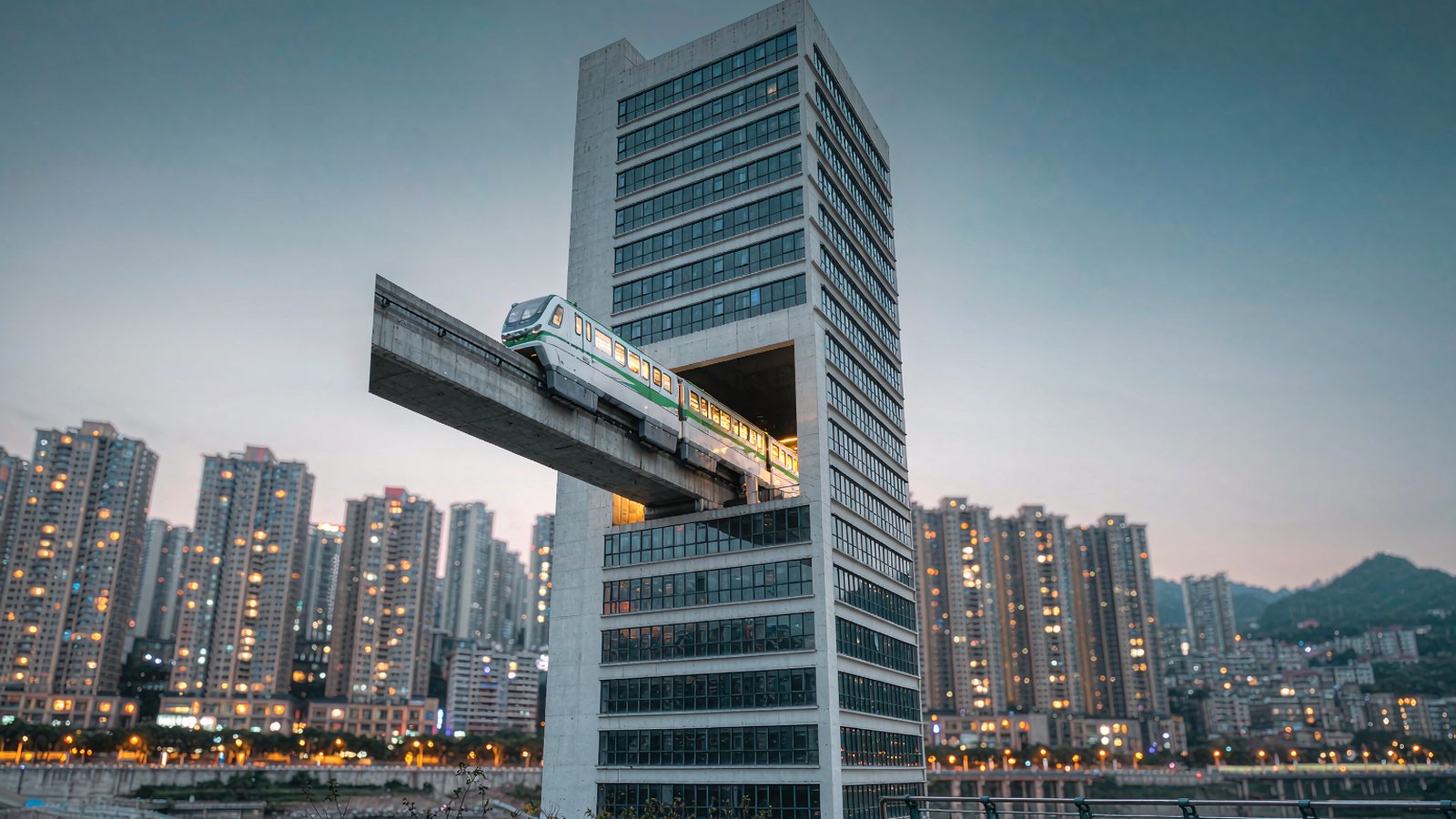
The two-second shot is easy; not wasting the trip is the hard part. Exit 1, platform hours, train frequency, the 2026 rebuild closures, and why morning light beats afternoon. Five angles, three half-day routes, seven mistakes.
A single monorail train slides through floors six to eight of a nineteen-storey residential block. The whole pass takes about two seconds. Those two seconds turned an ordinary metro station in Yuzhong District into one of China's most photographed urban sights.
In spring 2025 a new posing trend went viral: visitors stand on the viewing platform and mime swallowing the train as it emerges, so that the carriage appears to disappear into their mouths. By ten in the morning the tripods are lined up all the way to the steps.
Yet the most common failure here is not a bad photo. It is a wasted trip: arriving expecting a ticket booth, assuming the platform never closes, leaving by the wrong exit and climbing twenty minutes of stairs, or turning up in the middle of the 2026 station rebuild with half the site fenced off. This guide reflects conditions as of November 2026 and covers access, timing, camera positions, and how to fold the stop into a half day.
1. What exactly the train passes through
Liziba Station opened in March 2004 and is the first elevated straddle-monorail station in China built jointly with a commercial and residential building. The building did not later swallow a station: block and station were designed, built, and commissioned together. Yuzhong is a peninsula with almost no flat land, so the designers simply placed the station inside the building to save the ground it would otherwise have consumed.
The block is nineteen storeys, with a clear vertical division:
- Floors 1 to 5: street-level shops and offices;
- Floors 6 to 8: the concourse and platforms of Line 2;
- Floors 9 to 19: apartments.
Some sources say "floors 6 to 7", an older figure that merges concourse and platform. Official statements from the operator and CCTV describe the train running through floors 6 to 8.
Residents are not, as many visitors assume, living with constant vibration. The structure uses a separated viaduct: the columns carrying the track are a different set from the columns carrying the building, so the guideway behaves like an independent bridge passing through the block. The train itself is a straddle monorail running on rubber tyres over a concrete beam, with the car body carried on air springs. When a train passes, the bridge and piers may register a slight tremor; the building barely does, and the noise is well below that of a main road.
The station footprint is 3,100 square metres with 6,000 square metres of floor area. On the retaining wall beside it is a large relief, Soul of the Rock, created by the artist Jiang Bibo in 2001: the lower half is realistic, showing pedestrians pausing on the bridge to look at the city, while the upper half follows the shape of the cliff into an enormous face. Look up on your way out; it deserves two extra minutes.
2. Getting there: rail is reliable, driving is not
The short answer: take Line 2, leave by Exit 1, walk down to the riverside platform. Two minutes, no traffic, no parking.
| From | Route | Door to door | Notes |
|---|---|---|---|
| Jiefangbei / Hongyadong | Line 2 from Linjiangmen, four stops toward Yudong | 8–10 min | Fare 2–3 yuan; simplest option |
| Jiangbei Airport | Line 10 to Zengjiayan, change to Line 2, two stops | 50–60 min | With heavy bags a taxi takes 35–45 min |
| Chongqing North Station | Line 3 to Niujiaotuo, change to Line 2, one stop | About 30 min | Same-platform interchange at Niujiaotuo |
| Chongqing West Station | Loop Line to Xiejiagou, change to Line 2, seven stops | 40–45 min | Loop Line headways are wider; allow slack |
| By car | Navigate to the Liziba monorail viewing platform | Depends on traffic | Parking is extremely limited |
Buses 215, 219, 261 and 262 stop at Rail Liziba Station, a three to five minute walk away. Traffic on the peninsula, however, is unforgiving, and buses often stall around Niujiaotuo.
Three warnings for drivers. First, Liziba Main Street enforces time-limited passage: on a roughly 700-metre stretch from the petrol station ramp to the bus-stop lane signal, vehicles must clear the section within eight minutes; on a roughly 500-metre stretch from the Jialing New Road junction to the riverside ramp, within six minutes. Cameras enforce both. Second, during major holidays such as Labour Day and National Day, temporary controls run from 07:00 to 18:00, sometimes banning left turns at Guihuayuan Road and metering traffic from the Niujiaotuo interchange. Third, tour coaches may not pick up or drop off passengers anywhere along those restricted stretches; groups must use designated bays.
One more change: at midnight on 30 April 2026 the Liziba interchange opened, linking Jiahua Bridge, Huacun interchange, Liziba Main Street and Ruitian Road. Good for drivers, but it means older navigation routes may now lead you into one-way streets.
3. The viewing platform: free, no booking, fixed hours
The platform sits below the station on the river side, just above Jialing Riverside Road. It is not a makeshift stand but a permanent facility rebuilt during the riverside improvement works around 2020, with a total area of about 1,367 square metres, of which roughly 840 square metres is set aside for standing and shooting.
- Coach drop-off zone, keeping groups separate from independent visitors;
- Main photography square, facing the building head-on;
- Glass walkway viewing area, offset to the side, where you can catch a carriage half in and half out;
- Pedestrian paths, two of them, connecting to Liziba Park and the riverside road.
Entry is free and requires no reservation. Current published hours are 08:00 to 23:00 daily; during the rebuild some sections are fenced off in phases, so the usable area varies. A public toilet of more than 140 square metres sits beneath the platform, which matters if you are travelling with children or older relatives.
From the platform you look slightly upward at the side of floors 6 to 8. Trains appear from the east, coming from Niujiaotuo, cross the building, and exit west toward Fotuguan. The shot therefore depends on catching the nose of the train as it emerges, not on waiting for the carriage to reach the centre of the frame.
After dark there is a bonus: the 2020 upgrade added themed lighting around the block, the slope planting and the platform. Come after dinner and you will share the space with half as many people.
4. Timetable and light: when to go
Line 2 runs roughly 06:30 to 23:00. Minimum headway is three minutes on weekdays and four at weekends; in practice three to five minutes at peak and five to ten off-peak. Note that the southern section between Tianbao and Yudong is far less frequent: about 9 minutes 30 seconds at weekday peak, around 14 minutes off-peak and about 13 minutes at weekends. If you are staying down there, do not plan around a three-minute frequency.
The line currently mixes six-car and eight-car sets; the first eight-car train entered service on 23 April 2022. The longer set takes about three seconds to clear the building, which is a more forgiving window than the shorter one. Which set you get is luck, but two or three trains is usually enough.
| Window | Light | Crowd | Verdict |
|---|---|---|---|
| 08:00–10:00 | Side-front light, cleanest | Light | Best choice; two or three trains is enough |
| 10:00–16:00 | Hard overhead light | Peak coach groups, most crowded | Avoid if you can; if not, stand by the glass walkway |
| 16:00–18:00 | Backlight | Moderate | Switch to silhouettes and forced-perspective shots |
| 19:00–22:00 | Themed lighting, blue hour | Moderate | Bring a small tripod for light trails |
One easily missed point: trains alternate directions. One heads for Yudong, the next for Jiaochangkou, usually a minute or two apart. Do not fixate on a single direction; when the crowd suddenly raises its phones, a train is coming.
5. Five camera positions, and how to shoot them
Position one: head-on from the platform. Stand slightly right of the central axis and use a 24–35mm equivalent. On a phone, switching to the 2x lens often frames better. The critical technique is to record early: the pass lasts two to three seconds, so pressing the shutter when you see the train leaves you with a tail light. Shoot 4K at 60 frames per second, start when the headlights appear, and pull the frame later.
Position two: the glass walkway. About thirty degrees off axis, this angle captures the carriage half inside and half outside the building, which reads more clearly as "passing through". Glass reflections are the enemy: put the lens close to the panel or shade it with a hood.
Position three: from inside the front car. Board toward Yudong and walk to the very front of the first car, filming through the windscreen as the train dives into the block. This is the classic monorail point of view in Chongqing; start recording about fifteen seconds before entry. Do not block the doors, and never put a phone outside the window.
Position four: from Three-Layer Road. Leave by Exit 2 and climb Guihuayuan Road to the Three-Layer Road area, then turn and shoot downward. You get the rooftop guideway, the train and the Jialing River in one frame. Local photographers prefer this angle: fewer people, more layers. It is about ten minutes uphill, with plenty of steps.
Position five: long lens from the north bank. From the riverside walk between Jiangbeizui and Xiangguosi, a 200mm lens or longer compresses train, building and river into a city cross-section. The distance is over three kilometres and haze matters, so this is for photographers with time to spare.
Three things not to do: do not try to shoot from inside the paid platform area (you need to tap in, and safety barriers block the view); do not stand in the traffic lanes of Liziba Main Street; do not climb the platform railing onto the slope, which is steep, subject to rockfall, and off limits.
6. The 2026 rebuild: what you will actually meet
This is the part most guides have not updated. The station began renovation in February 2025 and entered full construction on 16 June 2026, with investment of about 71.45 million yuan and completion scheduled for 30 December 2026. The driver is not tourism but capacity: a twenty-year-old station handling more than 30,000 passengers a day needed its vertical circulation rebuilt.
Three headline numbers: fourteen new escalators plus refurbishment of ten existing lifts; station capacity raised from 16,600 to 40,200 passengers per hour; maximum daily capacity of 136,000. After completion, platform, main street, Guihuayuan Road and Three-Layer Road will be linked by escalators, cutting a detour of more than ten minutes to about five.
Work is phased, and the station has never closed. Per the published schedule:
| Area | Closure | Status on 20 Nov |
|---|---|---|
| Concourse Hall B, Exit 3 | 16 Jun – 31 Aug | Reopened |
| Exit 2 | 22 Jun – 20 Sep | Reopened |
| Concourse Hall A | 1 Sep – 31 Oct | Reopened |
| Part of platforms, part of Exit 1 | 16 Jun – 30 Nov | Still fenced |
In other words, in late November one side of the platform is still hoarded, waiting space is narrower, and Exit 1 may require a short detour through the adjacent shopping level. Trains stop normally and the viewing platform stays open, but individual zones may be temporarily occupied. With large luggage or a stroller, use Exit 2 on the Guihuayuan Road side, where the gradient is gentler and the escalators are new.
Check before you go: the operator's service notices or the station page in the official app. Ignore anyone at street level claiming the station is closed and offering a shortcut; it is the oldest hustle in the area.
7. Fitting it into a half day
Route A, two hours, pure sightseeing. Exit 1, thirty minutes on the platform, then the path to Liziba Park for twenty minutes of river and cliff views, and back to the station. Ideal if Liziba is one stop on a wider Yuzhong day.
Route B, half a day, the best value. Platform, Liziba Park, up Guihuayuan Road via Exit 2, the Three-Layer Road overlook, then a twenty to twenty-five minute climb to Eling Erchang creative park, the panorama from Eling Park, and out via Eling Station on Line 1. This strings together the train, the river, old factory buildings and the city skyline. Moderate fitness; wear trainers.
Route C, for photographers. 08:00 on the platform in front light, 09:00 up to Three-Layer Road for the high angle, 10:00 ride one stop to Fotuguan and walk the cliffside trail above the Jialing, finishing at Daping.
For food, Liziba Main Street is where locals eat too: taro chicken hotpot is the district signature, a bowl of pea-and-pork noodles costs about ten yuan, and a simple douhua rice set is around the same. Expect queues between noon and one; shift by half an hour and it eases.
8. Seven common mistakes
- Expecting a ticket or a booking. The platform is free and unreserved. Anyone selling "entry" or "fast track" is selling nothing.
- Paying ten yuan for a "best angle" guide. The free position is down the same staircase.
- Assuming it never closes. Published hours are 08:00 to 23:00; late at night you will see a dark building.
- Arriving at three in the afternoon for a hero shot. That is straight into backlight: white sky, grey facade. Come in the morning or after dark.
- Pressing the shutter when the train is already there. Record first, extract the frame later.
- Standing in the road or climbing the railing. Traffic never stops, cameras enforce the timed sections, and the slope is unstable.
- Driving during a holiday. Limited parking, timed clear-out zones and temporary controls combine badly.
9. Practical summary
| Item | As of November 2026 |
|---|---|
| Admission | Free, no reservation |
| Platform hours | 08:00–23:00 (some zones fenced during works) |
| Rail service | About 06:30–23:00; three-minute minimum headway on weekdays |
| Fare | 2 yuan for 0–4 km, 3 yuan for 4–8 km, rising by distance |
| Time needed | 30 minutes on site; half a day if linked with Eling |
| Best season | March–May and September–November; summer afternoons are brutal, winter is hazy |
| Effort | Flat on the platform; continuous stairs uphill to Three-Layer Road and Eling Erchang |
| Toilets | Beneath the platform, over 140 square metres |
| Accessibility | Fourteen new escalators link Exits 1 and 2 directly |
10. A closing thought
What makes Liziba worth ten minutes of anyone's time is not the optical trick. It is that the place explains something essential about Chongqing: where there is no flat ground, a city grows vertically, with rail inside buildings, escalators up hillsides and roads stacked in three layers. Stand on the platform long enough and you are watching a city solve terrain.
Because Liziba needs no ticket and no booking, it is the most flexible stop in a Chongqing itinerary: put it on arrival day or in the half day before departure, and it still works in poor weather. If you want the Yuzhong highlights and the surrounding routes sequenced around your flight and hotel, we can lay out a version for you: see custom tours.
Need help planning this trip?
Tell us your travel dates and group size — we reply within 24 hours.
WhatsApp +86 183 1705 8017 · WeChat 18317058017
Destinations in this guide

Related Tours

More Guides
Three Days Around Chongqing: Wulong, Dazu or Fuling, and How to Choose (2026)
Wulong, Dazu and Fuling all sit 1.5 to 2.5 hours from Chongqing, yet one is karst, one is Buddhist carving, one is hydrology. Tickets, door-to-door times, stamina and four ways to spend three days.
11/19/2026
G318 Sichuan-Tibet Highway: Drive Yourself or Hire a Driver, and How Many Days to Lhasa
Chengdu to Lhasa is 2,140 km. Eight days is the limit, ten is the norm, fourteen lets you actually see it. What changed in 2026, and why foreign passports cannot self-drive into Tibet.
11/19/2026
Mugecuo Lake, Kangding: Is Half a Day Enough at 3,780 m?
Tickets 105 + shuttle 90 in high season, 75 in winter, real-name booking, 16,000 daily cap. Stop order, half-day vs full-day plans, altitude advice and transport.
11/18/2026