
Yangtze Three Gorges Cruise: Upstream or Downstream, Which Ship, and What the Fare Actually Covers (2026)
Chongqing to Yichang in four days or Yichang to Chongqing in five: what is included, why the ship lift costs extra, and…
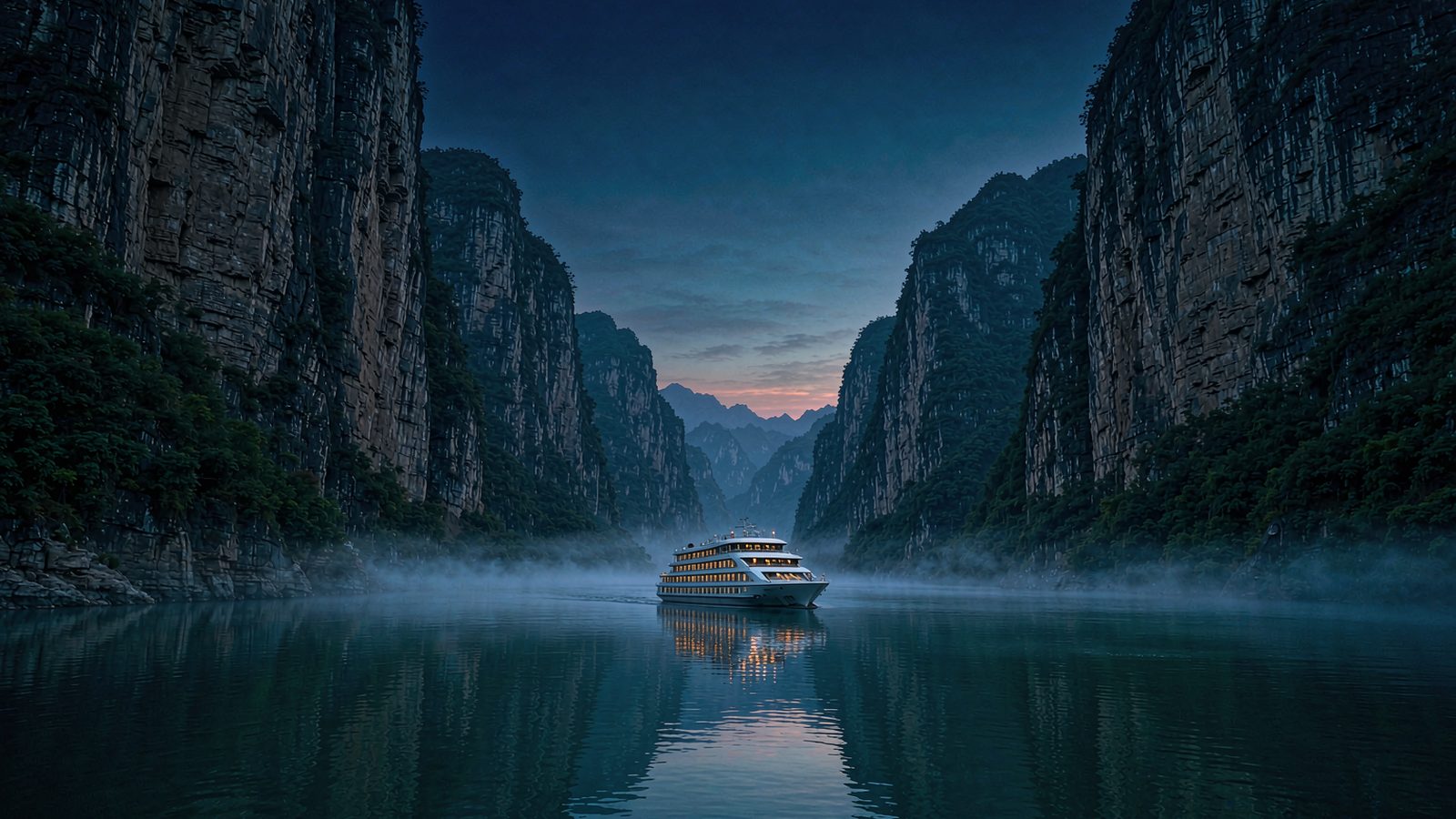
Chongqing to Yichang in four days or Yichang to Chongqing in five: what is included, why the ship lift costs extra, and how to choose among the 2026 newbuilds.
Almost everyone booking a Three Gorges cruise gets stuck at the same point. The booking page shows dozens of vessels, four cabin grades and two directions, with fares from roughly 240 to 2,500 US dollars, and nothing on the page explains the difference. In practice only three decisions matter: direction, cabin grade, and what the fare includes. Settle those and the rest is arithmetic.
The figures below reflect prices and schedules current in November 2026, cross-checked against cruise operators and the official ticketing channels of the scenic areas. Fares move with season, remaining inventory and deck, so treat them as a planning baseline rather than a quotation.
1. Direction first: four days downstream, five upstream
The Yangtze runs west to east. Sailing from Chongqing down to Yichang is the downstream route; sailing from Yichang back up to Chongqing is the upstream route. The difference is not just one extra night. It changes the pace, the order of the stops, and which gorge you see at which hour of the day.
Downstream is normally four days and three nights. You board at Chaotianmen in central Chongqing in the late afternoon, the ship casts off between 21:00 and 22:30, and the first evening is spent on deck watching the two rivers meet below the skyline. Day two stops at Fengdu, choosing between the Ming Mountain ghost city and the Xiaoguanshan historic courtyard complex, with a staged historical show after dinner on many vessels. Day three is the core: Baidicheng or the Three Gorges Summit, then a transfer to a small boat for Shennü Stream, passing Qutang Gorge and Wu Gorge in daylight. Day four you disembark at Maoping near Zigui, visit the Three Gorges Dam and the river-closure memorial park, and the group disperses in Yichang between 11:00 and 12:30.
Upstream is five days and four nights. Day one is a shuttle from Yichang East Railway Station or the Three Gorges Visitor Centre to the ship at Zigui. Day two covers the dam. Day three takes in Shennü Stream and Baidicheng. Day four is Fengdu. Day five you disembark in Chongqing around 08:30.
Both routes cover the same water. The real difference is density of time. Downstream compresses the highlights into four full days with an early start every morning. Upstream spreads the same stops across five days, and departures are typically thirty to sixty minutes later, which matters if you are travelling with older parents or young children. Sailing against the current is slower, and those extra hours on the water are the main reason the upstream route runs a day longer.
| Item | Downstream (Chongqing to Yichang) | Upstream (Yichang to Chongqing) |
|---|---|---|
| Duration | 4 days, 3 nights | 5 days, 4 nights |
| Boarding point | Chaotianmen, central Chongqing, metro access | Maoping port, Zigui, about 60 km from Yichang city |
| Sailing time | 21:00 to 22:30 on the first night | Docks overnight, departs next morning |
| Disembarkation | Morning of day 4, Yichang, 11:00 to 12:30 | Morning of day 5, Chongqing, around 08:30 |
| Pace | Tight, early starts | Relaxed, one extra buffer day |
| Typical fare | Lower for the same ship and cabin | Usually 40 to 85 US dollars more, for the extra night and meals |
| Best for | Limited holiday time, combining with Chongqing | Families, slower travellers, easier access from Yichang |
One detail that rarely appears on booking pages: most four-day itineraries only show you the western half of Xiling Gorge. Qutang and Wu are transited in full, but the eastern section of Xiling, below the dam toward Gezhouba, is not part of the standard Chongqing-Yichang run. To see all three gorges properly you either take a vessel that passes both dams, or one of the long-haul routes to Wuhan, Nanjing or Shanghai. Ask before you pay.
2. What the fare actually covers
This is where most complaints originate. There is no industry-wide all-inclusive standard. Some vessels genuinely include shore excursions, drinks and service charge; others include only the cabin and buffet meals, and charge separately for every site visited. The reliable method is to ask for two written lists, included and excluded, and have both attached to the contract.
| Item | Usually included | Usually excluded |
|---|---|---|
| Accommodation | The booked cabin for 3 or 4 nights | Single supplement, deck upgrade |
| Meals | Three buffet meals daily, sometimes morning tea and afternoon tea | Alcohol, soft drinks, specialty restaurants |
| Shore excursions | The sites named in the itinerary (Fengdu, Baidicheng, the dam) | Anything off-list: ship lift, Three Gorges Summit, Mini Three Gorges |
| Onboard programme | Welcome reception, lectures, shows, gym | Spa, karaoke, mahjong room, laundry |
| Pier services | Some ships include luggage handling and butler service | Maoping to Yichang shuttle bus, 50 CNY per person, 70 CNY on public holidays |
| Service charge | Included on most premium vessels | Charged per person per night on a minority of ships |
Three specific items deserve separate treatment, because they cause most of the disappointment.
The ship lift is not standard. The Three Gorges vertical ship lift has a chamber 120 metres long and 18 metres wide, lifting vessels of up to 3,000 tonnes through a maximum height of 113 metres. It is genuinely spectacular. But only one vessel, the Yangtze Explorer, is currently scheduled to carry its own passengers through it. Other ships either use the five-stage lock system or sell the lift as an optional add-on. Standalone tickets run about 258 CNY including the dam shuttle bus, 198 CNY for the boat ticket alone, and roughly 290 CNY when bought on board. The lift closes for maintenance periods, and when it does the segment is cancelled and refunded, not replaced.
The dam itself is free, but the shuttle is not. The Three Gorges Dam scenic area waives admission for both Chinese and foreign visitors, but requires real-name reservation and charges 35 CNY per person for the internal shuttle, which is effectively compulsory since the sites are kilometres apart. Children under six are exempt. Daily capacity is capped at 36,000, reservations open one to seven days ahead, and entry is split into morning and afternoon slots. Most cruises fold this into the fare; a few list it as optional.
Shore stops often involve a choice. On the same day, the same ship may offer either Ming Mountain or the Xiaoguanshan courtyards at Fengdu; at Fengjie, either Baidicheng or the Three Gorges Summit. The first is cultural, the second is panoramic, and the physical demands are very different. The summit sits above 1,400 metres on Chijia Mountain and needs a cable car plus shuttle, which is a poor fit for anyone with mobility limits.
3. Cabins: inside, balcony, suite
Cabin logic on a river ship differs from an ocean cruise. On the Yangtze, every cabin faces the river on the same side, so the value of a balcony is simply that you can watch the gorges without going up on deck. Qutang and Wu are transited in daylight, most often between seven and nine in the morning or three and five in the afternoon, and that is when a balcony earns its premium.
- Inside cabin, 20 to 24 square metres. No window or a fixed porthole. The 2026 newbuilds have improved these considerably; the Yangtze Yunfan offers a 20 square metre inside cabin from 1,599 CNY, the lowest entry point on the river. The trade-off is no daylight and no view except from the deck.
- Deluxe balcony cabin, 26 to 28 square metres. One room, one bathroom, one balcony, twin 0.9 metre beds or a 1.8 metre double. This is the sweet spot, typically 2,700 to 5,400 CNY per person in November 2026. Higher decks cost more; decks two and three are cheapest, decks five and six have the best sightlines with marginally more motion, though river ships move very little.
- Premium and executive cabins. Similar floor area on a higher deck, usually six, with lounge access, priority boarding and a separate dining area. Expect 150 to 220 US dollars more than a standard balcony.
- Suites, 33 to 85 square metres. Separate living area, some with a private deck. The Century Glory presidential suite is 85 square metres from around 2,100 US dollars per person. The Yangtze Explorer carries only 148 passengers, all in suites from 31 square metres, starting near 1,100 US dollars.
For two travellers a standard balcony cabin is enough. Families should ask for a family cabin: 34 square metres with a 1.8 metre double plus a 0.9 metre single, considerably more comfortable than a rollaway. A third adult in a shared cabin usually ends up on a sofa bed, and two cabins are worth the extra if the budget allows.
4. Choosing a ship in 2026
2026 is the busiest year for new tonnage on the Yangtze in decades. The Yangtze Yunfan and the Yangtze Parade both entered service on 18 April, the Yangtze Aurora followed on 5 August, and the Century Dream on 21 September, adding roughly four thousand berths across the provincial fleet. Age matters more than size: hull vibration, air conditioning, bathrooms and sound insulation on pre-2015 vessels do not match electric-propulsion newbuilds, even after refurbishment.
| Vessel | First sailed | Tonnage / berths | From (CNY per person) | Notes |
|---|---|---|---|---|
| Yangtze Yunfan | Apr 2026 | 18,000 / 650 | 1,599 inside, 20 sqm | New Chongqing flagship, lowest entry price |
| Yangtze Parade | Apr 2026 | 17,000 / 650 | 4,399 balcony, 28 sqm | Hybrid diesel-electric, smart cabin controls |
| Yangtze Aurora | Aug 2026 | 17,000 / 650 | 4,399 balcony, 28 sqm | Sister ship, seven decks |
| Century Dream | Sep 2026 | 15,000 / 650 | 3,709 inside, 24 sqm | 2,000 sqm sun deck, immersive theatre |
| Victoria Keel | Sep 2025 | 17,000 / 590 | 2,699 balcony, 25.9 sqm | Victoria fleet flagship |
| Century Voyage | Sep 2024 | 15,000 / 650 | 3,469 inside, 24 sqm | Markets itself as all-inclusive, day transit of the gorges |
| Century Oasis / Century Glory | 2023 / 2022 | 15,000 / 650 | 2,749 inside, 24 sqm | Quiet electric propulsion, proven hulls |
| Yangtze Explorer | May 2025 | 7,389 / 148 | 7,799 suite, 31 sqm | All-suite small ship, transits the ship lift |
A more useful order is the reverse of the booking page: set the budget, then filter by age, then pick the cabin. Under about 350 US dollars per person, take an inside cabin on a 2022 to 2024 vessel; the experience is fine. Between 350 and 570 dollars, take a balcony on something built after 2023, which is where most travellers land. Above that, the four 2026 newbuilds are a different generation in both hardware and service.
5. What the shore sites really cost
Spending beyond the fare concentrates ashore. These are November 2026 standalone prices; cruise packages usually cost less, but anything off the itinerary is charged separately.
| Site | Price (CNY per person) | Notes |
|---|---|---|
| Three Gorges Dam | 0, plus 35 shuttle | Free for Chinese and foreign visitors, real-name booking, 36,000 daily cap |
| Baidicheng and Qutang Gorge | 100 list, often around 60 online in low season | Opens 07:40, ticket sales end 17:00, last entry 17:30, closes 19:00, open year round |
| Fengdu Ming Mountain | 90, or 105 with one-way shuttle, 120 return | Ming Mountain, Shuanggui Shan and Xiaoguanshan are three separate entrances |
| Shennü Stream | About 120, including the small boat | Large vessels cannot enter; transfer boats take about 20 minutes each way |
| Wushan Mini Three Gorges | 120 | Departs from Wushan town pier, a different tributary from Shennü Stream |
| Three Gorges Family | 210, including admission, shuttle and ferry | Eastern Xiling Gorge, not on the standard Chongqing-Yichang route |
| Vertical ship lift | 198 to 290 | 258 for the package with dam shuttle and city transfer, about 290 bought on board |
A note on Baidicheng: the official ticket price is 100 CNY, while online low-season rates hover near 60. The gap reflects season and channel, so do not treat either number as year-round. The site is open every day, but ticket sales stop at 17:00, which is fine if you arrive with the ship and tight if you drive yourself.
Fengdu also confuses people. Ming Mountain, Shuanggui Shan National Forest Park and the Xiaoguanshan historic complex are three different places. When an itinerary says Fengdu ghost city it means Ming Mountain; when it says Xiaoguanshan it means the courtyard complex, which is quieter and better for photographs but far smaller.
6. Boarding: Chaotianmen has more than twenty berths
Chaotianmen runs from berth 1 to berth 24 along the river, and the long-haul Three Gorges vessels use the Yangtze side. Century and Golden series usually dock at berth 8, President and Victoria at berth 15, and the Chongqing-operated series often at berth 6. The exact berth is confirmed by the operator one or two days before departure. Search for the numbered berth, not for Chaotianmen Square; the square is large and walking to the wrong pier costs fifteen minutes.
Boarding normally runs from 16:00 to 20:00, with the Century fleet opening at 16:30. Arriving between 17:00 and 18:00 works well: you avoid the worst sun and still have time to find the berth, check luggage and clear security. Most ships sail between 21:00 and 22:30, and the safety briefing that evening is worth attending.
Since 1 January 2026, revised Chongqing water transport regulations require strict real-name ticketing on Three Gorges cruises, with identity checked at boarding. The document must match the booking exactly. Foreign travellers bring their passport and visa page; Chinese nationals bring their ID card; children need a household register or birth certificate.
The piers involve many steep steps. Check large luggage at the pier if you can, keep valuables with you, and note that there is no official ticket window on site. Everything is booked in advance, and the discounted berths offered by touts at the pier should be refused.
7. Disembarking and onward travel: allow three hours
The downstream route ends at Maoping in Zigui on day four. The port is outside Yichang city, roughly 60 to 67 kilometres from Yichang East Railway Station, or one to one and a half hours by road. Shuttle buses are sold on board, 50 CNY per person outside public holidays and 70 CNY during them, and must be booked a day ahead. Some operators run free shuttles from the Three Gorges Visitor Centre and Yichang East.
The practical rule: book trains after 19:00 and flights after 20:00. Group dispersal is usually 11:00 to 12:30, and water-level adjustments or lock queues can push it later. A 17:00 departure is a gamble.
Upstream reverses this. On day one you gather at Yichang East or the visitor centre between 17:30 and 19:30 for rolling shuttles to Maoping, exchanging your ID for a bus ticket. The common mistake is treating the Three Gorges Visitor Centre as the port: it is only a transfer point, and the ship is in Zigui.
8. Four things foreign travellers should know
- Documents. Passport plus a valid Chinese visa or visa-free entry permit, needed at boarding, at shore sites and for accommodation registration. The ship handles registration for you, so keep the passport accessible rather than locked in a suitcase.
- Dam reservations. Foreign visitors cannot self-book through the WeChat service account. Present your passport at the ticket window on site, and you still pay only the 35 CNY shuttle. On an organised cruise the guide handles it.
- Language. Premium vessels generally have English-speaking guides and English menus. Smaller shore sites have limited English signage, so having the site name written in Chinese to show a driver saves time.
- Payment. Ship reception usually accepts Visa and Mastercard, but pier stalls, shuttle buses and small entrance fees are effectively cashless Chinese: WeChat Pay, Alipay or cash. Carry a few hundred yuan and link an international card to Alipay or WeChat Pay before you arrive.
9. Five misconceptions
Bigger is better. The river imposes draft and length limits, and 18,000 tonnes is close to the ceiling. What separates a good ship from an ordinary one is age and propulsion, not the tonnage figure.
A balcony guarantees the gorges. Transits mostly happen in daylight, but Qutang Narrows is only a few dozen metres wide at its narrowest, and some ships pass sections at night or during dinner. Ask which day and roughly what time each gorge is transited; that is a more useful question than cabin grade.
Upstream is cheaper. It is the opposite. The extra night and meals usually add 40 to 85 US dollars for the same ship and cabin. The budget option is an inside cabin downstream, not a change of direction.
Nothing sails in the dry season. Ships sail, but from December to March low water pushes some deeper-draft vessels to board at Fengdu or Fuling. The operator covers the transfer at no extra cost, but you spend an extra two hours on a coach from Chongqing. Put that clause in the contract for winter departures.
Onboard spending is ruinous. Drinks, spa and karaoke are expensive, but three buffet meals and most shore admissions are already paid for. Real extra spending is commonly 40 to 115 US dollars per person, mostly the ship lift, drinks and pier transfers. Budgeting the fare plus fifteen per cent is a reasonable estimate.
10. Three recommendations for a first cruise
Write three lines into the contract: direction, cabin, inclusions. Ship name, departure date, direction, cabin grade, deck, which shore sites are included, whether the ship lift is included, and who pays for the pier shuttle. Most disputes on the Yangtze come from assuming something was included.
Add a day at one end. Stay in Chongqing the night before a downstream sailing so boarding day is not a race from the airport. After an upstream sailing, keep a day in Yichang for the dam or the Three Gorges Family without rushing. The cruise itself is full; a buffer day at each end changes how the whole trip feels.
Pack in three layers: carry-on (documents, cash, medication), ashore (light jacket, trainers, rain shell, power bank), and cabin (everything else). Shore sites involve steps and stone paving, so heels and hard soles are a bad idea. The deck is windy, and in November the gorges feel close to ten degrees Celsius.
The river by boat and the river by road are two different things. From a road you see a viewing platform; from the water you see the cliff walls close in on both sides. It is probably why almost every poem written about the Three Gorges over the past thousand years was written from a boat.
If you would like a specific sailing matched to your dates, group size and budget, send us the details and Jadetour will come back with an inclusion list and a like-for-like total, rather than leaving you to compare dozens of vessels alone.
Need help planning this trip?
Tell us your travel dates and group size — we reply within 24 hours.
WhatsApp +86 183 1705 8017 · WeChat 18317058017
Destinations in this guide

Related Tours

More Guides
Jiefangbei and Ciqikou in Half a Day: How to Link a Downtown Square with an Old River Town
Metro Line 1 takes 33 minutes, the Jialing ferry takes 60, and Ciqikou's lanes empty out before 10am. Here is the exact timing, fares and walking order for a half-day between Chongqing's monument square and its old porcelain port.
11/20/2026
Liziba Monorail Through a Building: Platform, Timetable and the Angles That Work (2026)
The two-second shot is easy; not wasting the trip is the hard part. Exit 1, platform hours, train frequency, the 2026 rebuild closures, and why morning light beats afternoon. Five angles, three half-day routes, seven mistakes.
11/20/2026
Three Days Around Chongqing: Wulong, Dazu or Fuling, and How to Choose (2026)
Wulong, Dazu and Fuling all sit 1.5 to 2.5 hours from Chongqing, yet one is karst, one is Buddhist carving, one is hydrology. Tickets, door-to-door times, stamina and four ways to spend three days.
11/19/2026