
Dazu Rock Carvings: Baodingshan or Beishan, Tickets and Whether You Need a Guide (2026)
November 2026 prices: Baodingshan CNY 115, Beishan CNY 70, combo CNY 140 with shuttle. How to read the 830-handed Guany…
November 2026 prices: Baodingshan CNY 115, Beishan CNY 70, combo CNY 140 with shuttle. How to read the 830-handed Guanyin, the 31-metre reclining Buddha and Cave 136.
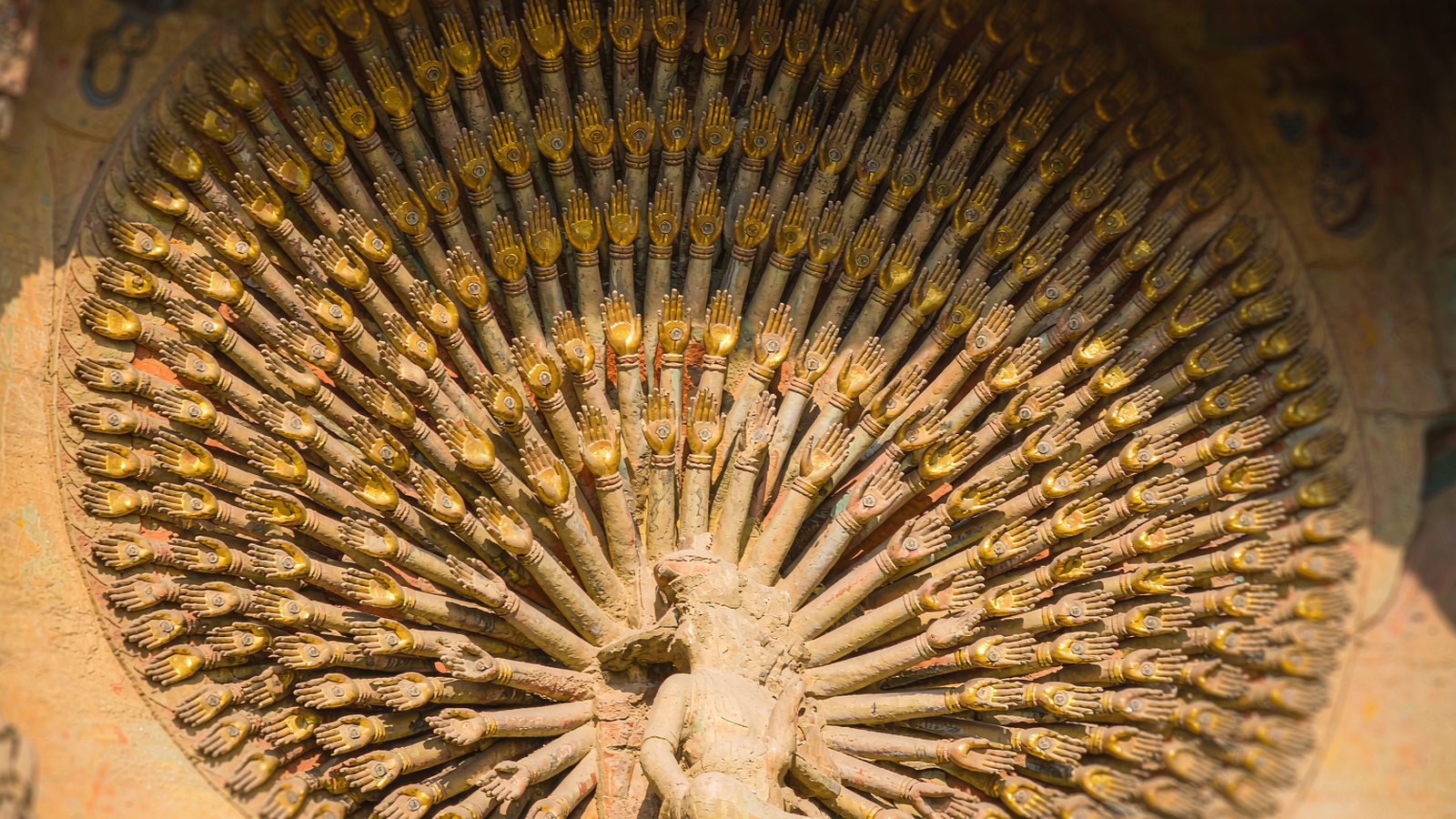
Dazu is the most underrated stop on almost any Chongqing itinerary. It sits 120 kilometres west of the city, has no light show and no monorail running through a building, and from the road it looks like nothing more than a cliff with some carvings on it. Then you stand in front of the Thousand-Armed Guanyin and stop talking: in the 88 square metres of rock in front of you, thirteenth-century sculptors cut 830 hands, one at a time, each palm holding an eye, each hand holding a different object.
The real question is not whether Dazu is worth the trip. It is which site to see, how to get there, whether to hire a guide and how to buy the ticket. Dazu is not one attraction but a collective name for 141 groups of cliff carvings across the district. Two of them matter to ordinary visitors: Baodingshan and Beishan, about ten kilometres apart, and utterly different in character. Some people see only Baodingshan and come away saying "one more Buddha and I would have screamed". Others see both and call it the best day of late Chinese cave art they have ever spent.
What follows is built on prices, opening hours and travel times checked in November 2026. Rates move with the season, so confirm the day's figures on the official Dazu Rock Carvings WeChat account or the Chongqing Dazu Rock Carvings mini program before you go.
1. The short answer: one day, both sites, buy the combo
With one day: Baodingshan in the morning, Beishan in the afternoon, and buy the combined ticket. Three hours at Baodingshan, ninety minutes to two hours at Beishan, twenty minutes between them by shuttle or taxi, plus lunch. That is a full, comfortable day.
With half a day: Baodingshan only. It carries the scale, the narrative and the visual punch. Beishan rewards a little experience; Baodingshan rewards anyone.
On a second visit, or if you care about sculpture: invert it. Give the weight to Beishan. Baodingshan is one complete sermon; Beishan is 250 years of changing style, and it gets better the slower you go.
| Baodingshan | Beishan | |
|---|---|---|
| Period | Southern Song, directed by the monk Zhao Zhifeng over about 70 years | Begun 892, continued through Five Dynasties and both Song dynasties, over 250 years |
| Who paid | One monk, one plan, built as a whole | A prefect, then officials, monks and lay donors, layer upon layer |
| Character | A large-scale teaching site, like a picture book in stone | A gallery of sculpture; craft and aesthetics |
| Signature works | Thousand-Armed Guanyin, 31-metre reclining Buddha, Huayan Trinity, Round Enlightenment Cave | Wheel of the Dharma cave, String-of-Beads Guanyin, Vaisravana, Peacock Wisdom King |
| Scale | Great Buddha Bend, about 500 metres of cliff, over 10,000 figures | Crescent-shaped cliff, 290 numbered niches, nearly 10,000 figures |
| Time needed | 3 hours, or 4 with museum and cinema | 1.5 to 2 hours |
| Best for | First visits, families, tight schedules | Second visits, photographers, art lovers |
2. What Dazu actually is
Carving began under the Tang in the Yonghui era (650 to 655) and continued through the late Tang, Five Dynasties, Northern and Southern Song, and on into the Ming and Qing: more than a thousand years. The district holds 141 sites, over 50,000 figures and more than 100,000 characters of inscriptions. On 1 December 1999 Dazu was inscribed on the UNESCO World Heritage List. It is Chongqing's only World Heritage property.
Its place in Chinese cave art is specific. Dunhuang, Yungang, Longmen and Maijishan represent the peak from the Northern Dynasties to high Tang. Dazu is the final chapter: carving moved south from dry northern sandstone into the damp Sichuan basin, from imperial commissions into popular devotion, and from remote Buddhas into ordinary life. These figures teach filial piety, herd cattle, raise chickens and wash clothes. That turn toward the vernacular, toward a fusion of Buddhism, Daoism and Confucianism, is what you cannot see anywhere else.
Of the five main zones, Baodingshan and Beishan are the core. The other three, Nanshan (largely Daoist), Shimenshan and Shizhuanshan (all three teachings together), cost CNY 30 each, are small and off the main line. Only specialists make the trip.
3. Baodingshan: seventy years, one complete sermon
Baodingshan lies about 15 kilometres northeast of the town, at 528 metres. The monk Zhao Zhifeng built the whole complex over roughly seventy years, and he did not open niches at random: the script came first, then the chisel. From entrance to exit, 31 numbered groups follow the logic of Buddhist teaching, one after another, with almost no repeated subject. Walking it is like hearing a structured sermon.
The Great Buddha Bend is the heart: east, south and north cliffs, about 500 metres long, more than 10,000 figures, one of the densest Southern Song carving groups in China. Five works should not be skipped.
1. The Thousand-Armed Guanyin
Niche 8 on the south cliff, carved between 1174 and 1252. The niche is 7.7 metres high and 12.5 metres wide, 88 square metres in area, and holds the largest cliff-carved Guanyin in China combining sculpture, pigment and gilding.
There is a well-known error about the hands. Popular accounts long said 1,007. Between 2008 and 2015 the state listed the figure as Priority Project No. 1 for stone conservation in China and spent nearly eight years on rescue work; three-dimensional laser scanning confirmed 830 hands and 227 ritual objects. The restoration covered 222.15 square metres and used one million sheets of gold leaf. It reopened on 13 June 2015.
How to look: do not just shoot the wide view. Step closer and look at the palms. Every hand differs in angle, front, side, upturned, downturned, flexed, extended. Each palm carries an eye; each grip holds something different, from jewels and ritual implements to everyday objects. That refusal to repeat a single hand is why it is called a wonder.
2. The reclining Buddha: 31 metres, upper body only
The Parinirvana scene, 31 metres long, is the largest half-length stone reclining Buddha in the world. Its genius is what is not carved: head north, feet south, everything below the knees disappears into the rock, the right shoulder sinks into the mountain, the left vanishes into cloud. By leaving the body unfinished, the sculptors made the Buddha lie across the landscape rather than on a slab. A local saying claims his head is in Dazu, his hand in Ba County, his feet in Luzhou.
3. The Huayan Trinity: a statue that leans 25 degrees
About seven metres tall, with Vairocana at the centre and Manjusri and Samantabhadra flanking. Manjusri holds a seven-storey pagoda 1.8 metres high and more than 400 kilograms, suspended from one forearm for eight centuries. The craftsmen enlarged the heads, lengthened the lower bodies and tilted the whole group forward by 25 degrees, so that from below it reads as perfectly upright. This is applied ergonomics, in the twelfth century.
4. The Round Enlightenment Cave: drainage as design
The largest cave at the bend, about 12 metres deep. It solves two engineering problems at once: a light well in the ceiling brings daylight in, and a concealed channel along the wall feeds spring water into a dragon's mouth and out, draining the cave without damaging the figures. The system still works, which is somehow more impressive than the sculpture.
5. Herding the Ox, and the Sutra of Parental Kindness
The Ox-Herding panels use a dozen reliefs to show a herdsman taming an ox, from the animal bolting to being haltered to the final stage where both man and ox are forgotten: a Zen diagram of mind-training, and a documentary of Song rural life. The Parental Kindness series is even more direct, carving pregnancy, birth, nursing, washing and the ache of a child far from home, folding Confucian filial piety into a Buddhist cliff. These are the strongest evidence of Baodingshan's secular turn, and the two places where guides most often say one sentence and move on when you should stand for five more minutes.
Two supporting stops
The Dazu Rock Carvings Museum sits inside the site, entered on the same ticket: Tuesday to Sunday, 09:00 to 17:00, closed Mondays except public holidays, last entry 16:30. It sets out the origins, the conservation campaigns and a comparison with cave sites elsewhere. See it before the carvings; twenty minutes gives you a frame and the rock becomes far more legible.
The digital cinema runs seven screenings a day, roughly 09:30, 10:20, 11:10, 12:00, 13:30, 14:20 and 15:10, about fifty minutes each, in 4K and dome formats. Most combo tickets include it; bought separately it is about CNY 30 to 50. Not essential, but a good buffer with children or in rain.
4. Beishan: 250 years, a chronicle of Tang and Song carving
Beishan, historically Longgangshan, rises about 560 metres, two kilometres northwest of town. It is far older than Baodingshan: in 892 the prefect Wei Junjing, military commander of four prefectures, opened the first figures on the western cliff inside his fortified camp. Officials, monks, nuns and lay donors then paid for their own niches for the next 250 years, ending around 1162.
That word "then" defines Beishan. Baodingshan is one man's coherent plan; Beishan is two and a half centuries of different people, different budgets and different taste, stacked in layers. There is no continuous story, but the evolution of style is exceptionally clear: late Tang full-bodied and sheer-robed, still carrying high Tang weight; Five Dynasties small, delicate, increasingly ornate; Song utterly secular, faces lovely, dress rich, bodhisattvas looking like elegant women.
The Buddha Bend is the core: crescent-shaped, 290 numbered niches, nearly 10,000 figures. Five caves are essential.
1. Cave 136, the Wheel of the Dharma
Carved 1142 to 1146, the cave is 4.05 metres high, 4.1 wide and 6.79 deep. At its centre stands an octagonal revolving sutra repository cut from a single block, dragons coiling up eight pillars, symbolising the ever-turning wheel of the law. Because the eight columns stand free, light reaches the walls evenly: a design decision, not an accident.
Around it are arranged Sakyamuni, Manjusri, Samantabhadra, Sun-and-Moon Guanyin and the Seal Guanyin. Manjusri sits on a blue lion, a scroll in the left hand and a mudra at the chest, faintly self-assured; Samantabhadra rides a white elephant, gentle and composed. The writer Han Suyin called it "a pearl on the crown of Chinese cave art", and nobody has improved on that.
2. Cave 125, the String-of-Beads Guanyin
Carved 1131 to 1162, the niche is 1.27 metres high, one metre wide, 0.72 deep; the figure itself is under a metre. Flower crown, slender body, ribbons lifting, beads in the right hand, left hand holding the right wrist, bare feet on a lotus, an S-curve through the torso, a smile in the eyes. It is nicknamed the "coquettish Guanyin" and crowned "the finest work at Beishan".
Why it matters: early Chinese Guanyin figures were male, seated upright and stern. From late Tang into Song the figure became female and human, and here it is fully a shy, lovely young woman. Divinity steps back and personality steps forward, and this is the clearest specimen of that shift.
3. Cave 5, Vaisravana: the foundation stone of 892
4.3 metres high, 2.86 wide, 1.76 deep, among the first figures Wei Junjing cut. The guardian wears a garuda crown and heavy armour, tramples a demon, eyes wide; attendants brandish swords and staffs. Wei cast himself in the role of the heavenly king: he was a warlord holding eastern Sichuan, and his camp stored grain and troops. Beishan's first Buddhas were, in effect, a political statement.
4. Cave 245, the Contemplation Sutra tableau
Late ninth century, 4.69 metres high and 3.61 wide, with 578 figures and 42 modelled buildings, pagodas and pavilions. The Western Trinity occupies the centre, the nine grades of rebirth and the story of Queen Vaidehi below, the sixteen contemplations along the sides. Celestial palaces, flying apsaras, the two-headed bird, musicians: it is generally judged the finest late Tang treatment of this subject anywhere.
5. Cave 155, the Peacock Wisdom King, and a craftsman's name
Carved in 1126, holding 950 figures. The Wisdom King sits on a lotus carried by a peacock whose tail feathers rise to the cave ceiling; four arms hold a sutra, a fan, a jewel and a peacock feather. On the door jamb is an inscription: "In the bingwu year, Fu Yuanjun, with his son Shikeng, carved this figure." Two generations of craftsmen signed their work. Named sculptors are rare in Chinese cave art, which makes that line precious.
Two steles worth a detour
Niche 103 holds the Old Text Classic of Filial Piety, written by Fan Zuyu in the Southern Song: 22 chapters, 1,819 characters, of which 1,620 survive. The old-text version was largely lost after the Han, and the historian Ma Heng called this stone "the only copy under heaven". The same area holds the Stele of Zhao Yijian, its heading and text by Cai Jing, 2.56 metres tall, a key object for Song calligraphy.
The Beishan cliff runs about 300 metres, seven to ten metres high, with far fewer steps than Baodingshan. In summer there is evening opening, 19:30 to 23:00 with last entry 21:30, when lighting rakes the cliff and the figures read more sculpturally than in daylight. It is the most underrated experience at Dazu, and worth a night in town for anyone with a camera.
5. Tickets, and the trap nobody mentions
Sites are ticketed separately. The 2026 range, with high season from 1 March to 30 November and low season from 1 December to the end of February:
| Ticket | High season | Low season | Notes |
|---|---|---|---|
| Baodingshan adult | CNY 115 | CNY 100 to 110 | Includes museum and Shengshou Temple |
| Beishan adult, daytime | CNY 70 | CNY 50 | Evening session separate |
| Combo, both sites | CNY 140 | CNY 120 | Includes shuttle, valid two days, best value |
| Digital cinema | CNY 30 to 50 | same | Usually inside combo tickets |
| Baodingshan shuttle | CNY 22 return | same | Visitor centre to gate, about 2 km |
| Human guide | from CNY 100 | same | Priced per group and route |
| Nanshan / Shimenshan / Shizhuanshan | CNY 30 each | CNY 30 each | Specialists only |
Third-party platforms often list CNY 110, 58 and 135: a few yuan below the official board price. What you give up is flexible cancellation and access to the concession categories. The official channels are the Dazu Rock Carvings WeChat account and the Chongqing Dazu Rock Carvings mini program. Nothing else.
Here is the trap. Free and half-price eligibility frequently cannot be applied online. You book and pay full price, then present your passport or ID and the supporting document at the ticket window, and the difference is refunded or a free voucher issued. If you are travelling with parents aged 60 to 64, or a full-time student, buying a full-price ticket online is not a mistake: it is the process. But you must budget time for the queue, which on a public holiday can start at twenty minutes.
- Free: age 65 and over; under 18; serving military and immediate family, martyrs' dependants; veterans and retired military; serving and retired firefighters; disabled visitors (levels 1 and 2 for vision, intellectual or physical disability may bring one carer); registered Buddhist and Daoist clergy; holders of the New Chongqing Talent card, with three to seven guests depending on tier.
- Half price: full-time students at undergraduate level or below, aged 18 and over, with a student card; visitors aged 60 to 64.
- Excluded: concessions cover the first gate only. Cinema, shuttle and guiding are charged as normal.
One more rule that catches people out: only original documents count. A photo of an ID, an electronic ID, a screenshot of a student card: none of these will be accepted at the window. If you have forgotten your passport, the site police office can issue a temporary certificate, but it costs time.
6. Hours and booking: three numbers decide your day
Remember three: doors at 08:30, last entry between 16:10 and 16:30, close at 18:00. In low season (December to end of February) closing moves to 17:30 and last entry earlier still.
- Visitor centre: 08:30 to 16:30, last admission 16:10.
- Baodingshan, including Shengshou Temple: 09:00 to 18:00, last entry 17:00.
- Beishan, daytime: 09:00 to 18:00, last entry 17:00.
- Beishan evening: summer, 19:30 to 23:00, last entry 21:30, subject to daily notice.
- Museum: Tuesday to Sunday 09:00 to 17:00, closed Monday, last entry 16:30.
- Internal transport: buses 08:40 to 19:00, shuttle carts 09:00 to 18:30, roughly every ten minutes.
Book three to five days ahead on the official account or mini program. Summer holidays, National Day and Spring Festival sell out; same-day tickets are not guaranteed at the gate. On weekdays in winter, same-day booking is usually fine.
And a scheduling trap: many people slot Dazu into an afternoon, leaving the city at 14:00, arriving at 16:00, and managing a third of Baodingshan before being swept out. 16:10 last entry is a hard line. Leave in the morning, or stay the night.
7. Getting there: the last 40 kilometres is the real problem
Online advice on this varies wildly, so read carefully.
By high-speed rail. Chongqing West or Shapingba to Dazu South takes 30 to 40 minutes, from about CNY 28 to 32. The catch is where Dazu South sits: in Youting town, roughly 43 kilometres from Baodingshan, not the "twenty minutes" often quoted. Mapping puts driving at 55 to 60 minutes, a taxi at around CNY 100 or a little more depending on the meter, and public transport above two hours: bus 204 or 206 into town, then 205 or the Dazu shuttle line, plus about a kilometre on foot.
So rail suits two kinds of traveller: those with a pre-booked transfer, and those with time to spare and patience for a two-hour bus. With luggage and older parents, take a taxi or a car from the station.
By car. About 120 kilometres on the Chengdu-Chongqing expressway, 1.5 hours, good road throughout. Navigate to the Baodingshan visitor centre. Parking is CNY 6 to 10 per entry or per 24 hours depending on the lot. Driving is the best way to see both sites, because Baodingshan and Beishan are ten kilometres apart with no frequent shuttle between them.
By direct coach. From Jiefangbei in Chongqing, departing 08:00 and returning from the Baodingshan car park at 16:00, CNY 48 one way. Good for solo travellers or couples who do not want to drive. The cost is a fixed clock: you must leave at four, which rules out Beishan.
By private car and driver. For international visitors this is usually the best answer. Pick-up at the hotel, three hours at Baodingshan, ninety minutes at Beishan, straight back to the city for dinner. What you buy is the elimination of three transfers and all the waiting.
8. Guides: CNY 100 very well spent
The local saying is blunt: without a guide you are looking at rocks. It is not exaggeration. Nothing at Baodingshan is placed casually; the position, the order of subjects and even the hand gestures carry a single argument. At Beishan, the cave names, dates and craftsmen only come together with someone talking.
- Official human guide, from CNY 100, priced by group size and route. You can ask questions and adjust the pace. For a family, or for anyone with no background in Buddhist iconography, take this option.
- Audio guide, a few dozen yuan, repeatable, good if you like controlling your own pace. The content is standardised, so it stops exactly where your curiosity starts.
- Free online commentary from creators and touts around the gate: zero cost, fragmented, and a fair amount of it invented. Do not use it as your main source.
A practical split: human guide at Baodingshan, audio at Beishan. One needs storytelling, the other needs looking.
9. A one-day plan, to the half hour
| Time | What | Note |
|---|---|---|
| 07:30 | Leave Chongqing | Expressway; breakfast in the car |
| 09:00 | Baodingshan visitor centre | Collect tickets, book a guide first |
| 09:20 | Museum | 20 minutes for the frame; closed Mondays |
| 09:50 | Digital cinema, optional | 50 minutes; good with children |
| 10:50 | Enter the Great Buddha Bend | Clockwise: Wheel of Life, Huayan Trinity, Guanyin, reclining Buddha, Ox-Herding, Round Enlightenment |
| 12:30 | Shengshou Temple, exit | Quiet inside; incense optional |
| 13:00 | Lunch in Baoding town | Preserved mustard, Youting carp, tofu pudding |
| 14:00 | Reach Beishan | 10 km, 15 minutes by car |
| 14:15 | Caves 136, 125, 5, 245, 155 | Follow the numbers, do not wander |
| 16:00 | Leave for the city | About 1.5 hours back |
| 18:00 | Dinner in Chongqing |
Half day: Baodingshan only. In at nine, out at one; fifteen minutes in the museum, two and a half hours at the bend, twenty minutes at the temple. Skip the cinema and Beishan, and look properly at the Guanyin and the reclining Buddha. That beats rushing two sites.
Two days: arrive the first afternoon for Beishan by day, stay for the summer evening session, sleep in town; see Baodingshan early the next morning with the fewest people and the best light. This is our preferred rhythm, because the raking light on the Thousand-Armed Guanyin before nine in the morning is the best it gets all day.
10. Five common mistakes
- Assuming Dazu is close to the city. 120 kilometres each way, three hours of driving. Wedged between Ciqikou in the morning and Hongyadong at night, all you will photograph is the gate.
- Skipping Beishan. The difference is about CNY 25. What you skip is the summit of Song dynasty carving.
- Expecting to claim a concession online. Free and half-price entries are handled at the window with original documents; you pay full price first and are refunded. No papers, no discount.
- Leaving at two in the afternoon. Last entry is 16:10. Leave at two, arrive at four, see a third. If you must go in the afternoon, stay the night.
- Using flash. Strong light accelerates the decay of pigment and gilding, and it is banned inside the caves. Tripods are a hazard in the narrow ones when it is busy.
11. How we handle this stop
Jadetour builds in-depth itineraries across Chongqing and Sichuan, and Dazu is the stop we most often rescue from a bad schedule. Our standard placement is day two of the Chongqing leg: the first day in the city to absorb the time difference, the second leaving early for a full day at both sites and back for dinner. If the traveller cares about sculpture, we invert it and spend a night in Dazu to photograph the Guanyin at first light.
In practice we do four things in advance: work out the ticket category for every member of the party, since age and student status decide whether you queue at a window; secure slots on the official channel three to five days out; assign a guide who can actually read the iconography in Chinese or English rather than recite dates; and set the order of the two sites around light and crowd flow, which normally means Baodingshan first and Beishan after lunch, but reverses in quiet seasons.
If you are planning Chongqing, Dazu deserves a full day rather than a glance on the way past. For a route and a price that includes it, start with custom tours or contact us. For the city itself, we have a separate guide at Chongqing travel tips.
One honest note to finish. Dazu is not a photo-stop. It will not make you gasp in the first minute. But if you stand still for five minutes, look at the angle of one hand, follow one chisel mark made eight hundred years ago, it will be the part of the trip you remember longest.
Need help planning this trip?
Tell us your travel dates and group size — we reply within 24 hours.
WhatsApp +86 183 1705 8017 · WeChat 18317058017
Destinations in this guide

Related Tours

More Guides
Zigong, Sichuan: Dinosaurs, a 1,000-Metre Salt Well and the Lantern Fair (2026 Guide)
The dinosaur museum reopened on 28 July 2026: 40 yuan, real-name booking only. Shenhai Well is 25 yuan and now closes at 17:00 for winter. No lantern fair in November - the 33rd edition opens January 2027. Trains from Chengdu take 50 minutes.
11/13/2026
Zhangjiajie in Four Days: Forest Park, Tianmen Mountain and Fenghuang (2026)
November 2026 prices: Wulingyuan four-day pass CNY 228 to 240, Tianmen CNY 278, Fenghuang combo CNY 128. The order, the lodges, the bookings, the luggage and the wet-weather plan.
11/13/2026
Sanxingdui Museum 2026: Ticketing, Three Halls and the Objects That Matter
Tickets are 72 yuan, released at 20:00 five days ahead, none sold on site. Under-18s enter free but still need a booking. The right order for the three halls, what the star objects really are, and nine mistakes to avoid.
11/12/2026