
Guangzhou In Depth: How to Eat Yum Cha Properly, the Old City in Three Slices, and Shunde & Kaiping
One of the key ancestral homelands of the Chinese diaspora. Covers yum cha etiquette and the tea charge, the Xiguan arc…
One of the key ancestral homelands of the Chinese diaspora. Covers yum cha etiquette and the tea charge, the Xiguan arcade district, the river cruise, plus Shunde and the Kaiping diaolou.
On many inbound itineraries Guangzhou is just "the stop before Hong Kong", one night at most. That is a waste. Guangzhou is the birthplace of Cantonese cuisine and one of the most important ancestral homelands of the Chinese diaspora — the dim sum you eat here and the arcaded streets you walk are the source of the emigrant culture that flowed to Southeast Asia and the Americas over more than a century. For overseas Chinese travellers, Guangzhou is often less a city than a coordinate in a family history.
When to go
- October to December: the best months — clear, cool and dry, the most comfortable stretch of the year.
- March to April: pleasant temperatures, but watch for "hui nan tian" — when warm, wet air follows a cold front, condensation forms on walls and floors, and laundry simply will not dry.
- January to February: mild and dry, with flower markets and lion dances around Lunar New Year. Note that some heritage restaurants close over the holiday.
- May to September: long, hot and humid, with typhoon season from July to September. Watch the forecast.
- Avoid: the two Canton Fair sessions (April and October), when citywide hotel rates jump and availability tightens.
Yum cha: not breakfast, a ritual
"Eat in Guangzhou" finds its clearest expression in morning tea. Many visitors treat it as "a bite in the morning" and end up ordering a table of food without understanding what matters.
A few ground rules
- Timing: traditionally from just after 6 a.m. until around 11 a.m. Many restaurants now serve it all day, but the atmosphere of an old teahouse exists only in the morning.
- "One pot, two pieces": one pot of tea and two dim sum is the minimum unit. Do not fill the table at once — order in waves.
- Tea cover charge: charged per person. It is part of how teahouses operate — not a tip and not a service charge.
- Pouring tea: when you pour for someone else, they may tap the table with their fingers in thanks. That is Cantonese courtesy, not impatience.
What to order
- Har gow (shrimp dumpling): the benchmark of any teahouse — the wrapper should be thin, translucent and unbroken, the pleats even.
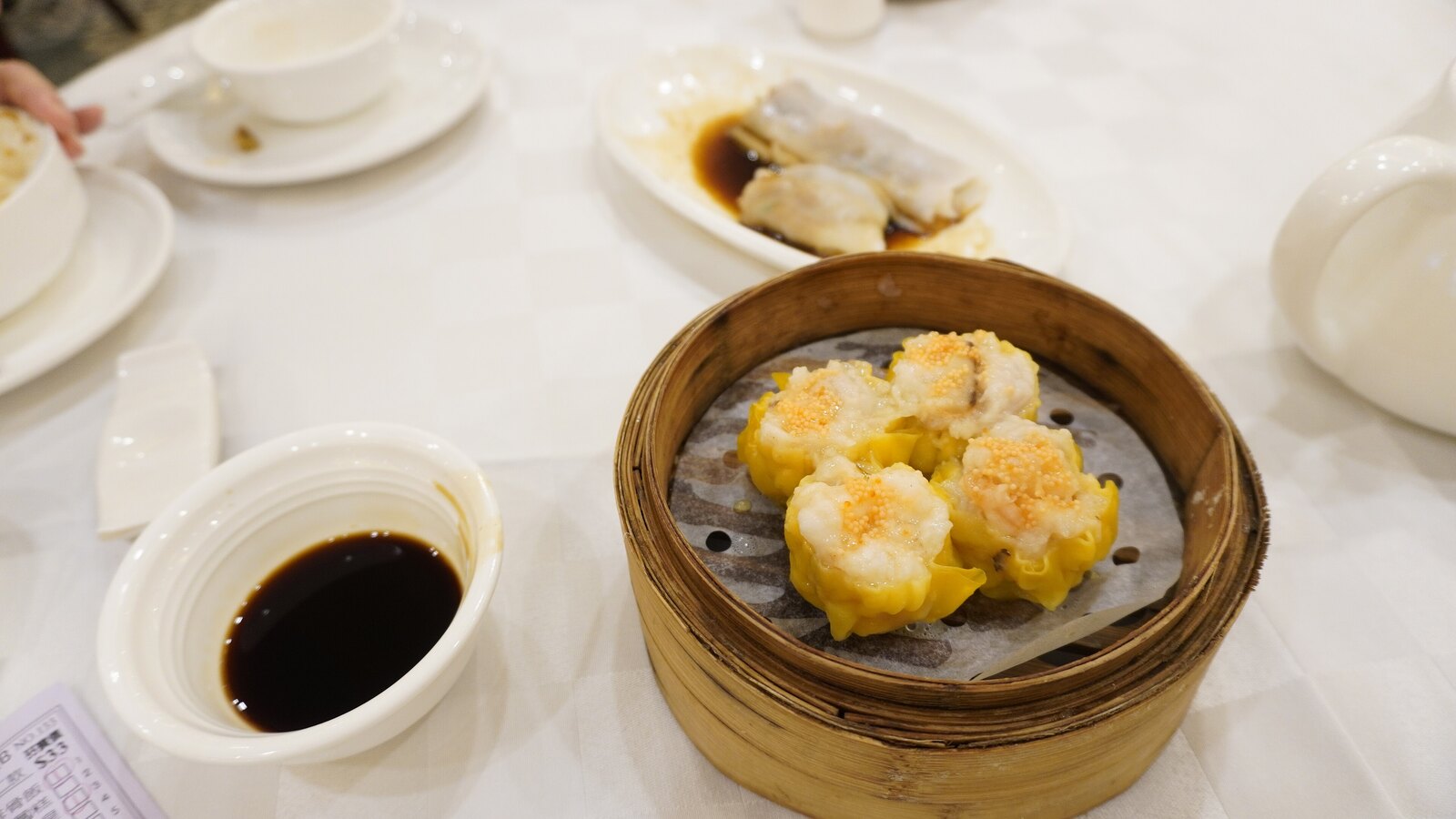
- Siu mai: pork and shrimp, topped with crab roe or carrot.
- Rice noodle rolls: steamed rice sheets wrapped around fillings — silky but never sticky.
- Chicken feet, spare ribs, glutinous rice in lotus leaf: the classic steamer trio.
- BBQ pork buns, egg tarts, custard buns: the sweet finish.
- Congee and desserts: sampan congee, jidi congee, double-skin milk — a whole parallel breakfast tradition.
Where to go: the heritage teahouses of the old city (Liwan, Yuexiu) have the most atmosphere; chains are consistent and transparently priced, which suits a first attempt. The simplest quality test is the ratio of local guests at 8 a.m.
Three slices of the old city: Xiguan, Shamian, Yongqingfang
- Chen Clan Ancestral Hall (Guangdong Folk Art Museum): the high-water mark of Lingnan architectural decoration — wood, brick and stone carving, pottery figurines, lime sculpture and cast iron all on one ancestral hall, at a density rarely seen in China. Allow one to two hours and look up at the ridges and eaves.
- Shamian: a small island on the Pearl River with an intact cluster of colonial-era European buildings and the old concession layout. Best at dusk, and a sharp contrast to the arcaded old town.
- Yongqingfang and Enning Road: a revitalised Xiguan arcade district with the Cantonese Opera Art Museum, heritage shops and craft studios. This is the best place to understand the qilou arcade — a recessed ground floor that shades from sun and shelters from rain, perfectly adapted to the Lingnan climate.
- Shangxiajiu pedestrian street: the busiest commercial old street. Good for street life; prices and quality vary, so shop with care.
The Pearl River and Canton Tower
Canton Tower stands 600 m and is China's tallest television tower. The observation decks and the rooftop ferris wheel are ticketed separately, and visibility decides whether it is worth it.
A better choice is the Pearl River night cruise: from the water you see Canton Tower and Zhujiang New Town lit up, with skyline layers from different decades side by side. The logic matches Shanghai's Huangpu cruises, but the river is wider here and the lights denser.
Chimelong and other themed attractions
Chimelong sits in Panyu and includes a safari park, a theme park and a water park — the largest themed resort complex in southern China. Each park takes a full day, so do not attempt two in one. Families usually give Chimelong two to three days of its own.
Around Guangzhou: Foshan, Shunde, Kaiping
- Foshan: reachable on the Guangfo metro line in about 40 minutes. The Ancestral Temple, the Wong Fei-hung Memorial Hall and Lingnan Tiandi make this the easiest introduction to southern martial arts and lion dance.
- Shunde: about an hour by car, widely regarded as home to the highest standard of Cantonese cooking. Double-skin milk, raw fish, roast goose and Chencun rice noodles are essential. For food-focused travellers, Shunde outranks any single sight in Guangzhou.
- Kaiping diaolou and villages: a World Heritage site about two hours away. These defensive towers were built by returning emigrants in the early 20th century, and their hybrid Chinese-European form is unmistakable. For travellers with overseas-Chinese roots, this is often the most emotionally resonant stop of the trip.
How to structure the trip: 3 days and 5 days
3-day core
- Day 1: arrive → old city (Chen Clan Hall → Yongqingfang, Enning Road) → dusk walk on Shamian.
- Day 2: morning tea at a heritage teahouse → Zhujiang New Town and Canton Tower → Pearl River night cruise.
- Day 3: Baiyun Mountain or Shangxiajiu → departure.
5-day extended
Add a full day of Shunde food and a day at Kaiping (strongly recommended for travellers with emigrant roots). With children, swap two days for Chimelong. We already run "Guangzhou + Shunde + Kaiping" as a fixed itinerary — see the related tours section.
Practical tips
- Getting around: the metro is dense and covers the airport, rail stations and nearly every sight — the most efficient way to move. Baiyun Airport is about 30 km out, on the metro.
- Language: Cantonese is the everyday local language, though Mandarin works with younger people. Staff in old teahouses may speak only Cantonese — have the dim sum list or a translation app ready.
- Climate: summers are hot and humid; bring breathable clothing and sun protection. During the damp "hui nan tian" period, pack a spare pair of shoes and socks.
- Payment: QR payment is near-universal, even in small old-town shops. Link an overseas card or carry a little cash.
- Eating: Cantonese cooking favours original flavour, heat control and freshness over heavy seasoning. If you prefer bold flavours, say so in advance. Dim sum portions add up — order in rounds of two dishes.
Common misconceptions
- "There is nothing to see in Guangzhou." Its value is not a single landmark but three lines: food, architecture and emigrant history.
- "Yum cha is just breakfast." It is a social institution — pacing, the tea charge and pouring etiquette are all part of it.
- "Do two Chimelong parks in a day." Each needs a full day; forcing it ruins both.
- "Shunde is a side trip." Shunde deserves its own day — treating it as a stopover wastes it.
Need help planning this trip?
Tell us your travel dates and group size — we reply within 24 hours.
WhatsApp +86 183 1705 8017 · WeChat 18317058017
Destinations in this guide

More Guides
Flying with a Pet to and from China: Cabin, Hold and Quarantine in 2026
Cabin, live-animal hold or cargo, plus quarantine certificates, the 21-day rabies rule and China entry requirements.
10/17/2026
Solo Female Travel in China: Safety, Night Transport and a 2026 Checklist
Registration, late-night rides, payments and emergency numbers: a practical 2026 checklist for women travelling alone in China.
10/17/2026
Student Travel in China: 2026 Rail Fare Rules and the Best Hands-On Activities by City
A practical guide to study tours in China: 2026 rail student fare scope, visa-free basis for camps, hands-on activities by city, and group safety standards.
10/16/2026