
Flying with a Pet to and from China: Cabin, Hold and Quarantine in 2026
Cabin, live-animal hold or cargo, plus quarantine certificates, the 21-day rabies rule and China entry requirements.
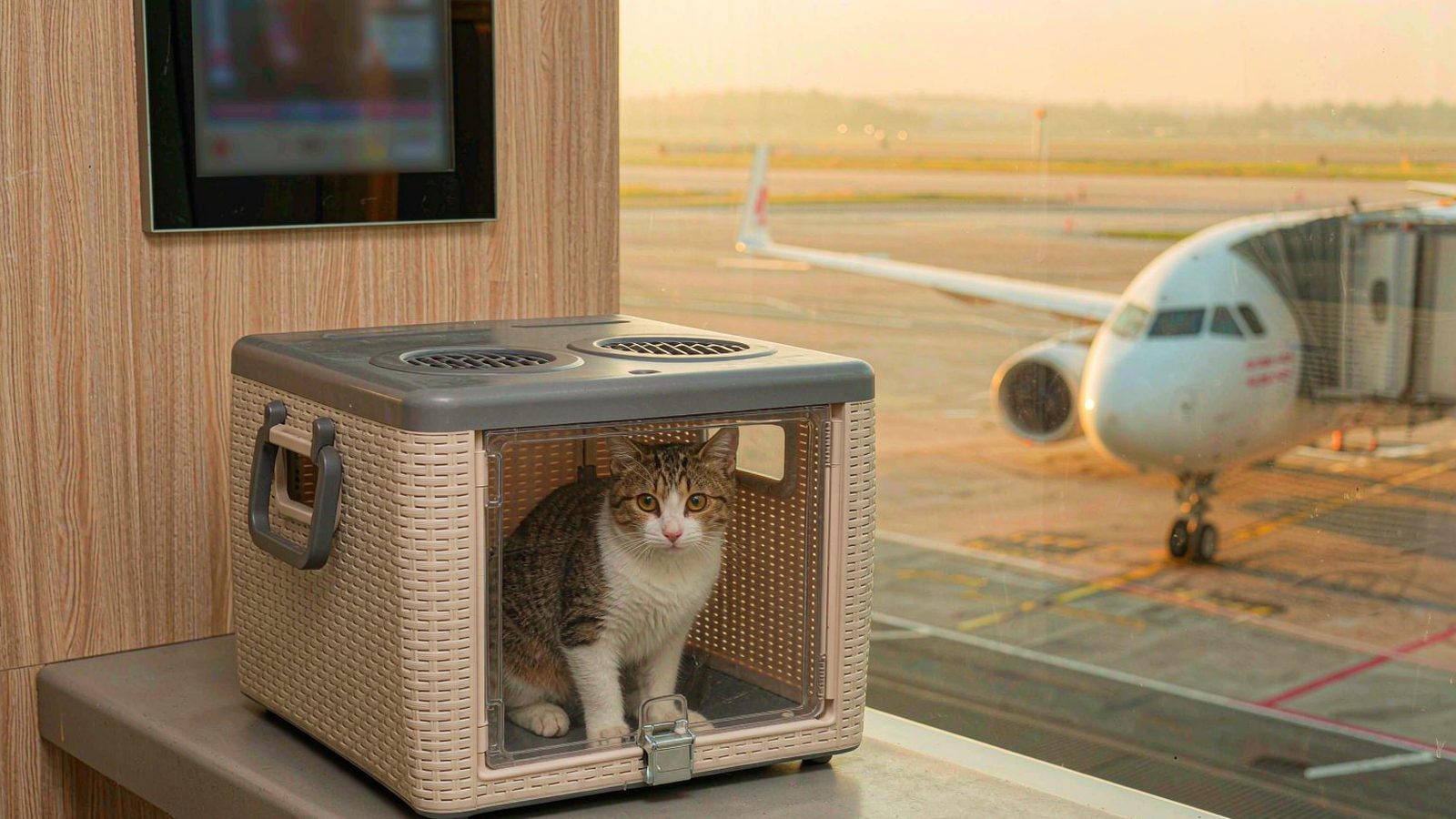
Cabin, live-animal hold or cargo, plus quarantine certificates, the 21-day rabies rule and China entry requirements.
Yes, and it is considerably easier than it was three years ago. Before 2024, pets on domestic Chinese flights almost always travelled in the temperature-controlled cargo hold. By 2026, more than ten Chinese airlines offer in-cabin pet travel: China Southern covers 35 domestic airports and 760 routes, Xiamen Airlines covers more than 270 routes and 20 popular airports, and Hainan Airlines and Tianjin Airlines have extended the service to international routes. Your pet no longer has to be baggage. It can lie in a carrier under the seat in front of you.
But permitted is not the same as smooth. Flying with a pet involves three completely different paths, namely in-cabin, checked baggage in the live-animal hold, and standalone air cargo, and each has its own paperwork, weight limits, carrier rules, fees and booking deadlines. This guide takes them one at a time and ends with a timeline you can follow directly.
First, separate the three paths
- In-cabin. The pet stays in a soft or hard carrier under the seat in front of you for the whole flight. Cats and dogs only, economy class only, and only on certain aircraft and routes.
- Checked in the live-animal hold. The pet travels as excess baggage in a pressurised, temperature-controlled hold on the same aircraft. Almost every airline offers this, and for a large dog it is the only realistic option.
- Standalone cargo. The pet flies as freight, not necessarily on your flight. This suits relocation or when you are not travelling. You need an agent licensed for live animal transport.
The eligibility rules for the three paths barely overlap. Most failures happen at booking, when nobody confirms the aircraft type and cabin, and the problem only surfaces at the airport.
In-cabin travel: the 2026 thresholds
This is the option people ask about most and misunderstand most. Details differ by airline, but the common floor is now fairly clear.
- Species and breed. Family-raised cats and dogs only. Brachycephalic breeds such as French bulldogs, pugs and Exotic Shorthair cats, and aggressive breeds such as pit bulls and Tibetan mastiffs, are not carried at all, in the cabin or the hold, because of breathing risk at altitude.
- Age and health. Usually at least eight weeks old, healthy, free of infectious disease and odour. Pregnant animals, animals within 48 hours of giving birth, and nursing animals are refused.
- Quantity. One pet per passenger, economy class only, and some aircraft types such as the C909 are excluded.
- Carrier. The common maximum is 35 x 28 x 24 cm, small enough to fit fully under the seat, ventilated, lockable, with a quick-release protective net. Most airlines require double locks and double protection.
- On board. The carrier must stay closed and no feeding is allowed. Dogs must wear a muzzle for the whole flight, and both cats and dogs must wear a diaper.
- Booking. Apply through the airline website, app or call centre 24 to 48 hours before departure and confirm that the specific flight has a cabin pet quota. Quotas are small and first come, first served.
- Cost. The mainstream market range is 1,000 to 1,600 yuan per segment, with an extra charge if a larger pet needs its own seat.
- Airport timing. Arrive two to three hours early so the check-in desk can verify documents, fit the lock and attach the net.
Checked in the hold: the realistic choice for a big dog
If your pet exceeds the cabin limits, or the route has no cabin quota, the hold is the standard solution. What matters is not the pet but the carrier and the aircraft.
- Weight. Pet plus carrier usually must not exceed 32 kg. Above that it must go as cargo, not baggage.
- Carrier. Hard plastic or metal, ventilated on three sides with at least 16 percent open area, a metal door lock and a protective net. It needs an internal water bottle and an absorbent mat, and must be large enough for the animal to stand, turn and lie down.
- Aircraft. Some holds lack oxygen or temperature control and simply cannot take animals. Give the airline the pet and carrier weight at booking so it can confirm aircraft suitability.
- Temperature. Airlines refuse transport when ground temperatures at origin, transit or destination are too high or too low. Midday summer and early morning winter flights carry the highest risk.
- Cost. Charged by distance and by combined pet-plus-carrier weight, and not counted against free baggage. China Southern, for example, charges roughly 398 to 698 yuan for up to 8 kg domestically, 498 to 798 yuan for 8 to 15 kg, and up to 1,098 yuan for 15 to 23 kg beyond 2,400 km. Always check the airline's current tariff.
The three domestic documents
Whether cabin or hold, the domestic paperwork is a fixed set of three. Missing any one stops the journey.
- Animal quarantine certificate. Issued by the county-level or higher animal health authority, obtained within three to seven days before departure, stamped with the official quarantine seal, and showing origin and destination that match the actual itinerary.
- Rabies vaccination certificate. Issued by a licensed veterinary clinic, showing that at least 21 days have passed since vaccination and that the vaccine is still valid. Vaccinating the day before travel is a common and avoidable failure.
- Airline application forms. Most carriers require a small animal transport application, and some also ask for a fitness-to-fly certificate. Submit these online, not at the counter.
One separate note: guide dogs, hearing dogs and search-and-rescue dogs follow different rules. They can usually enter the cabin without counting against the pet quota, but the airline must be notified in advance and working-dog documentation presented.
Leaving China with a pet: customs is the issuing authority
The airline is only one part of an international move. Customs issues the document that the destination country actually wants.
- Microchip. Must meet ISO 11784 and 11785, with a 15-digit numeric code. If the chip is not compliant, bring your own reader.
- Rabies vaccination. A valid record, and some destinations also require a titre test.
- Online declaration. Submit the export quarantine application through the customs service platform or the China International Trade Single Window, and book the on-site clinical examination.
- Inspection and certificate. Once documents are complete and the clinical check passes, customs issues an Animal Health Certificate. This is the core document for entry into the destination, and it usually has a validity window of around 14 days, so it cannot be obtained too early.
Destination requirements vary widely. The European Union, for example, typically requires an ISO chip and a rabies antibody titre of at least 0.5 IU/ml, with the blood sample taken after vaccination and, in most cases, a three-month wait from sampling before entry, waived where a continuous vaccination history exists. Japan, Australia and Singapore are stricter still, with timelines measured in months. These rules change, so always verify with the embassy and the destination's official veterinary authority.
Entering China with a pet: 19 designated places avoid quarantine
- Quantity. One dog or cat per person entering.
- Designated countries and regions (19). New Zealand, Australia, Fiji, French Polynesia, Hawaii, Guam, Jamaica, Iceland, the United Kingdom, Ireland, Liechtenstein, Cyprus, Portugal, Sweden, Switzerland, Japan, Singapore, Hong Kong, China, and Macao, China. With an official quarantine certificate, a vaccination certificate and a compliant microchip, the animal is released after a satisfactory on-site inspection.
- Non-designated countries and regions. In addition to those three items, a rabies antibody report from a laboratory recognised by China Customs is required, with a titre of at least 0.5 IU/ml. Complete documents plus a satisfactory inspection also mean no quarantine.
- When quarantine applies. An invalid chip, a missing or failed antibody report, or symptoms of infectious disease at inspection lead to 30 days of quarantine, and the animal must enter through one of ten ports equipped for it: Beijing Capital, Beijing West railway station, Shanghai Pudong, Shanghai Hongqiao, Shanghai railway station, Shanghai International Passenger Transport Centre, Wusongkou cruise terminal, Urumqi Diwopu, Alashankou and Guangzhou Baiyun.
- When return or destruction applies. Exceeding the quantity, missing valid quarantine or vaccination certificates, or arriving at a port without quarantine facilities when quarantine is required.
Rail is also an option
For trips under about 1,000 km, high-speed rail pet transport is worth considering. China Railway Express carries the animal in a dedicated transport box kept in a freight cabinet, monitored remotely, with water provided on request but no feeding and no visits. You are notified by text or call within an hour of arrival. You must hold an animal quarantine certificate valid on the day of carriage, with origin and destination matching your rail segment. Bookable trains must be confirmed and reserved on the 12306 platform, and quotas are limited.
A timeline you can follow directly
| When | What to do |
|---|---|
| T-30 days | Confirm the airline and aircraft carry pets; choose cabin or hold; check the breed against banned lists |
| T-21 days | Complete rabies vaccination (21 days must elapse); confirm the microchip meets ISO standards |
| T-14 days | International: complete any required antibody blood draw; book a quarantine-capable port if needed |
| T-7 days | Obtain the animal quarantine certificate; buy a carrier that meets size and ventilation rules and let the pet get used to it |
| T-3 days | International: submit the customs export declaration and book the clinical examination |
| T-2 days | Submit the cabin or hold application to the airline and get written confirmation; print two copies of everything |
| T-1 day | Reduce high-fibre food, stop feeding four hours before departure, allow small amounts of water; check locks and net |
| Departure day | Arrive two to three hours early; verify, lock and net at the counter; collect your pet promptly on arrival |
Five common myths
- Myth one: a ticket is enough. Pet transport is a separate application, unrelated to your passenger ticket. Without written airline confirmation, you will be refused at the airport.
- Myth two: brachycephalic pets are merely uncomfortable. The risk is pressure and oxygen, and these breeds are explicitly banned in both cabin and hold. Do not conceal the breed.
- Myth three: the quarantine certificate can be obtained a month ahead. Domestic carriage usually accepts only certificates issued within three to seven days of departure. Earlier means invalid.
- Myth four: a bigger carrier is more comfortable. Oversized carriers may not be securable in the hold and can be refused. The standard is enough room to stand, turn and lie down.
- Myth five: entering China always means 30 days of quarantine. With complete documents, a designated origin or a valid antibody report, a satisfactory inspection means release.
Let someone sequence the process for you
The hard part of flying a pet to China is not the animal. It is the order of operations: 21 days for the vaccine to become valid, a quarantine certificate valid for only three to seven days, a cabin quota locked 24 to 48 hours ahead, and an international antibody blood draw that has to be counted back three months. One misaligned step and the whole trip moves.
Jadetour can check the airline's pet policy, confirm whether a transit airport has quarantine facilities, and turn the timeline above into a checklist counted back from your flight date. Visas and quarantine certificates must still be handled by you through official channels; we do not provide or promise agency services. If you would like a pet-inclusive itinerary built around your route, start from our custom tour page.
Need help planning this trip?
Tell us your travel dates and group size — we reply within 24 hours.
WhatsApp +86 183 1705 8017 · WeChat 18317058017
Destinations in this guide



Related Tours



More Guides

Chengdu Travel Guide 2026: Panda Base Booking, Dujiangyan, Qingcheng and a Five-Day Route
Panda Base CNY 55 and booked ahead, Dujiangyan and Qingcheng CNY 80 each. A 2026 Chengdu guide to booking, routing, hotpot and common mistakes.
10/19/2026
Guilin Travel Guide 2026: Li River Cruises, Longji Rice Terraces and a Three-Base Route
Li River cruises from CNY 215, Longji terraces CNY 80, Elephant Trunk Hill free but booked. A 2026 guide to piers, tickets, routes and common mistakes.
10/19/2026
Beijing Travel Guide 2026: Reservations, the Great Wall and Daily Routes
Palace Museum, National Museum and Tiananmen all need timed bookings. Release times, routes and transport for 2026 in one place.
10/18/2026