
WeChat Pay for Foreign Visitors: Linking a Card, Paying by QR and Refunds Explained
China runs on QR codes. WeChat Pay now accepts international credit cards — here is the real sequence: sign-up, linking…

China runs on QR codes. WeChat Pay now accepts international credit cards — here is the real sequence: sign-up, linking a card, identity checks, the two ways to pay, the 3% fee and the 2026 waivers.
In China, what actually trips you up is rarely the language — it is paying the bill. A noodle shop, a fruit stall in a wet market, the shuttle bus at a scenic gate, even incense money at a temple: there is a QR code taped to the counter. Cash is awkward because nobody keeps change, and card terminals simply do not exist. So every visitor asks the same question: will my Visa card actually work here?
Yes. WeChat Pay has accepted international bank cards since 2019, streamlined the process sharply after 2023, and by 2026 it is one of the two payment legs visitors cannot do without (the other being Alipay). This guide walks the real sequence: sign-up, linking a card, identity verification, paying, saving money, refunds — and the points where people get stuck.
Last updated: September 2026. Fees and limits change; always check the live notice inside the WeChat app.
1. What WeChat Pay allows a foreign visitor to do
- Sign up: a non-Chinese mobile number is enough — no Chinese SIM required. Identity verification accepts six document types, including a passport, the Mainland Travel Permit for Hong Kong and Macao Residents, the Mainland Travel Permit for Taiwan Residents, and the Foreign Permanent Resident ID Card.
- Link a card: cards issued by Visa, Mastercard, American Express, JCB, Discover and Diners Club. Important: cards issued outside mainland China can only be linked if they are credit cards — a pure debit card will not work.
- Pay: offline at restaurants, transport, supermarkets, attractions, hotels and hospitals; online inside selected Chinese apps. Visitors from 13 countries and regions can also use more than 40 overseas e-wallets to scan a WeChat Pay QR code directly, with no card linking at all.
- Get help in your language: WeChat Pay has expanded its QR payment guidance to 16 languages, including English, Thai, Korean, Russian, Spanish and Arabic. Support hotline: 95017.
2. Ten minutes before you fly: sign-up and linking in six steps
The smart move is to install, register and link before departure. Doing it after landing means fumbling at a checkout counter while a queue builds behind you.
- Download and register: search WeChat on the App Store or Google Play. Tap Sign Up, then Sign up with mobile, pick your region code, enter your overseas number and set a password. One number, one account.
- Find the wallet: Me (bottom right) then Services, Wallet, Cards, Add a Card. If the entry point is missing, go to Me, Settings, General, Tools, then Weixin Pay and tap Enable.
- Enter card details: card number, card organisation, expiry and CVN2. Cards issued in the United States and Canada also require billing address verification. You can only link a card in your own name, and the name must match the card exactly.
- SMS verification: enter the code your bank sends to complete the link.
- Set a 6-digit payment password: used for every payment from then on.
- Complete identity verification: upload a photo of your passport data page plus a clear selfie. It normally clears automatically within minutes. Until this is done, a linked card still cannot pay.
3. Identity verification: the step that gets rejected most
Have four things ready: your passport number, your name written exactly as it appears on the document (capitalisation and punctuation included), a phone number that can receive SMS, and photos of the document plus a selfie. Nine failures out of ten come down to one cause — the name does not match the passport. An extra space, a missing hyphen, an omitted middle name: any of these will bounce it back. Check character by character against the machine-readable strip before you submit.
4. There are only two payment gestures
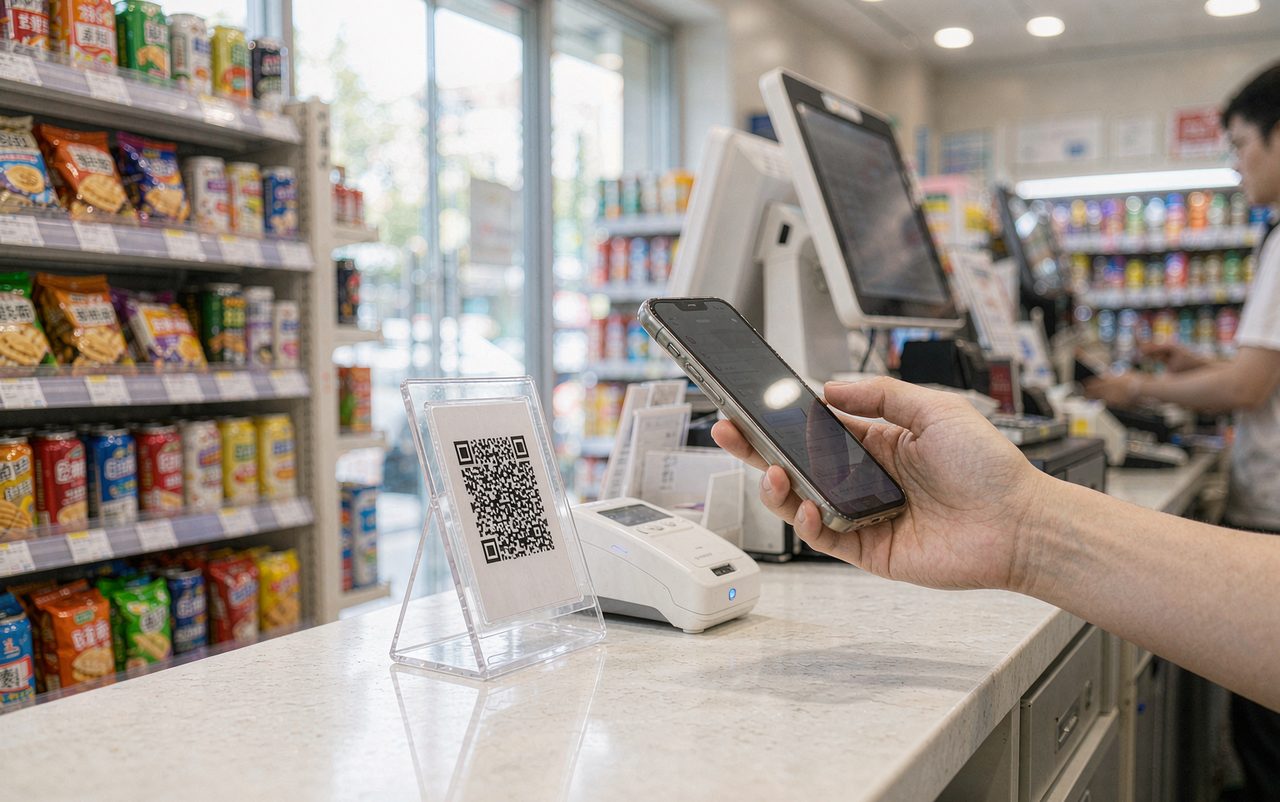
- The merchant scans you (payment code): tap + in the top right, then Money, and let the cashier scan the barcode or QR code on your screen. Enter your 6-digit password. Fastest option — the norm in convenience stores, supermarkets and chain restaurants.
- You scan the merchant (Scan): tap +, then Scan, point at the QR code on the counter or table and type the amount yourself before confirming. This covers street stalls, wet markets, taxis and small shops at scenic sites.
- Pay inside an app: Chinese apps such as Didi, Meituan and Ctrip let you choose WeChat Pay at checkout, with no scanning at all.
- Receive money: + then Money, then Receive Money, for transfers between travelling companions.
One caveat: a few small stalls only display a personal transfer code, which an overseas card may not be able to pay. Move to the next stall, or simply use cash — which is why keeping a little cash as a safety net is still sensible, especially on mountain, village or early-morning market days.
5. Fees, limits and refunds
| Item | Rule in 2026 |
|---|---|
| Single payment of RMB 200 or less | No international card fee |
| Single payment above RMB 200 | 3% of the transaction amount |
| Per-transaction limit | RMB 6,000 |
| Monthly cumulative limit | RMB 50,000 |
| Annual cumulative limit | RMB 60,000 |
| Refunds | Returned to the original card, with the fee refunded pro rata |
- How to save: because payments of RMB 200 or less carry no fee, splitting a larger bill into smaller payments — if the merchant agrees — avoids the 3% entirely.
- Exchange rate: calculated at the rate set by the card organisation and your issuing bank. WeChat adds nothing, but your bank may charge roughly 1.5% for an overseas transaction.
- Refund timing: back to the original card, typically within 3 to 15 working days.
6. Two pieces of good news for 2026
- First-time linking offer: until 31 December 2026, users who link an international bank card to WeChat for the first time receive a 3% fee waiver for 90 consecutive days, on up to RMB 1,000 per day, after their first purchase.
- Small payments stay free: throughout 2026, all international card users continue to pay no 3% fee on transactions of RMB 200 or less.
- WeChat Pay is now connected with PayPal World, letting global PayPal users pay at tens of millions of WeChat Pay merchants in China. Its overseas wallet network covers more than 40 wallets across 13 countries and regions.
7. WeChat Pay or Alipay?
The short answer: install both, but WeChat is essential. WeChat wins on ecosystem — you will already be using it to reach drivers, guides and restaurants, so paying is just the same app. Alipay wins on onboarding for overseas cards and on a more complete English interface, and tends to be more reliable for very small amounts.
The most robust combination is Alipay + WeChat Pay + a physical Visa or Mastercard. Use the physical card for larger spends such as hotels, high-speed rail tickets and flights (which also often avoids the 3% fee), and scan for meals, taxis, tickets and bottled water. If one app will not work at a small stall, the other usually will.
8. Frequently asked questions
Can I sign up without a Chinese phone number?
Yes. WeChat accepts overseas numbers and SMS verification. That said, drivers and delivery riders often call to confirm, so buying a local SIM after arrival makes life easier — useful for ride-hailing and food delivery, though not required for paying.
What if linking my card keeps failing?
Three usual causes: the card is not enabled for overseas or online transactions; the bank blocked it as a security precaution; or your name does not match the passport. Call your bank to enable overseas online transactions, or try a different card.
How many cards can I link?
Several cards under the same verified identity, up to the limit shown in the app. Keep at least two so you can switch instantly if one is blocked.
Is it safe?
WeChat Pay uses dynamic codes, so a screenshot is useless, and larger amounts require your 6-digit password. Turn on fingerprint or face unlock, and tell your bank before you travel that you are going to China so your first payment is not declined.
How do I unlink or close the account?
Unlink: Me, WeChat Pay, Cards, select the card, then the "..." menu, then Unlink. Close: Me, WeChat Pay, the "..." menu, then WeChat Pay Cancellation. Once cancelled, your cardholder profile, transaction history, balance and balance details are erased permanently, so spend or withdraw the balance first.
What about money left in the wallet?
Balances usually come from transfers. You can spend it or withdraw it to a linked bank card, depending on whether your bank supports withdrawal. It is best to finish the balance before leaving China.
Let us sort out the paying part before you land
Jadetour has looked after inbound travellers for over a decade, with bilingual advisers on both Chinese and English. Before you arrive we can help you install, link and verify WeChat Pay and Alipay, book high-speed rail and attraction tickets, arrange private cars with Chinese or English speaking guides, and leave you a contact who always answers. Chongqing, Sichuan, Beijing, Xi'an, Zhangjiajie, Wulong and Pengshui can all be tailored to your dates.
Need help planning this trip?
Tell us your travel dates and group size — we reply within 24 hours.
WhatsApp +86 183 1705 8017 · WeChat 18317058017
Destinations in this guide


Related Tours



More Guides

Flying with a Pet to and from China: Cabin, Hold and Quarantine in 2026
Cabin, live-animal hold or cargo, plus quarantine certificates, the 21-day rabies rule and China entry requirements.
10/17/2026
Solo Female Travel in China: Safety, Night Transport and a 2026 Checklist
Registration, late-night rides, payments and emergency numbers: a practical 2026 checklist for women travelling alone in China.
10/17/2026
Student Travel in China: 2026 Rail Fare Rules and the Best Hands-On Activities by City
A practical guide to study tours in China: 2026 rail student fare scope, visa-free basis for camps, hands-on activities by city, and group safety standards.
10/16/2026