
Eating on Chinese Trains and Cruise Boats: Seat Delivery, 15 CNY Meal Boxes and Cruise Meal Plans
Three ways to eat on Chinese trains, the rules behind 12306 seat delivery, the 15 CNY meal-box floor, and a line-by-lin…
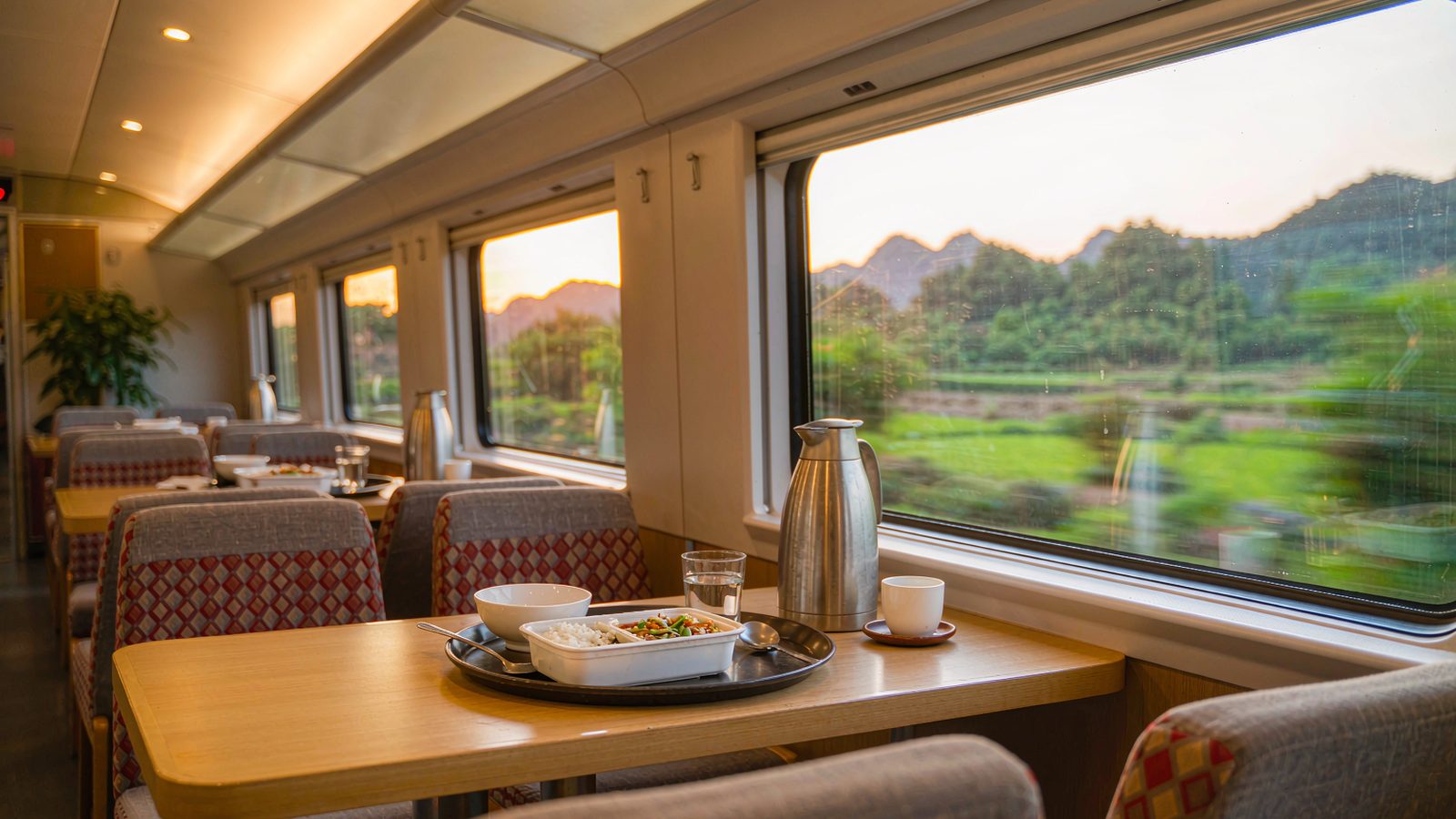
Three ways to eat on Chinese trains, the rules behind 12306 seat delivery, the 15 CNY meal-box floor, and a line-by-line breakdown of what Li River and Yangtze cruise fares include.
How meals work on Chinese trains and river cruise boats is one of the least clearly answered questions travellers ask before a China trip. Is train food overpriced? Can you really have a restaurant meal delivered to your seat? Does a Yangtze cruise fare include every meal? Is the buffet on the Li River boat worth it? The answers have shifted noticeably in the last two years, especially on rail, where the delivery network now reaches far more stations than most older guides suggest.
This guide separates the two settings. First, trains: the three ways to eat on board, what each costs, and the rules that decide whether you can still order. Then cruise boats: how meals are structured on Li River day cruises and on multi-day Yangtze Three Gorges sailings. By the end you should be able to work out how much extra food budget a given train or boat actually requires.
1. Three ways to eat on a Chinese train
On board, there are only three practical routes, and they can be combined freely. The price gap between them is large.
- Dining car and trolley meals — a crew member pushes a cart through each carriage, or you walk to the dining car. Most convenient, highest price.
- Online delivery to your seat — you order from a restaurant at a station along the route, staff hand the meal over on the platform, and a crew member brings it to your seat. Currently the best overall experience.
- Bring your own food and use the free hot water — Chinese stations and trains both allow passengers to carry their own food, and every carriage has free boiling water.
The bring-your-own route costs the least. Most carriages have a water boiler at one end, supplying free boiling water around the clock — a genuinely useful Chinese rail tradition. Pack a vacuum flask or a lidded cup, plus tea bags or instant coffee. One caution: instant noodles are permitted, but the smell is strong in a sealed carriage and crew may ask you to avoid disturbing others, especially on high-speed trains. If that matters to you, cold food such as sandwiches, bread, fruit, nuts and yoghurt is the safer choice.
2. High-speed train meal boxes: a 15 yuan floor and a 60 yuan habit
Many travellers assume high-speed train food is simply expensive and poor. There is truth in that, but the picture is incomplete, because a price floor does exist.
China Railway requires every high-speed train set to carry main meals and packaged food at 15 yuan or less, and forbids hiding them: the cheap tier has to sit visibly in the dining car display. In practice, crew pushing the trolley usually offer the 30 to 60 yuan sets first, so the 15 yuan option often has to be requested directly. If your budget is tight, asking "is there a 15 yuan meal box?" works — unless it has genuinely sold out.
| How to buy | Price range | Notes |
|---|---|---|
| Online delivery (stations en route) | 20–60 CNY plus a flat 8 CNY delivery fee | Chain brands and local specialities, delivered to your seat; order at least 1 hour ahead |
| Dining car meal box | 15–60 CNY | Walk-up purchase, no advance planning; mostly chilled ready meals, limited choice |
| Onboard self-operated menu | 15–50 CNY | Meal boxes, congee and noodles; some trains carry snacks from about 5 CNY |
| Station pickup | 15–40 CNY | Same prices as city branches and the widest choice — but you must leave the train, which risks missing it |
| Bring your own | Your own cost | Full control, mostly cold food, paired with the free hot water |
Why are the meal boxes pricier than in the old green trains? Because open flame is banned inside high-speed carriages. There is no cook on board: meals are prepared in central kitchens in the city, delivered chilled to the train, and reheated. Cold-chain logistics, packaging and spoilage are all priced in. Industry figures put the onboard dining rate on high-speed trains at roughly 4 percent — on a full train of a thousand passengers, often fewer than forty buy a meal box. That ratio explains both the cautious stocking and the pricing.
3. Online delivery: how, when, and when it gets refunded
Online delivery is the area that has changed most, and it is what we recommend to guests most often. As of 2026, railway online catering covers 94 stations nationwide, spanning major hubs and high-traffic stations, and the Railway Easy Travel QR code is available on all high-speed train sets.
It takes five steps on your phone:
- Open the official 12306 app and go to the Dining & Local Specialities section. Alternatively, scan the QR code on your seat armrest — the system matches your current train automatically, so no manual entry.
- Confirm your train number and travel date. Every station along the route that offers delivery, and its partner merchants, will be listed.
- Choose the station where you want to eat, and enter your carriage and seat numbers.
- Pay. Options include meals from the train's own dining car as well as local specialities and chain restaurants at the stations along the way.
- Wait for delivery. The merchant or station delivery centre brings the food to the platform, hands it to train staff on arrival, and a crew member carries it to your seat.
Four rules to remember:
- Order at least 1 hour in advance. Popular merchants sell out, and around public holidays we suggest ordering a day or more ahead. Some merchants accept bookings several days in advance.
- The delivery fee is a flat 8 CNY nationwide, regardless of distance.
- You can cancel online up to 1 hour before departure. After the cut-off, or once the train has departed, cancellation is not possible.
- If the train is cancelled or delayed by more than 30 minutes, the order is refunded automatically. Passengers holding standing tickets should wait in the carriage area marked on their ticket, or collect the order from the dining car using the last digits of the order phone number.
Guilin North Station shows how precise this has become: merchants finish packing 30 minutes before the train arrives, deliver to the platform 10 minutes before, hand over to the dining car attendant on arrival, and the meal reaches the passenger within 10 minutes of departure. After ordering, the app also shows the estimated delivery time and the deadline for free cancellation.
4. Li River cruises: three, four and five star boats differ by more than seats
The Li River between Guilin and Yangshuo is a highlight of most itineraries, and the boat class decides directly whether lunch is included and how good it is. The full Guilin to Yangshuo sailing takes about 4 to 4.5 hours, so lunch on board is unavoidable — which means this choice has to be made before departure, not on the day.
| Boat class | 2026 reference fare | Meal included | Notes |
|---|---|---|---|
| Three star | 215 CNY per person (child approx. 108 CNY) | No | Departs Mopanshan pier; onboard meal box 30–50 CNY extra |
| Four star | 360 CNY per person | Buffet lunch included | Departs Zhujiang pier; wider seats, private toilets, business waiting lounge included |
| Five star | From about 1,200 CNY per person | Deluxe buffet included | Private transfer to the pier, small passenger count, high service ratio |
| Yangdi–Xingping raft | 118–255 CNY per person | No | Four people per raft, empty-seat fee if fewer; children under 1.2 m and guests over 65 may not ride |
The fare breakdown is worth knowing. The three star fare of 215 CNY comprises a 54 CNY scenic-area ticket and a 161 CNY boat ticket; the extra you pay for four star buys wider seats, private toilets, full commentary and that buffet lunch. The conclusion is straightforward: for families with children or older travellers, the four star boat is the best value, because it removes the two things most likely to go wrong — queueing for a meal box and hunting for a toilet. Younger travellers wanting to be close to the water are better served by a raft, but do arrange companions in advance to fill four seats.
Two practical warnings. First, the cruise is one-way: it departs from Mopanshan or Zhujiang pier near Guilin and ends at Longtoushan pier in Yangshuo, and vehicles cannot follow, so self-driving guests must plan how to retrieve their car. Second, the onboard photography service mostly produces standard souvenir shots; there is no obligation to buy.
5. Yangtze Three Gorges cruises: what "all inclusive" really covers
Multi-day Yangtze cruises work differently. The ticket is normally sold as a package covering accommodation, meals, attraction tickets and guiding, which looks expensive but is often simpler than independent travel once itemised. The two main routings are Chongqing to Yichang downstream (4 days, 3 nights) and Yichang to Chongqing upstream (5 days, 4 nights).
Typically included:
- Accommodation — 3 or 4 nights in the cabin category booked.
- Meals — commonly 3 breakfasts and 5 main meals, or 4 and 7, mostly buffet; some ships add a light supper or cocktail reception on boarding day.
- Attraction tickets — the sites listed in the itinerary, usually with an A or B option.
- Service — scenic-area guiding plus an onboard guide.
- Extras — pier luggage handling and onboard entertainment.
Typically excluded:
- Breakfast and lunch on boarding day, and dinner on disembarkation day — these are taken ashore at your own cost.
- Transport to and from the departure city — flights or train tickets to Chongqing or Yichang.
- The Three Gorges Dam ship lift, listed by most ships as an optional extra, reference price 380 CNY per person.
- Personal spending — drinks, laundry, massage, karaoke, card rooms.
- Deck or cabin upgrades.
- Local transport inside scenic areas, such as the Three Gorges Dam shuttle bus at about 10 CNY per person.
On pricing, 2026 fares for the Chongqing–Yichang 4 day, 3 night route span a wide range, from roughly 1,800 CNY to 4,500 CNY per person. The difference comes mainly from ship age, cabin class, meal standard and whether the fare is genuinely all inclusive. One well-known ship, for instance, lists a family river-view cabin sleeping three at about 4,499 CNY per person and states explicitly that the ship lift visit is included. Newer electric-propulsion vessels such as the Yangtze No.3 and the Star Athena start lower and add family-friendly features including a children's play area and a swimming pool.
Cancellation rules vary widely between operators, and holiday or charter sailings are usually non-refundable and non-changeable. Some ships allow free cancellation more than 22 days before sailing, charge 20 percent between 21 and 15 days, and 100 percent within 14 days; others use 180, 60 and 30 day tiers. Confirm the operator's cancellation terms line by line and have them written into your tour contract — do not judge on the headline price alone.
6. Special diets: vegetarian, halal and allergies
Adaptation for special diets is improving on Chinese trains and cruise buffets, but flexibility remains limited, so advance notice is the only reliable method.
- Vegetarian — Yangtze buffets and the four star Li River buffet usually offer vegetables, tofu and soy products, rice, noodles and fruit, enough to eat well but with limited variety. Strict vegans should request the diet when booking. High-speed meal boxes offer very few vegetarian options; bringing your own is the safest route.
- Halal — stations and some dining cars on northwestern routes carry halal-labelled food; on Yangtze cruises you must ask the ship in advance. Routes through Xi'an, Lanzhou or Urumqi offer noticeably more halal restaurants.
- Children and allergies — if your child is allergic to egg, seafood or nuts, tell us and the guide at the itinerary confirmation stage so the note reaches restaurants and the ship. On buffets, avoid sauces and cold dishes whose ingredients are unclear.
- Taste preferences — train and cruise food tends to be saltier, oilier and spicier than most European and North American guests expect. Carrying a small bottle of chilli sauce or seasoning often improves the whole trip noticeably.
7. Six practical suggestions for Jadetour guests
- Check which stations along your route offer delivery before departure, especially on long-distance trains. Enter the train number in the 12306 app; ordering a day ahead gives the widest choice.
- Allow at least one hour of lead time on board. Miss the cut-off and you are limited to what the trolley still carries.
- Bring a vacuum flask. Free boiling water is the single most useful service on Chinese railways, and the money saved on drinks pays for a meal.
- For cruise tickets, focus on what is included and excluded, not the starting price. Add the two excluded meals and the optional ship lift to see the true cost.
- On the Li River, choose the four star boat if travelling with children or older guests — the extra hundred-odd yuan buys convenience.
- Always declare special diets early. Raised at confirmation stage we can pass the note to restaurants and the ship; raised after boarding, it is often too late.
Eating on trains and cruise boats is essentially a competition in preparation: those who know the rules in advance spend less and eat better, while those who decide on the spot accept whatever is left on the trolley. If you would like us to build this into your itinerary — which day needs an order placed, which meal to bring your own, which boat includes meals — tell us during planning and we will check timings and budget together. You can design a tailor-made tour or simply contact us.
Need help planning this trip?
Tell us your travel dates and group size — we reply within 24 hours.
WhatsApp +86 183 1705 8017 · WeChat 18317058017
Destinations in this guide


Related Tours



More Guides
Flying with a Pet to and from China: Cabin, Hold and Quarantine in 2026
Cabin, live-animal hold or cargo, plus quarantine certificates, the 21-day rabies rule and China entry requirements.
10/17/2026
Solo Female Travel in China: Safety, Night Transport and a 2026 Checklist
Registration, late-night rides, payments and emergency numbers: a practical 2026 checklist for women travelling alone in China.
10/17/2026
Student Travel in China: 2026 Rail Fare Rules and the Best Hands-On Activities by City
A practical guide to study tours in China: 2026 rail student fare scope, visa-free basis for camps, hands-on activities by city, and group safety standards.
10/16/2026