
Departure Procedures for Flights in China: Check-in Cut-offs, Transfers and Missed Flights
Domestic check-in closes 30 to 45 minutes before departure and international 45 to 60 minutes; gates shut 15 to 20 minu…
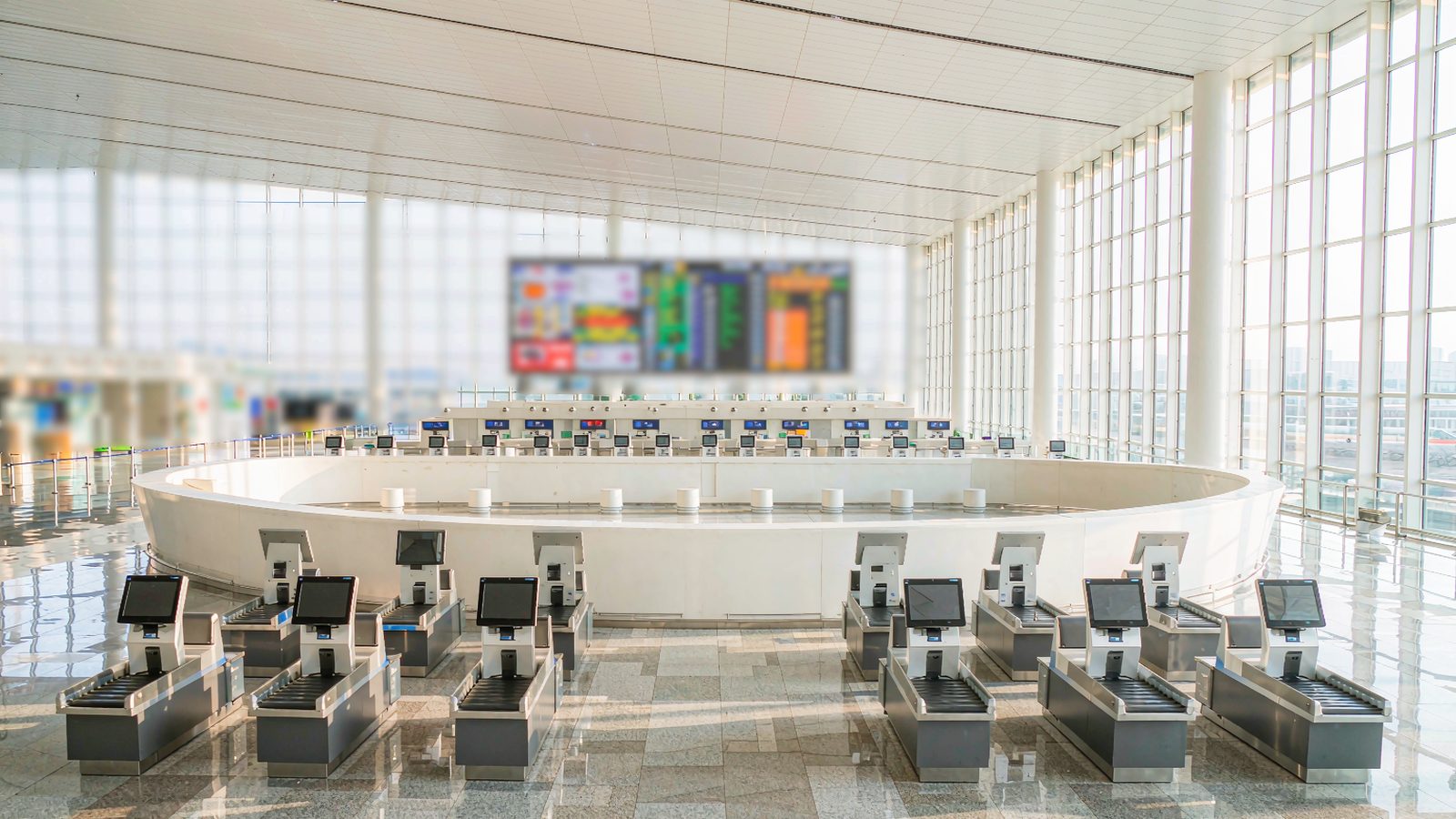
Domestic check-in closes 30 to 45 minutes before departure and international 45 to 60 minutes; gates shut 15 to 20 minutes prior. One-ID boarding, through-checked baggage and missed-flight rules.
When people miss flights in China it is rarely because they set off too late. It is almost always a miscalculation: they assume formalities are open until the aircraft departs, when in fact check-in has already closed; or they assume check-in and boarding are the same thing, then discover the gate is a fifteen-minute walk away. What actually decides whether you fly are a few firm cut-off points.
This guide sets out the whole departure process: the full sequence for domestic flights and for international and regional flights, the check-in cut-off times actually in force at hub airports in 2026, how paperless and biometric boarding has developed, baggage through-check and minimum connection times for transfers, and how missed flights, wrong flights and no-shows are each handled and what they cost.
1. Four things to settle before you leave for the airport
- Check document validity. Domestic flights accept a resident identity card or a temporary one; international flights need a passport, plus confirmation that the visa or entry permit the destination requires is still valid. Being refused carriage because your documents do not comply counts as a passenger-caused missed flight, and the consequences are yours.
- Check in online and choose a seat early. Most airlines open online check-in 48 to 24 hours before departure. On long sectors take a front-row or aisle seat. Bassinets, wheelchairs and other special services must be requested at booking or in advance; they generally cannot be arranged at the airport.
- Declare special passengers in advance. Infants, children including unaccompanied minors, pregnant passengers, elderly passengers, passengers with injuries or illness, and wheelchair users all require formalities under the carrier's rules, and a carrier may refuse carriage if they are not completed.
- Read the fare conditions. Deep-discount tickets often state that they cannot be refunded or changed. The small print on the booking page determines the cost of every later change.
2. How much time to allow at the airport
- Domestic flights: arrive two hours before departure. There is a concrete reason. Once check-in closes, the airport and airline must complete more than a dozen fixed-duration tasks: passenger and baggage reconciliation, weight and balance calculation, baggage screening and loading, engineering checks, cabin preparation and air traffic clearance.
- International and regional flights: arrive three hours before departure. The extra hour goes to customs, border inspection and quarantine, none of which can be compressed.
- If you are travelling with an infant, pushing a stroller, accompanying elderly relatives, checking bulky baggage, or departing from a major hub such as Beijing, Shanghai, Guangzhou, Chengdu or Shenzhen, add another 30 minutes.
- If you arrive at the airport by high-speed rail or metro, check the cut-off time at the ground transportation centre. Some airports allow check-in and baggage drop there, but the cut-off is earlier than in the terminal.
3. The domestic departure process
- Check in. Use a staffed counter, a self-service kiosk, or the airline's app or mini-program, and collect a boarding pass or generate a mobile one. Anyone with checked baggage must still use a counter or a self-service bag drop.
- Check your baggage. Oversized, over-count and overweight items will be redirected to the hold and may undergo a second screening. Power banks, lithium batteries and spare batteries may never go into checked baggage and must stay with you.
- Security screening. Show your boarding pass and identity document. Liquids must be in containers of no more than 100 ml each with a total of no more than one litre, and laptops, power banks, umbrellas and liquids must be presented separately.
- Wait at the gate. Follow the gate shown on your boarding pass and watch the screens and announcements. Gates do change at short notice, especially at large hubs.
- Board. Gates generally close 15 to 20 minutes before departure. Arriving at the gate after that means you cannot board.
- Depart. Take your seat and fasten your belt. If you have checked in but do not board, you are treated as a no-show and the unused portion of the ticket is normally not refundable.
4. The three extra checks on international and regional flights
The sequence matches the domestic one but adds three linked inspection stages on the outbound side:
- Customs — inspecting dutiable goods, excess cash (amounts above 20,000 yuan, or the equivalent of 5,000 US dollars in foreign currency, must be declared) and prohibited or restricted items.
- Quarantine, including health inspection — temperature checks and health declaration verification, with intensified surveillance of priority infectious diseases at certain times.
- Border inspection on departure — confirming that your passport, visa or other entry permit is valid and meets the destination's requirements.
The order of these stages varies between airports; some handle customs alongside pre-security. Follow the signage and staff instructions on site. One warning worth repeating: even where the destination grants visa-free entry or a visa on arrival, you may still be asked to show a return ticket, hotel booking or electronic arrival card. Have those documents ready and within easy reach.
5. Check-in cut-off times actually in force in 2026
The cut-off is the last moment at which check-in and baggage acceptance are available. Once it passes, the system closes and no boarding-related formality can be completed. Practice varies widely between airports and carriers; the table shows typical ranges with real examples.
| Flight type | Typical cut-off | Examples in force in 2026 |
|---|---|---|
| Domestic, staffed counter | 30 to 45 minutes before departure | Shanghai Hongqiao: all domestic flights including checked baggage now cut off within 30 minutes; Haikou Meilan staffed counter 35 minutes; Qingdao terminal counter 30 minutes |
| Domestic, self-service | 30 to 50 minutes before departure | Haikou Meilan self-service check-in 50 minutes; Qingdao terminal self-service 50 minutes; some ground transportation centres 60 minutes |
| International and regional | 45 to 60 minutes before departure | Shanghai Hongqiao: 45 minutes for most carriers, 40 minutes for Cathay Pacific, Air Macau, Korean Air, Asiana, Hong Kong Airlines, China Eastern and Shanghai Airlines; Haikou Meilan staffed counter 45 minutes |
| Gate closing | 15 to 20 minutes before departure | Standard practice across airports |
Two trends are worth noting. First, hub airports keep shortening cut-off times. Shanghai Hongqiao has applied a uniform 30-minute cut-off to all domestic flights including checked baggage since 29 June 2026, and China Eastern, Shanghai Airlines and China United have launched a service allowing passengers with no checked baggage to complete check-in, security and boarding 15 minutes before departure. Second, these services come with conditions — specific carriers, no checked baggage, originating airport only — so they are not general rules. Planning for two hours remains the safe approach.
6. Paperless and biometric boarding: the new normal in 2026
- Mobile boarding passes are now standard. Once you check in through an airline app or mini-program you can generate a QR boarding pass, scanned at both security and the gate. Passengers with checked baggage must still visit a counter or self-service bag drop first.
- Self-service check-in, bag drop and boarding now form a closed loop. At Shanghai Hongqiao in 2025, self-service accounted for 76 percent of check-ins, 33 percent of bag drops and 73 percent of boardings; the average self-service boarding took about 5.5 seconds, and 250 passengers on a wide-body flight boarded in 12 minutes, five to six minutes faster than the traditional process.
- One-ID facial recognition has reached international and regional flights. On 26 June 2026 Shanghai Hongqiao International Airport launched full-process One ID for international and regional flights, creating a unique identity from facial features so that, once the passenger authorises it, check-in, clearance and boarding can all be completed by face. It was the first airport in mainland China to cover the whole international and regional departure flow. The first carriers to support it were China Eastern, Shanghai Airlines, Hong Kong Airlines and Air Macau. No prior registration or app download is needed, and gate boarding by face takes about three seconds.
- Similar upgrades are spreading. Terminal 5 at Xi'an Xianyang introduced full-process facial recognition for check-in, bag drop, security and boarding in July 2026; Shenzhen Airport optimised its self-boarding gates during the 2026 Spring Festival travel period, improving throughput by about 30 percent; Shanghai Pudong plans to complete a fully self-service route in the Terminal 2 international and regional departure area, with eight gates converted, by the end of 2026.
- Facial recognition is not universal. Passengers whose appearance has changed significantly, for example after cosmetic surgery, are routed to manual verification, so carry your original documents anyway.
7. Transfers: through-flights, connections and minimum connection times
- Through-flights (one payment, one check-in, one security check, through-checked baggage): the best form of transfer. You receive all boarding passes at the origin airport, baggage is checked to the final destination, and at the transfer airport you neither reclaim baggage nor repeat security if you stay airside.
- Connecting flights: usually offer at least one convenience such as a single payment or a single check-in, but whether baggage is through-checked depends on the specific product.
- Self-arranged transfers on separate tickets: neither sector is responsible for the other. If the first sector is delayed and you miss the second, the second carrier bears no liability, and you must reclaim and re-check your baggage. Unless the price gap is very large, avoid it.
- Minimum connection time (MCT): the shortest time the airport and airlines need to move passengers and baggage from one flight to the next. It differs by airport. Always confirm that your connection exceeds the airport's MCT and leave extra buffer.
- Cross-airport transfers need special care: Beijing Capital (PEK) and Daxing (PKX), Shanghai Pudong (PVG) and Hongqiao (SHA), and Chengdu Shuangliu (CTU) and Tianfu (TFU) are separate airports. Moving between them takes hours, so never build such a transfer into a single ticket.
One rule catches people out: the sectors of a ticket must be used in sequence. If you skip a sector for your own reasons, for example abandoning the first leg to take the second, the carrier may refuse check-in and boarding, and the unused portion usually refunds only the airport construction fee and fuel surcharge.
8. Missed flights, wrong flights and no-shows: three cases, three outcomes
| Situation | Responsible party | Handling | Cost |
|---|---|---|---|
| Cancellation, mechanical fault, crew issue or widespread delay prevents travel | Airline | Involuntary: full refund or free rebooking to a later flight | No fee |
| You arrive late, have a document problem or go to the wrong airport | Passenger | Governed by the fare conditions; rebooking depends on seat availability | Per the fare rules; deep-discount tickets may refund taxes only |
| Wrong airport or wrong direction booked | Mainly passenger | For genuine mis-bookings some carriers accept an application within 24 hours of purchase and more than a week before departure, processing it as an involuntary refund | Free if eligible, otherwise involuntary refund rules do not apply |
| An earlier flight delays you and you miss the connection on one through ticket | Airline | Treated as involuntary: free rebooking or refund | No fee |
| Checked in but did not board (no-show) | Passenger | The unused portion of the fare and taxes are normally not refunded | Loss of the fare |
Two things to do immediately after missing a flight: contact the original booking channel or the airline to establish whether rebooking is possible and at what cost, and complete the missed-flight confirmation the carrier requires. Note too that a sudden illness affecting you or an immediate family member is grounds for a discretionary waiver, and a hospital certificate can reduce or remove the fee.
9. How change and refund charges are structured
There is no need to memorise the tables, but understand the two-axis logic: the further from departure, the lower the rate; the deeper the discount, the higher the rate.
- Time axis. Common bands are more than 14 days before departure, 14 to 7 days, 7 days to 48 hours, 48 hours to 4 hours, and 4 hours or less through to after departure. Rates rise as you move down the list.
- Fare-class axis. Under one carrier's domestic rules dated August 2026, a full-fare economy ticket (class Y) refunded between four hours before departure and after departure carries a 10 percent charge, while a heavily discounted class H ticket in the same window carries up to 60 percent. Two adjacent fare classes on the same flight can differ several-fold.
- Connecting and transfer products are usually stricter. Some explicitly forbid voluntary date changes, so a change is processed as a voluntary refund.
- One near-universal rule: a change fee already collected is not returned if you later refund the ticket.
10. Eight practical tips that save time and money
- Watch the cut-off, not the departure time. The cut-off is your real deadline.
- Two hours for domestic, three for international. Do not cut it fine.
- Keep power banks with you and clearly labelled. Checking them in is a breach, and unmarked units are refused.
- Prefer connections on a single ticket. Only then do you have involuntary rebooking rights if the first leg is delayed.
- Mind the airport codes. PEK and PKX, PVG and SHA, CTU and TFU are separate airports.
- Prepare a return ticket and hotel booking before an international departure. Visa-free and visa-on-arrival passengers may be asked for them.
- A lost identity card is not fatal. Apply for a temporary flight permit through the civil aviation mini-program on WeChat or Alipay, or obtain a paper permit from the airport police office.
- Use sectors in sequence. Skipping one forfeits the value of the later ones.
11. Build the departure process into the itinerary
On multi-city trips almost every real risk sits at the airport connections: two airports in one city, insufficient transfer time, an early delay cascading into the next sector. Jadetour's tailor-made itinerary service calculates airports, connection times and ground transfers as part of the routing, so a timetable that looks reasonable on paper does not turn into a missed flight. Send your travel dates, party size and city order to contact us and we will work out the timings with you in advance.
Need help planning this trip?
Tell us your travel dates and group size — we reply within 24 hours.
WhatsApp +86 183 1705 8017 · WeChat 18317058017
Destinations in this guide




Related Tours



More Guides
Flying with a Pet to and from China: Cabin, Hold and Quarantine in 2026
Cabin, live-animal hold or cargo, plus quarantine certificates, the 21-day rabies rule and China entry requirements.
10/17/2026
Solo Female Travel in China: Safety, Night Transport and a 2026 Checklist
Registration, late-night rides, payments and emergency numbers: a practical 2026 checklist for women travelling alone in China.
10/17/2026
Student Travel in China: 2026 Rail Fare Rules and the Best Hands-On Activities by City
A practical guide to study tours in China: 2026 rail student fare scope, visa-free basis for camps, hands-on activities by city, and group safety standards.
10/16/2026