
China Hotel Room Types Explained: Twin vs Double, Suites and Single Supplement
Chinese hotel rooms fall into rooms and suites, with five basic room types and four suite tiers. Twin means two single…
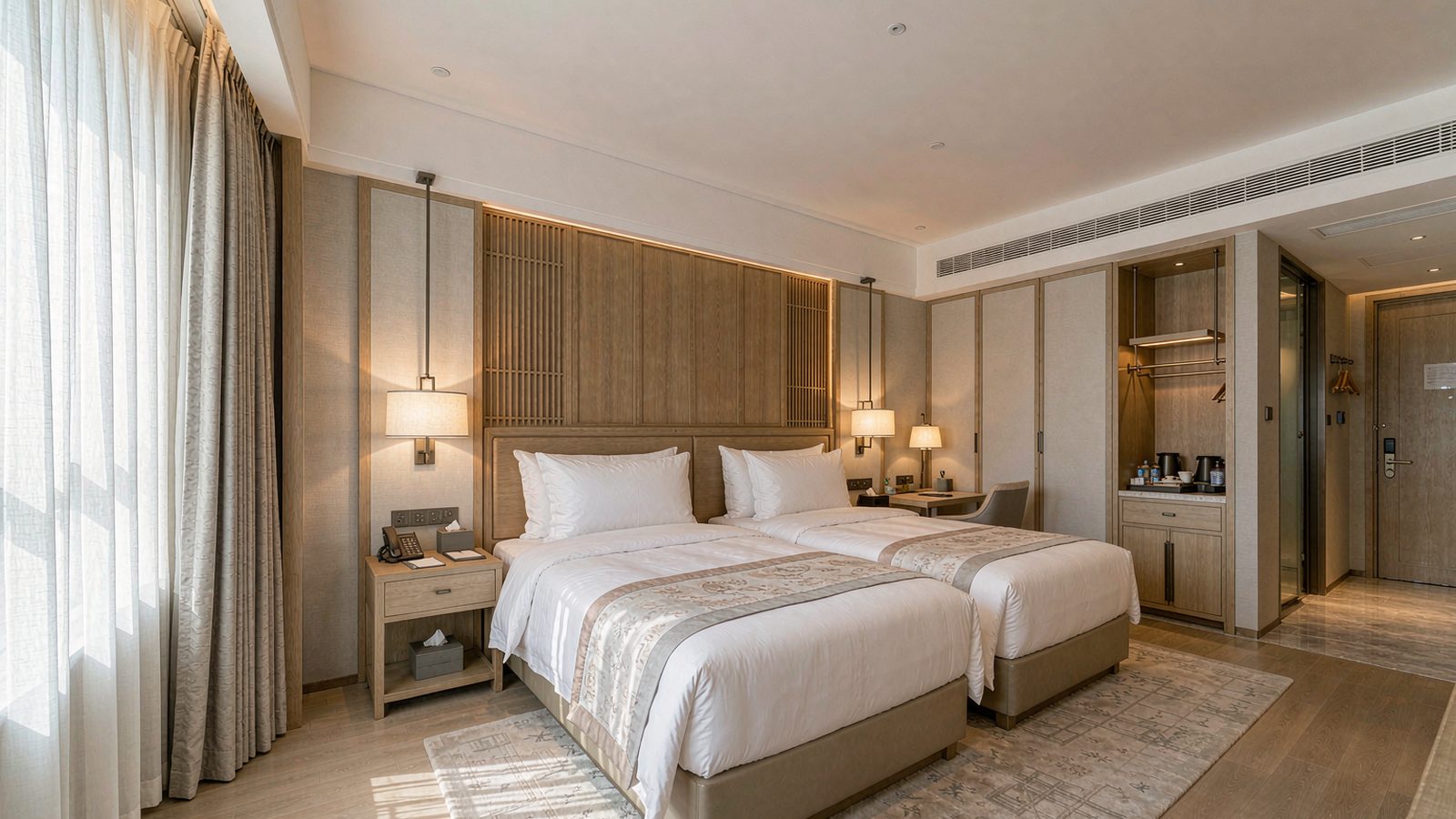
Chinese hotel rooms fall into rooms and suites, with five basic room types and four suite tiers. Twin means two single beds, Double means one. Includes real bed sizes and single supplement.
The most common mistake travellers make when booking a hotel in China is not about price, it is about the room name. Many guests read "Double Room" and picture two beds, or assume a "Single Room" is simply a smaller version of a standard room. They only find out at the door: a couple is handed two separate single beds, or a family of three walks into a room that cannot take an extra bed at all. A wrong room type is the single hardest problem to fix on the day of arrival.
This guide unpacks Chinese hotel rooms layer by layer: the two broad categories of rooms and suites, the five standard room configurations, why "Twin" and "Double" cause more confusion than any other booking term, the four tiers of suites, the actual bed sizes used in China, when a single supplement applies, and the five details that most often cost travellers money.
1. Start with the two main categories: rooms and suites
In the internal language of Chinese hotels, every unit falls into one of two categories: Room and Suite. A room contains a bedroom and a bathroom, and it is what the vast majority of guests actually stay in. A suite adds a separate living space on top of the bedroom, and is usually placed on higher floors where the view is better and the corridor is quieter.
The distinction is easy to remember: look for the second room. A suite always includes an independent sitting area, so you step into a lounge before reaching the bedroom. A room has no such layer, you open the door and the bed is right there.
Chinese booking platforms sometimes stretch the word "suite" to cover a room with a sofa corner. To judge accurately, check three things instead of the name: the floor area, whether a living area is explicitly listed, and the maximum occupancy.
2. Five standard room types at a glance
These five configurations cover almost every booking. The differences lie not only in the beds but in floor area, whether an extra bed is possible, and how many people can stay comfortably.
| Room type | Configuration | Best for |
|---|---|---|
| Single Room | One single bed, smallest floor area | One business traveller, budget first |
| Twin Bed Room / Standard Room | Two single beds | Colleagues, friends, parent with child |
| Double Room / King-size Room | One large bed | Couples |
| Triple Bed Room | One large bed plus one single bed | Three travellers sharing one room |
| Connecting Room | Two separate rooms with an internal door | Families keeping an eye on children or elders |
One pattern specific to China is worth memorising: twin rooms outnumber double rooms at lower star levels, and only as you move up the star rating and the rate ladder does the share of large-bed rooms grow. So if a large bed is essential to you, do not leave it to the front desk, lock the room type at the time of booking.
Connecting rooms and triple rooms are scarce inventory. A hotel may hold only a handful, and in high season they are effectively impossible to arrange on the spot. If you need them, request them in writing and insist on a confirmation that says "guaranteed" rather than "subject to availability".
3. The three English words that cause the most misbookings
Twin, Double and Queen are misread more often than any other hotel terms. Their meanings are actually simple:
- Twin means two identical single beds. The word refers to a matching pair of beds, not to the width of either one.
- Double means one double bed. It describes a bed twice the width of a single, not two beds in the room.
- Queen and King are bed size grades, not room categories. A queen bed runs roughly 1.5 to 1.8 metres wide, a king roughly 1.8 to 2.0 metres.
A one-line memory aid: Twin counts beds, Double measures width. Note also that a "double" in Europe or North America is often only 1.35 to 1.5 metres wide, while in China it is commonly 1.5 to 1.8 metres, which is good news for couples.
There is one more layout worth knowing: the Hollywood Twin, where two single beds sit flush together and read as one large bed but can be separated on request. Guests who want the look of a large bed but prefer to sleep apart should simply ask whether the hotel can set the room up this way.
4. The four tiers of suites, and what each adds
Suites sit on higher floors and are graded into four tiers. As you move up, what increases is not more expensive furniture but independent functional space.
| Suite tier | Spaces included | Signature features |
|---|---|---|
| Standard suite (junior or family) | Living room, bedroom, one bathroom | Guest sofa, coffee table, comfortable furniture |
| Executive suite | Spacious main bedroom, separate living room, large bathroom | Main bedroom can hold two king beds, whirlpool bath, plus a guest toilet |
| Deluxe suite | Everything in the standard suite plus multi-function rooms | Kitchenette, dining room, study, lounge, veranda |
| Presidential suite | Typically seven to eight rooms | Master bedroom, second bedroom, two bathrooms, parlour, boardroom, study, kitchen, dining room, staff room |
One warning: an "executive room" does not automatically include executive lounge access. Some hotels label a room "executive" while selling lounge access separately or reserving it for top-tier loyalty members. Read whether the listing says "executive lounge access" rather than trusting the room name alone.
5. Actual bed sizes in Chinese hotels
The table below reflects the industry standard for Chinese hotels. Real dimensions vary slightly with the age of the property and the brand. If you are travelling with elders or children, or you are sensitive to bed width, put the requirement into your booking notes.
| Room type | Bed type | Typical size in China |
|---|---|---|
| Single Room | One single bed | 120 x 200 cm |
| Twin Room | Two single beds | 120 to 135 x 200 cm each |
| Double Room | One double bed | 150 to 180 x 200 cm |
| King Room | One king bed | 180 to 200 x 200 cm |
| Hollywood Twin | Two beds pushed together | 220 to 300 cm combined width |
Extra beds deserve their own note. Most Chinese hotels at four stars and above can supply one, usually charged per night and commonly in the range of 200 to 400 yuan, but an extra bed eats into the floor space and some room types explicitly refuse them. When travelling with a child, treat "can this room take an extra bed" and "how much does the extra bed cost" as two separate questions, and get an answer to both.
6. The single supplement: why travelling alone costs more
The single room supplement is often mistaken for a hidden fee, but the logic is straightforward: when one guest occupies a room designed for two, such as a twin or a double, the hotel still charges for the whole room. When a tour operator divides cost by head count, a gap appears, and that gap is the supplement.
It arises in three situations: a member of a group is left without a roommate, a guest insists on a room alone, or two travellers who planned to share end up as one. If the hotel itself offers genuine single rooms and the guest accepts the smaller space, the single-room rate usually applies and no supplement is needed.
Our advice to guests is to state your sleeping preference at the enquiry stage. Willing to share with a same-gender companion, or determined to stay alone, the two produce different quotes. Settling it early is far easier than negotiating at check-in.
7. Five details that most often cost travellers money
- The hidden flaws of the cheapest category. The lowest-priced room type in a hotel is often the one beside the lift, facing the street, or with no exterior window. If you sleep lightly, paying a little more for a mainstream room type is a better trade than losing a night's rest.
- The gap between a "view room" and the view. City, garden, sea and lake views each carry a price step. Some so-called sea-view rooms reveal only a sliver of water through a side gap. If the view matters to your trip, say so at booking and ask the hotel to confirm the angle.
- Executive room is not executive lounge. As noted above, the name and the benefit are two different things.
- Accessible rooms are not universal. Wheelchair-accessible guest rooms have limited coverage at lower star levels. If a family member uses a wheelchair or has reduced mobility, tell us at the time of booking so we can confirm the room and the bathroom fittings in advance.
- Special requests are best-effort only. Bed type, floor, orientation and non-smoking status are handled on a best-effort basis and are not pre-guaranteed. Anything that truly must be guaranteed, such as a connecting room, an accessible room or a specific bed type, should be booked as a room type rather than requested as a note.
8. A pre-booking checklist for Jadetour guests
Compressed into an actionable list, run through these before you confirm any booking:
- Confirm whether it is one bed or two, using the precise meaning of Twin and Double rather than a vague description.
- Confirm how many people will stay, whether a third bed or extra bed is needed, and the extra-bed charge.
- For scarce room types such as connecting, accessible or large-bed rooms, lock them in writing in advance and do not accept "subject to availability".
- Travelling with elders or children, put bed width and floor preference into the notes.
- Decide between accepting a single supplement and sharing a room at the enquiry stage, not on arrival.
- For special occasions such as a honeymoon or birthday, tell the hotel early, free room decoration is common but needs time.
The Chinese room-type system is not complicated, what is complicated is the gap between the name and the actual configuration. Learn these terms precisely, secure scarce room types early, and bookings stop going wrong. If you would rather have us choose the right room type for your family structure, sleeping habits and budget, send us your requirements and Jadetour will verify and propose options: plan a custom tour or contact us directly.
Need help planning this trip?
Tell us your travel dates and group size — we reply within 24 hours.
WhatsApp +86 183 1705 8017 · WeChat 18317058017
Destinations in this guide



Related Tours



More Guides
Flying with a Pet to and from China: Cabin, Hold and Quarantine in 2026
Cabin, live-animal hold or cargo, plus quarantine certificates, the 21-day rabies rule and China entry requirements.
10/17/2026
Solo Female Travel in China: Safety, Night Transport and a 2026 Checklist
Registration, late-night rides, payments and emergency numbers: a practical 2026 checklist for women travelling alone in China.
10/17/2026
Student Travel in China: 2026 Rail Fare Rules and the Best Hands-On Activities by City
A practical guide to study tours in China: 2026 rail student fare scope, visa-free basis for camps, hands-on activities by city, and group safety standards.
10/16/2026