
Drinking Water in Chinese Hotels: Is Tap Water Safe, and How to Use the Kettle
Tap water meeting GB 5749-2022 is technically potable, but secondary contamination means Chinese hotels expect you to b…
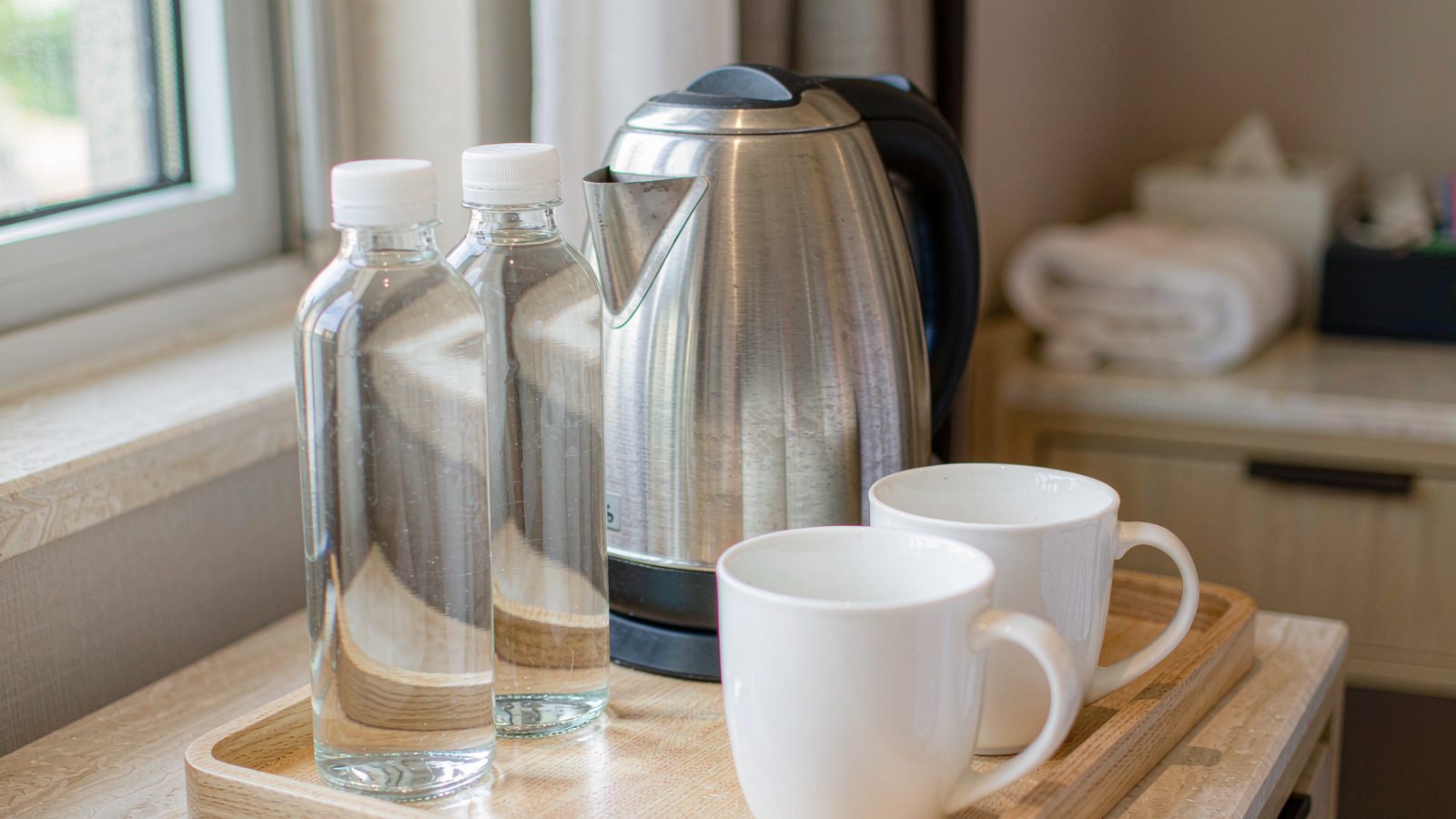
Tap water meeting GB 5749-2022 is technically potable, but secondary contamination means Chinese hotels expect you to boil it. Covers the four supply setups, kettle practice, bottled water prices and boiling points at altitude.
In most Chinese hotel rooms you will find two complimentary bottles of mineral water. On the very first night, almost every traveller asks the same questions: is the water from the tap safe to drink? Why does the kettle leave a white deposit? And once the free bottles are gone, where do you buy more? These details look trivial, but they directly affect how your stomach behaves on the road, which matters even more when you are travelling with children or older family members.
This guide covers the full practical picture along four lines: whether you can drink it, how to boil it, where to buy it and how to carry it. It also explains the water quality standard, the four ways hotels supply drinking water, how to use a kettle sensibly, how bottled water is graded and priced in China, the myths that keep circulating, and what changes in inland and high-altitude regions.
1. The direct answer: can you drink Chinese tap water?
The conclusion is this: tap water meeting the national standard is technically potable, but in Chinese hotels we do not recommend drinking it straight from the tap.
The issue is not the treatment plant but the last mile. Water leaving a Chinese municipal plant is tightly controlled by national standards, but between the plant and your bathroom tap it passes through the city mains, the secondary supply facilities of the building compound, the risers inside the block, and finally the older pipes within the room itself. Any ageing section or an uncleaned rooftop tank can reintroduce contamination. The established local practice is therefore simple: boil tap water before drinking it. This is also what the great majority of Chinese households do every day.
A small number of newer high-end hotels do state that tap water in the room is potable. The check is easy: look for a sign in the bathroom or at the minibar that says the water is drinkable, or simply ask the front desk. Without an explicit statement, treat the water as needing to be boiled.
2. What the national standard actually says: 97 parameters
The current Chinese drinking water standard is GB 5749-2022, the Standards for Drinking Water Quality. It sets 97 water quality parameters, of which 43 are routine and 54 are extended, covering microbiology, heavy metals, disinfectants, organic compounds, radioactivity and sensory properties. This framework is broadly comparable with the standards used in developed economies, which is reassuring.
The standard also specifies residual chlorine at the pipe network endpoint: no less than 0.05 mg per litre, which keeps bacteria suppressed along the network. That is exactly why many visitors notice a faint disinfectant smell in Chinese tap water. It is not a sign of poor quality but evidence that chlorine is present as intended. Chlorine volatilises when heated, so after the water has boiled for a short while the taste largely disappears.
Another widely held misunderstanding concerns scale. The white deposit inside a kettle is calcium and magnesium carbonate formed when those minerals in the water are heated. It is a normal mineral precipitate, not evidence that the water fails the standard. Water in southern China tends to be softer and in the north harder, so the same kettle may show very different amounts of scale in Xi'an and in Guangzhou. That is geology, not hygiene.
3. The four ways a hotel supplies drinking water
Supply arrangements vary with the hotel's grade, but they fall into four patterns. Spend one minute locating them on arrival and you will save yourself a lot of aggravation.
| Setup | Common in | How to use it |
|---|---|---|
| Water dispenser, hot and cold | Mid-range chains, business hotels | Blue for cold, red for hot; the hot side is close to boiling and works for tea or instant noodles |
| Electric kettle | Almost all hotels | Boil tap water yourself; the most universal option. Boil one kettle and discard it before the second |
| Thermos flask | Some mid and lower tier, older properties | Usually filled in advance by housekeeping; call them to refill when empty |
| Complimentary bottled water | Mainly four and five star | Typically two bottles daily, replenished free; premium hotels may provide branded water |
Two practical points are worth remembering. First, you can always ask for more bottled water. Once the two bottles on the desk are finished, call the front desk or housekeeping and say you need a few more. Most hotels restock free of charge. This is rarely printed on the in-room card, but it is the industry norm.
Second, check the price list before taking anything from the minibar. Minibar items fall into two categories: those with a price, settled at check-out, and those marked free or unmarked, which are complimentary. Mistaking a charged item for a free one is a common source of check-out disputes, and one glance at the price card prevents it.
4. Using the kettle correctly, and the hygiene question
The electric kettle is the most useful appliance in the room and also the subject of the most rumours. Once you separate the real concerns from the noise, it is straightforward.
- Boil one kettleful of tap or bottled water, pour it away, then boil the second. The purpose of the first is not sterilisation but rinsing out any dust. It is the simplest effective step.
- Never cook food in a hotel kettle. Instant noodles, boiled eggs or sterilising utensils leave residue and odours for the next guest and can damage the appliance.
- After it boils, keep it simmering for one to three minutes. Guidance is to hold a gentle boil for one to three minutes, which kills pathogens such as E. coli and salmonella and drives off residual chlorine. Boiling far longer is unnecessary and simply evaporates the water.
- Drink boiled water the same day where possible. Water left open at room temperature should not be kept beyond 24 hours, and less in summer, mainly to avoid bacterial regrowth.
- If you are uneasy about the appliance, use the complimentary bottled water only. No hotel will object, and it is a perfectly reasonable choice.
5. Buying bottled water in China: where, and at what price
If the free bottles run out, buying more in China is cheap and easy. The main channels and typical prices are below.
| Channel | Typical size | Typical price |
|---|---|---|
| Hotel lobby shop or room service | 500 ml | Most expensive, usually 6 to 15 yuan a bottle |
| Street convenience store, chain brands | 550 ml | Commonly 2 to 3 yuan a bottle |
| Supermarket | 550 ml, or packs of four to six | 1.5 to 2.5 yuan a bottle, cheaper by the pack |
| Restaurant | 550 ml | Usually 5 to 10 yuan a bottle |
Two points help when choosing. First, note the water category. Legitimate packaged water in China follows three national standards: treated municipal water under GB 5749, purified drinking water under GB 17323, and natural mineral water under GB 8537. For everyday thirst, purified water is the most economical. Choose natural mineral water if you prefer a mineral taste. Second, stick to recognised brands. Mainstream brands sold in chain convenience stores and supermarkets are all within the regulatory system. Avoid unbranded loose water sold at roadside stalls or repackaged privately.
One easily overlooked point: Chinese hotel rooms generally do not offer an ice service, and making ice from room tap water is not advisable. If you want a cold drink, a convenience store or a restaurant is the easier route.
6. Four claims that are simply wrong
- "Repeatedly boiled water causes cancer" is false. Water boiled several times, or plain water left overnight, contains nitrite far below safe limits and can be drunk within 24 hours if stored covered. What you should avoid is water left open for a long period.
- "Heavy scale means poor water quality" is false. Scale is precipitated calcium and magnesium, entirely normal, and simply needs periodic descaling. Northern China has harder water and therefore more scale.
- "Mineral water is healthier than boiled water" has no basis. Chinese regulators have explicitly banned concept names such as micro-cluster water, activated water, oxygen-rich water and alkaline water on packaged products. For daily hydration, boiled water is the simplest reliable choice.
- "A chlorine smell means the water is not properly treated" is the opposite of the truth. Residual chlorine shows the network is actively suppressing bacteria. The smell disappears after one to three minutes of boiling.
7. What changes in inland and high-altitude regions
Once your itinerary moves into western China, the drinking water picture shifts slightly.
At high altitude, such as western Sichuan, north-western Yunnan and parts of Qinghai, the boiling point falls with elevation. At around 3,000 metres water boils near 90 degrees Celsius, and above 4,000 metres the boiling point can be only about 85 degrees. That means "it boiled" does not equal "it is sterilised". Two responses work well: hold the boil for a few extra minutes, or simply rely on bottled water for anything consumed directly, including tea and infant formula.
In arid inland regions, such as Gansu, Ningxia and parts of Xinjiang, tap water is generally harder, shows more scale and tastes drier. A white crust in the kettle is normal and does not affect safety, but if you are sensitive to taste or serious about tea, buy bottled water instead.
One further warning: some hotels in scenic areas and small towns operate restricted or tank-based supply and may cut water at night. Ask at check-in whether the water is shut off overnight. If it is, fill the thermos with drinking water in advance.
8. How much to drink, and how to carry it
Chinese dietary guidance suggests that in a temperate climate an adult should drink roughly 1,500 to 1,700 millilitres a day, about seven to eight glasses. In summer, at altitude, or on days with long walks and climbs, that rises significantly.
A few practical suggestions for carrying water:
- Bring a 500 ml bottle or flask. Hotel breakfast areas will usually refill it with hot water and restaurants are happy to help. Buying water inside a scenic area can cost double or more.
- For long drives or train journeys, prepare two or three bottles before departure. High-speed and conventional trains have hot water on board, but you queue at the vestibule between carriages.
- Do not rely on the two free bottles alone. Two 550 ml bottles is only about 1.1 litres, not enough for a full day. Top up at a convenience store after arrival.
- Travelling with a child, carry a small bottle of room-temperature water. For formula or medicine, do not use room tap water; use bottled water or water that has been fully boiled and cooled.
9. A room water checklist for Jadetour guests
Two minutes on arrival covers almost every drinking water question for the trip:
- Locate the supply points: dispenser, kettle, thermos and complimentary bottles.
- Confirm whether the bottled water is free; if so, call for more once the first two are finished.
- Boil the first kettle and discard it, then start drinking from the second.
- Clarify the minibar charging boundary so no surprise appears on the bill.
- Once the trip reaches high altitude, switch your main drinking supply to bottled water.
- If the supply looks abnormal on arrival, cloudy, discoloured or odorous, stop using it and tell the front desk or our staff immediately.
Drinking water is the least glamorous part of a trip and one of the most likely to affect how you feel. Work through these steps once and you will never again hesitate over whether the water is safe. If you would like us to mark refill and water arrangements along your route in advance, send us your itinerary and group size and Jadetour will plan it in: plan a custom tour or contact us directly.
Need help planning this trip?
Tell us your travel dates and group size — we reply within 24 hours.
WhatsApp +86 183 1705 8017 · WeChat 18317058017
Destinations in this guide


Related Tours

More Guides
Flying with a Pet to and from China: Cabin, Hold and Quarantine in 2026
Cabin, live-animal hold or cargo, plus quarantine certificates, the 21-day rabies rule and China entry requirements.
10/17/2026
Solo Female Travel in China: Safety, Night Transport and a 2026 Checklist
Registration, late-night rides, payments and emergency numbers: a practical 2026 checklist for women travelling alone in China.
10/17/2026
Student Travel in China: 2026 Rail Fare Rules and the Best Hands-On Activities by City
A practical guide to study tours in China: 2026 rail student fare scope, visa-free basis for camps, hands-on activities by city, and group safety standards.
10/16/2026