
Hotel Deposits in China: How Much, How to Pay, and When You Get It Back
A Chinese hotel deposit is a guarantee, not an extra fee, typically CNY 200 to 500, or a card pre-authorisation at upsc…
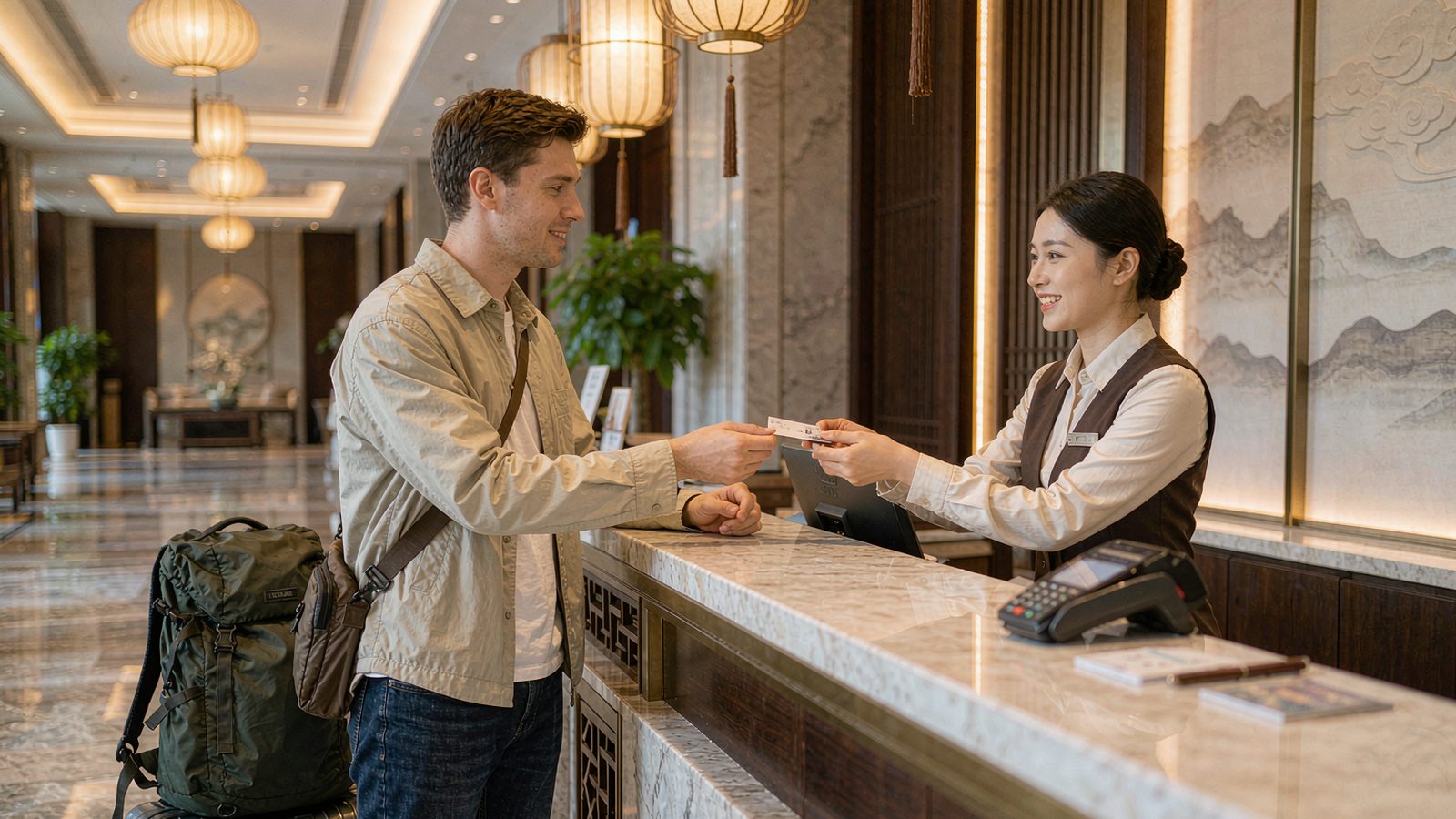
A Chinese hotel deposit is a guarantee, not an extra fee, typically CNY 200 to 500, or a card pre-authorisation at upscale hotels. Covers cash versus pre-auth, legitimate deductions, three deposit-free routes and six common mistakes.
At check-in in China, the front desk will often ask for a second payment on top of your room rate. Many overseas visitors wonder why: the room was already paid for through the booking platform. That extra amount is the room deposit, and it is sometimes taken as a credit card pre-authorisation instead of cash. It looks like a minor detail, yet it directly affects how much of your money is tied up, how long check-out takes, and whether a puzzling charge appears on your statement afterwards.
This guide explains the whole picture: what the deposit actually is, why cash deposits are disappearing in 2026, how the amount is calculated, how to choose between cash and pre-authorisation, how long the money takes to come back, when a deduction is legitimate, how the deposit-free routes work, and the six mistakes that cost travellers money.
1. What the deposit is, and why Chinese hotels take one
The room deposit is a security guarantee, not part of the room rate. The hotel holds it during your stay to cover potential charges and risks beyond the room: minibar drinks, laundry, telephone calls, damage to room facilities, lost key cards or towels, and late check-out fees.
The practice is standard in China because Chinese hotels usually settle room rate and incidentals separately. The room rate is normally paid in advance through the booking channel, while incidentals are settled at check-out according to what you actually used. The deposit is the guarantee that makes this bill-later arrangement possible. It is therefore not an extra charge: it is a hold, released once the final bill is settled.
Once that is clear, everything else follows. The deposit is a held amount, not an additional fee, and only part of it is actually taken if you genuinely consumed something beyond the room rate.
2. The 2026 shift: credit and pre-authorisation are replacing cash
If your last visit to China was a few years ago, the process may look different now. Deposits have not been abolished, but the way they are handled has moved rapidly from collecting cash towards credit guarantees and pre-authorisation holds.
Three industry patterns are visible. First, manual room inspection at check-out is in broad retreat. Industry reporting indicates that more than seventy per cent of star-rated hotels nationwide no longer inspect every room on departure, and the proportion is higher among upscale properties. Handing back the key card and walking out has become the mainstream experience. Second, deposits are increasingly replaced by credit card pre-authorisation or credit-based waivers, so hotels no longer count cash and guests no longer tie up funds. Third, policy explicitly encourages this direction: the culture and tourism authorities have published a draft opinion on a credit-plus programme for the culture and tourism market, proposing credit-based products such as pay-later, travel-now-pay-later and reduced or waived deposits, and pilot work on credit economy development in the sector is running across 2025 and 2026.
Two caveats matter. The credit-plus framework is still at the consultation and pilot stage; it is not yet a nationwide mandatory rule. Deposit-free and inspection-free service is the industry trend and the current practice in many hotels, but not an obligation on every property. Whether your hotel takes a deposit, and how much, still depends on that hotel's own policy.
A second boundary needs stating plainly: no inspection does not mean no cleaning check, and no deposit does not mean no liability. Housekeeping still inspects the room after you leave. If there is abnormal damage, the hotel can still claim the cost. What has changed is that you are no longer asked to pay up front.
3. How much: typical ranges and the logic behind them
There is no national standard. The amount is set by each hotel and usually reflects the room rate, room category, length of stay and property grade. The table below gives the common ranges as a budgeting reference.
| Property grade | Typical deposit | How it is set |
|---|---|---|
| Economy chains | CNY 100 to 200 | A flat amount, largely unrelated to the room rate |
| Mid-range chains, three to four star | CNY 200 to 500 | Commonly one night's room rate, or the rate plus a fixed incidentals guarantee |
| Four and five star, resorts | CNY 500 to 2000 | Scaled to room value and incidentals risk; suites and premium rooms sit higher |
| Multi-night stays | Cumulative or scaled up | Some hotels charge against the total room charge, and may settle in stages |
As a rough conversion, CNY 500 is around USD 70, moving with the exchange rate. Paid in cash, that money is unavailable for the whole stay. Taken as a pre-authorisation, it only occupies credit limit and ties up no cash at all.
Two practical points. First, the amount is negotiable. If you are staying one night and do not intend to use the minibar or laundry, say so politely at the desk; some hotels will accept a lower amount. Second, asking in advance beats arguing on the spot. An email before arrival confirming the deposit, how it is taken and how it is returned avoids the problem entirely.
4. Two ways to pay: cash versus credit card pre-authorisation
This is the part worth reading closely, because it determines when your money comes back.
Cash deposit
You hand over cash, the hotel issues a receipt, and the balance is returned at check-out against that receipt. It is simple and involves no bank. The drawbacks are that you must carry the cash, and that the desk needs time to count and make change, which is awkward when you have an early flight or a train to catch. Keep the paper receipt safe; losing it can create verification work.
Credit card pre-authorisation
This is the usual method at upscale hotels. The desk places a hold on your card for a set amount. The money is not transferred; only your available credit is temporarily reduced. At check-out, if there are no incidentals, the hotel reverses or settles the hold and the limit is released. Many guests see the bank notification and assume they have been charged, which is a misunderstanding.
Three details matter. First, timing. A reversal usually takes several business days. If the hotel does not initiate it, the issuing bank normally releases the hold automatically after a set period, which varies by bank. Second, a pre-authorisation is not a charge and appears on statements as an authorisation or hold, a different accounting state from a purchase. Third, cards issued outside China may involve extra steps, and cross-border processing generally takes longer, so check one or two statements after departure.
5. What happens at check-out: three steps
- Bring luggage down and return the key card. Take your bags to the desk, usually one person is enough, and hand back the key card. If it is lost, some hotels charge a small replacement fee; ask at check-in.
- The desk checks for incidentals. This covers minibar items, laundry, telephone, pay television and late check-out. Properties that still inspect rooms require a short wait; elsewhere the system settles directly or charges follow later.
- Settlement and refund of the balance. The principle is straightforward: no incidentals means a full refund; incidentals are deducted and the balance returned; if incidentals exceed the deposit, you pay the difference. Cash deposits are refunded in cash, and a pre-authorisation is released.
On timing, the standard check-out time in China is before 12:00 noon, with check-in usually from 14:00. Whether late check-out is charged, and until what hour, varies by hotel. Some hotels give loyalty members free late check-out until 14:00 or even 18:00. Ask rather than assume.
6. When money is legitimately deducted
The scope is not mysterious: it is whatever you used beyond the room rate.
| Deduction | Explanation | How to avoid it |
|---|---|---|
| Minibar drinks and snacks | Alcohol, imported drinks, nuts; priced far above convenience stores. Sensor minibars charge the moment an item is lifted | Read the price list; if unsure, leave it alone |
| Laundry and pressing | Charged per item; the price list is usually in the wardrobe and the desk may not mention it | Ask about charges and pricing before sending anything |
| Damage to facilities | Abnormal damage is charged at cost and is not waived by inspection-free service | Photograph any pre-existing damage on arrival and tell the desk |
| Items taken home | Bathrobes, towels, hairdryers and similar are not gifts. Disposable slippers and dental kits are | Ask before packing anything you are unsure about |
| Late check-out | Beyond the free window, hotels may charge half a day or a full day | Request late check-out a day in advance |
| Smoking indoors | Indoor smoking is banned across China; some hotels add a cleaning fee | Use designated smoking areas |
One easily missed point: the complimentary bottles in the room can usually be replenished free, but identical bottles inside the minibar are often chargeable. They look the same; the difference is position and whether a price is shown. The two on the desk are normally complimentary, while those in the cabinet tend to appear on the price list.
If you believe a deduction is wrong, act in two stages. Check the itemised bill at the desk before you leave, which is by far the most effective step. If it cannot be resolved on site, keep the bill and the booking record and pursue it through the booking channel or the hotel group's customer service. Once a pre-authorisation has been settled, disputes are harder to unwind than before, so on-the-spot checking is the best protection.
7. How to get deposit-free check-in: three routes
- Prepay the room rate online. Settle the full room charge through the booking channel and simply present your ID at arrival. This is the most reliable option: no hidden fees and no credit assessment, though some hotels still take a small incidentals deposit on third-party bookings.
- Hotel loyalty tier waiver. Register with a hotel group and reach a higher tier, and directly operated properties will often waive the deposit. It is stable but requires accumulated status, usually applies only to directly operated hotels, and often excludes third-party bookings. Expensive room categories such as suites and view rooms may still require a deposit.
- Credit-based waiver. A payment platform locks in a deposit-free allowance, restored automatically once the bill is settled. It requires meeting the platform's credit score threshold and only works at partner hotels. For overseas visitors, identity verification and the absence of a local credit record limit availability, so confirm with the front desk before booking.
In short: online prepayment is the most reliable, loyalty status comes next, and credit-based waiver is the most convenient but has the narrowest coverage. Whichever route you take, check-in normally requires valid identification and facial verification, which is the real-name registration requirement in China.
8. The six mistakes that cost travellers money
- Reading a pre-authorisation as a charge. A bank notice saying hold or authorisation is not a purchase. Check the statement status first.
- Assuming inspection-free means liability-free. It only moves the check later. Liability remains.
- Not recording existing damage. One minute on arrival to photograph any flaw and tell the desk is the cheapest protection available.
- Asking for late check-out on the day. Free windows are limited and often unavailable in peak season. A day's notice is far more likely to succeed.
- Discarding the deposit receipt. Cash refunds are settled against the receipt or registration details; keeping it avoids verification work.
- Expecting cards to work everywhere. Foreign cards are accepted in international hotel chains, large malls and airport shops, but street businesses rely on mobile payment. Carry a small amount of cash.
9. A deposit checklist for Jadetour guests
- Before arrival, confirm three things: the amount, the method, and the refund timeline.
- Where a card pre-authorisation is accepted, prefer it, and check in your banking app that the entry reads as an authorisation rather than a purchase.
- For cash deposits, photograph the receipt and keep the paper copy.
- On arrival, inspect the room and record any pre-existing damage.
- Do not touch unmarked minibar items; ask about laundry and late check-out charges first.
- At check-out, review the itemised bill on the spot and confirm how and when the balance is returned.
- If a hold is still in place after a week, follow up with the hotel or your card issuer using the bill and booking record.
The deposit is the least discussed and most misunderstood step of staying in China. Working through these actions means no unnecessary charges and no waiting around at departure. If you would like us to flag each hotel's deposit policy and settlement method in your itinerary, and sequence your check-ins and check-outs properly, send us your route and group size and Jadetour will plan it in: plan a custom tour or contact us directly.
Need help planning this trip?
Tell us your travel dates and group size — we reply within 24 hours.
WhatsApp +86 183 1705 8017 · WeChat 18317058017
Destinations in this guide



Related Tours



More Guides
Flying with a Pet to and from China: Cabin, Hold and Quarantine in 2026
Cabin, live-animal hold or cargo, plus quarantine certificates, the 21-day rabies rule and China entry requirements.
10/17/2026
Solo Female Travel in China: Safety, Night Transport and a 2026 Checklist
Registration, late-night rides, payments and emergency numbers: a practical 2026 checklist for women travelling alone in China.
10/17/2026
Student Travel in China: 2026 Rail Fare Rules and the Best Hands-On Activities by City
A practical guide to study tours in China: 2026 rail student fare scope, visa-free basis for camps, hands-on activities by city, and group safety standards.
10/16/2026