
Baggage Rules on China Domestic Flights: Carry-on, Checked and Power Banks
Since 2021 airlines set their own baggage rules. Carry-on sizes, the 20 kg checked reference, excess at 1.5% of full fa…
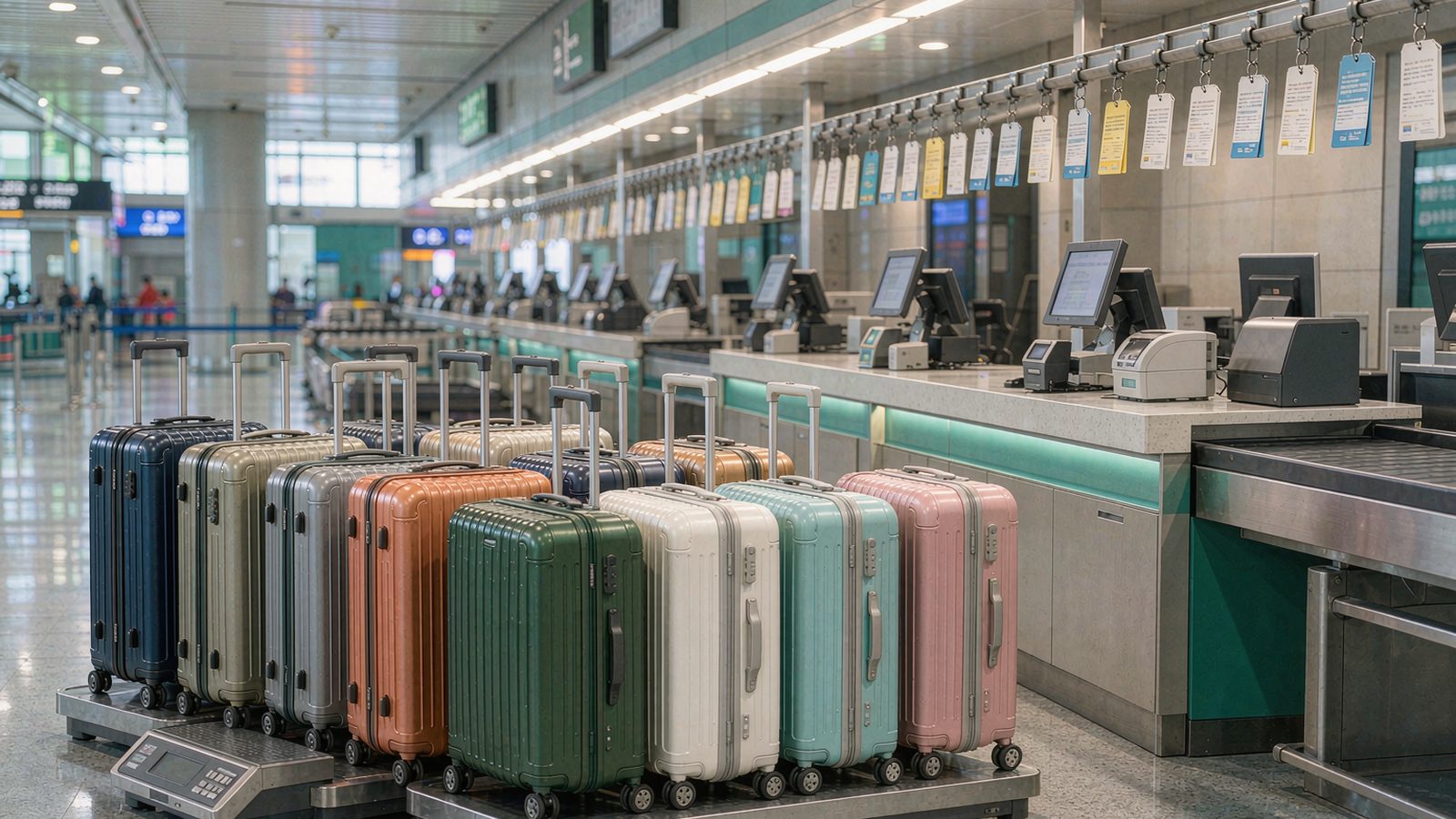
Since 2021 airlines set their own baggage rules. Carry-on sizes, the 20 kg checked reference, excess at 1.5% of full fare per kg, and the CCC and 100 Wh power bank tiers.
Baggage rules cause more arguments at Chinese airports than anything else. The same 20-inch carry-on case that sails through at one gate gets sent back to be checked, with a bill of over a hundred yuan, at another. The reason is simple: since 2021 Chinese civil aviation authorities no longer set a single standard for baggage size, weight, free allowance or excess charges, leaving each airline to decide for itself.
This guide covers domestic baggage rules end to end: how the three categories differ, the limits for carry-on and checked baggage, how excess charges are calculated, the power bank and lithium battery rules that tightened in 2026, what can never be carried or checked, and five practical tips that save money and hassle.
1. One key fact first: the airline, not the regulator, sets the standard
The 1996 domestic passenger and baggage regulations once fixed a uniform rule: self-carried baggage not exceeding 10 kg per piece and 20×40×55 cm in volume.
- The Public Air Transport Passenger Service Regulations that took effect in 2021 repealed those clauses. The regulator no longer sets uniform limits for baggage size, weight, free allowance or excess fees.
- In other words, each airline, and even each fare product within one airline, can have its own baggage rules. Low fares with no free checked allowance are an open industry practice.
- The new rules do require that baggage conditions be published conspicuously. The rules are public, just often tucked into small print on the booking page.
That is why checking whether your fare includes a free baggage allowance matters far more than arguing at the counter later.
2. The three baggage categories
- Checked baggage: handed over at check-in, carried in the hold and collected at the carousel. Subject to a free allowance and excess charges.
- Carry-on or hand baggage: taken into the cabin and stowed in the overhead bin or under the seat. Subject to size and weight limits.
- Self-carried baggage: items the passenger looks after inside the cabin; in practice the same standard as carry-on.
Note that carry-on is weighed at the gate too. So-called "three excesses" baggage, meaning oversized, over-count or overweight, is barred from the cabin, and being caught can mean re-checking, a second security screening, or even the bag arriving on a different flight.
3. Carry-on size and weight
| Airline type | Typical size | Weight and pieces |
|---|---|---|
| Full-service carriers (Air China, China Southern, Sichuan Airlines) | 20×40×55 cm (about 20 inches) | Economy: 1 piece, usually up to 7 kg, some carriers 5 kg; business and first: 2 pieces |
| Differential-service carriers (West Air, Lucky Air, Tianjin Airlines, China Express, Suparna) | 20×30×40 cm (about 14 inches) | Usually 1 piece, up to 7 kg |
Three common size bands: 14 inches is 20×30×40 cm, 20 inches is 20×40×55 cm, and anything larger exceeds the carry-on limit. Check the standard shown on the booking page, or call the airline in advance.
4. Free checked allowance on domestic flights
| Cabin | Reference for traditional full-service carriers | Notes |
|---|---|---|
| Economy | 20 kg | The baseline for most carriers |
| Business | 30 kg | Subject to the allowance shown on the e-ticket |
| First | 40 kg | Subject to the allowance shown on the e-ticket |
| Infant fare | No free allowance | May carry one folding stroller or bassinet free |
Two easily missed distinctions: international routes usually differ between weight-based and piece-based systems; routes to the Americas are mostly piece-based, commonly 2 pieces up to 23 kg each, with one piece not exceeding 158 cm in total dimensions and two pieces not exceeding 273 cm combined. Economy passengers with a student passport get 30 kg on some carriers. All of this follows the e-ticket record in the departure system, so confirm before buying.
5. How excess baggage is charged
- Traditional carriers: on domestic flights the excess fee is 1.5% of the full economy fare per kilogram, rounded to whole yuan. The base is the full fare, not the discounted fare, so a deeper discount makes the excess relatively more expensive.
- Low-cost carriers: Spring Airlines and 9 Air use their own standards, often per piece or tiered by whether you buy early, and buying online in advance is usually cheaper than at the airport.
- International flights: rates and methods vary even more and follow the carrier's own rules.
A quick illustration: if the full economy fare is 1800 CNY, the excess fee is about 27 CNY per kilogram, so 5 kg over is close to 135 CNY. This is exactly how a low fare saves on the ticket and charges back on the baggage.
6. Lithium batteries and power banks: the rules that tightened in 2026
This is the fastest-changing and most strictly screened item in recent years and deserves its own section.
| Rated energy | Carriage requirement | Typical capacity at 3.7V |
|---|---|---|
| Up to 100 Wh | Carry-on directly, no airline approval needed | 20000 mAh is about 74 Wh; 25000 mAh about 92.5 Wh |
| 100–160 Wh | Requires airline approval, maximum 2 per passenger | 30000 mAh is about 111 Wh |
| Over 160 Wh | Strictly prohibited, neither carry-on nor checked | About 43000 mAh and above |
| Unmarked or uncalculable | Strictly prohibited | Unclear marking or no parameters |
- Never checked, carry-on only. A power bank must travel in hand baggage or on your person; putting it in checked baggage is a violation.
- Domestic flights require a clear CCC mark. Since 28 June 2025, power banks carried on domestic flights must show a clear China Compulsory Certification mark; unclear markings, recalled models or recalled batches are prohibited.
- No in-flight use. Since 24 April 2026, some carriers have expressly banned using a power bank to charge devices in the cabin, and it must never be checked.
- Spare lithium batteries are carry-on too. Spare batteries for phones, cameras and laptops must be carried on and protected against short circuits, for example by taping the terminals or using the original packaging.
- International flights differ slightly. On international or regional flights, a compliant power bank bought through a legitimate overseas channel generally passes, but if the itinerary includes a domestic connecting leg, domestic security will still verify the CCC mark.
The conversion is simple: rated energy in Wh = capacity in mAh × cell voltage in V ÷ 1000. Mainstream power banks use 3.7V cells, so 20000 mAh is about 74 Wh and 27000 mAh about 99.9 Wh, both inside the no-approval range. What actually gets stopped is usually the marking itself.
7. What cannot be carried or checked
| Category | Examples | Handling |
|---|---|---|
| Valuables and documents | Cash, securities, credit cards, jewellery, cameras, passports, tickets, business papers, manuscripts, heirlooms | Not checked, must be carried |
| Urgent items and fragile goods | Medicine, keys, glasses, glass containers | Not checked, must be carried |
| Knives and sharps | Kitchen knives, scissors, fruit knives, razors, scalpels, carving knives, butchers' knives | Not carry-on, must be checked |
| Performance and martial arts weapons | Swords, spears, halberds and similar | Not carry-on, must be checked |
| Lithium batteries, power banks, lighters, matches | All lithium batteries and ignition devices | Not checked; power banks must be carried |
| Flammable and explosive goods | Fireworks, petrol, high-strength alcohol | Prohibited both as carry-on and checked |
A simple memory aid: valuable, fragile or needed at hand goes with you; dangerous, bladed or flammable follows the list and in most cases can only be checked or is banned outright.
8. Liquids, cosmetics and alcohol
- Liquid cosmetics: containers with a volume of 100 ml or less can be carried; anything larger must be checked. The judgment is based on the volume printed on the container, not on how much remains.
- Alcohol: checked only, and only in unopened factory packaging. Under 24% alcohol there is no quantity limit; between 24% and 70% the limit is 5 litres per passenger; above 70% carriage is prohibited.
- Other liquids: excess drinks and toiletries should be checked; carry-on portions beyond the limit will be surrendered.
9. Special baggage
- Strollers and child seats: most carriers allow one folding stroller free; an infant not occupying a seat may bring one folding stroller or bassinet in addition.
- Musical instruments: small instruments can be carried or occupy a seat, which needs a separate ticket; large instruments should be checked in a hard case.
- Sports equipment: golf clubs, skis and bicycles usually need advance declaration, separate charges and specific packaging.
- Wheelchairs: electric wheelchairs require advance application and batteries that meet the rules.
10. Five tips that save money
- Check the allowance before booking: the small print on the booking page decides the real cost, and a low fare may need baggage bought separately.
- Buy baggage online in advance: airport counter prices at low-cost carriers are usually much higher than pre-purchase.
- Keep the carry-on under 20 inches: 20×40×55 cm is the common ceiling across carriers, and 14 inches is safer still.
- Carry the power bank with a clear mark: one without a CCC mark will be stopped, so check before you leave home.
- Keep valuables with you: if checked baggage goes wrong, compensation is capped, as covered in our lost and damaged baggage guide.
11. Build baggage rules into the whole itinerary
On multi-city or multi-segment trips in China, baggage rules often shape the total cost and experience more than the fare itself. Jadetour's custom tour service plans flights together with allowances, connections and airport transfers, so you avoid hidden costs like a 20 kg allowance on the first leg and only 7 kg on the second. Send your dates, group size and cities through our contact page and we will work the rules out in advance.
Need help planning this trip?
Tell us your travel dates and group size — we reply within 24 hours.
WhatsApp +86 183 1705 8017 · WeChat 18317058017
Destinations in this guide

Beijing
Imperial Capital · Great Wall, Forbidden City & Hutongs

Shanghai
China's Modern Metropolis · The Bund & Classical Gardens

Chongqing
The 8D Mountain City · Gateway to the Yangtze Cruise

Chengdu
Home of the Pandas · Gateway to Western Sichuan
Guangzhou
A Thousand Years of Trade · Dim Sum & Lingnan Arcades
Related Tours



More Guides
Flying with a Pet to and from China: Cabin, Hold and Quarantine in 2026
Cabin, live-animal hold or cargo, plus quarantine certificates, the 21-day rabies rule and China entry requirements.
10/17/2026
Solo Female Travel in China: Safety, Night Transport and a 2026 Checklist
Registration, late-night rides, payments and emergency numbers: a practical 2026 checklist for women travelling alone in China.
10/17/2026
Student Travel in China: 2026 Rail Fare Rules and the Best Hands-On Activities by City
A practical guide to study tours in China: 2026 rail student fare scope, visa-free basis for camps, hands-on activities by city, and group safety standards.
10/16/2026