
What to Pack for China in 2026: A Packing List from Documents to Power and Medicine
Passport validity, baggage limits, 220V sockets and China's 3C power-bank rule: what to pack for China, what to leave a…
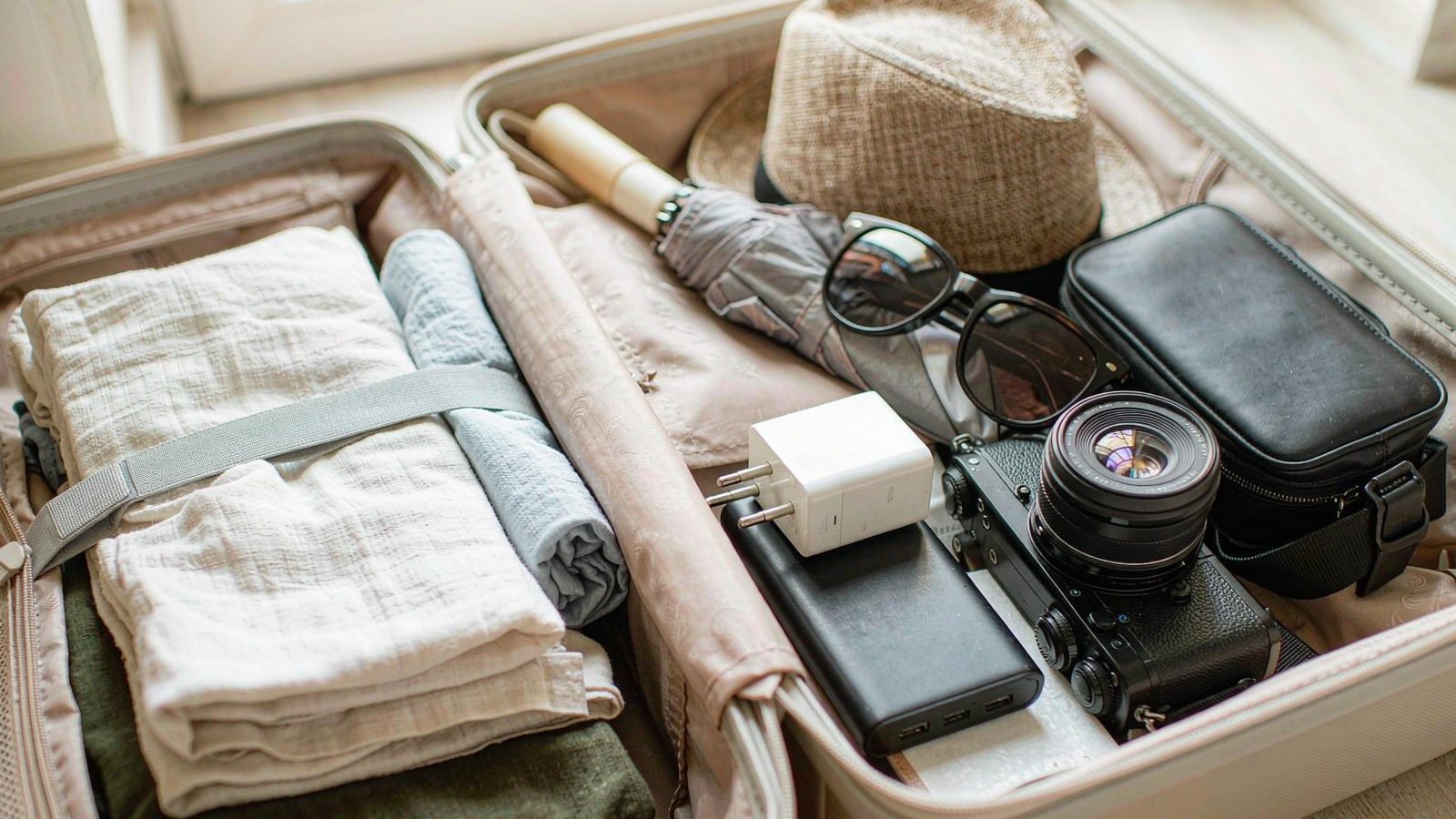
Passport validity, baggage limits, 220V sockets and China's 3C power-bank rule: what to pack for China, what to leave at home, plus a 72-hour checklist.
Packing goes wrong in two familiar ways. One is bringing everything, and then hauling a 25-kilo suitcase up the stone steps of Chongqing. The other is bringing nothing and discovering at midnight that the hotel has no spare toothbrush and your plug does not fit the wall. A genuinely useful packing list is not the longest one. It starts with four variables — season, route, length of stay and altitude — because China spans roughly 37 degrees of latitude, from tropical to subarctic. In the same September week, Harbin needs a windbreaker while Guangzhou still runs its air conditioning.
This guide runs in order: documents and money, power and charging, baggage limits, clothing, toiletries, medicine, what not to bring, and a final 72-hour checklist. Everything reflects the rules in force in October 2026. Visa, visa-free and entry-document matters should always be confirmed with the Chinese embassy or consulate in your country and with China's National Immigration Administration. We do not provide visa application services.
1. Decide four variables first
- Season. Northern winters are dry and cold — Beijing averages around -4°C in January, with lows below -9°C — but buildings are centrally heated, so moisturiser is more often forgotten than a heavy coat. Southern winters are damp and chilly at 5-15°C, which many northern visitors find harder to handle.
- Route. City itineraries (Beijing, Shanghai, Xi'an, Chongqing, Chengdu) are walking-heavy, so shoes matter more than clothes. Mountain routes (Guilin, Zhangjiajie, Jiuzhaigou) mean many steps and high humidity: pack grip and quick-dry fabrics.
- Length. Under a week, pack light and wash as you go. Over ten days, plan for laundry and a spare pair of shoes.
- Altitude. Kunming sits near 1,900m, Qinghai Lake near 3,200m and Lhasa near 3,650m. Strong UV, wide day-night temperature swings, and separate sun and warmth layers.
2. Documents and money: three must-haves and two backups
- Passport. China requires your passport to be valid for at least six months beyond your date of arrival, with two blank pages. It is your only valid ID in China: attraction tickets, rail ticket checks and hotel registration all need the original.
- Visa or visa-free proof. Keep a screenshot of your visa page or of the visa-free clause you rely on (for example the 30-day unilateral visa-free entry or the 240-hour visa-free transit) in an offline album, so you can show it at check-in or at the border.
- Paper backups. Photocopy the passport data page and visa page, store them separately from the originals, and keep a photo on your phone. If the passport is lost, that copy is the first document anyone will ask for.
- Payments. China in 2026 runs on QR codes. Install Alipay and WeChat Pay before you fly, link an international card and complete identity verification with your passport. Almost everything — metro, convenience stores, street stalls — can then be paid by phone.
- Cash. Carry 200-500 yuan in small notes as a fallback for remote areas or a dead battery. Customs limits are RMB 20,000 per person per crossing, and foreign cash above the equivalent of USD 5,000 must be declared in writing on entry.
3. Power and charging: 220V, three socket types, and a new power-bank rule
- Voltage. Mainland China uses 220V at 50Hz, the same as Europe and Australia. Devices built for North America's 120V need checking.
- Sockets. Under the current national standard (GB 1002-2024) the mainstream outlet is a Type A + Type I hybrid, and many hotel rooms add a Type C (two round pins) slot. US two-flat-pin plugs, Australian angled plugs and European round pins usually fit directly; UK Type G three-rectangular-pin plugs need an adapter.
- The one check that matters. Read the INPUT line on the charger. If it says 100-240V — phones, laptops, cameras and power banks almost always do — you need a plug adapter only. If it says 110V or 120V only (some North American hair dryers and straighteners), a step-down converter is mandatory; plugging it in directly destroys the device and can start a fire.
- Power banks (rule effective 28 June 2025). On domestic flights within China, power banks without a 3C mark, with an unclear 3C mark, or belonging to a recalled model or batch are prohibited. Units rated 100Wh or less may be carried; 100-160Wh requires airline approval and a maximum of two per passenger; above 160Wh is forbidden; unlabelled units that cannot be calculated are also forbidden. Power banks must be carried, never checked, and must not be used in flight.
- Rail. High-speed and regular trains accept power banks with a clear rating of 100Wh or less per unit.
4. Baggage allowances: international and domestic legs differ
This is where travellers lose money. Many China itineraries include a domestic flight — Chongqing to Jiuzhaigou, Shanghai to Xi'an — and domestic allowances are usually tighter.
- Economy commonly allows 20kg of checked baggage, business 30kg and first 40kg, but your ticket is the authority: some domestic routes now charge per piece, and excess is billed by the kilo.
- Keep any single checked bag under roughly 76 x 46 x 26cm. Carry-on should not exceed 115cm in total dimensions (typically 56 + 36 + 23cm).
- Liquids in carry-on must be in containers of 100ml or less, in a sealed clear bag, with a total of about one litre.
- One principle: the lighter the bag, the smoother the trip. Leave about 20% of the space for souvenirs.
5. Clothing: layering beats stuffing
- Base layer: two or three moisture-wicking tops. Essential in humid southern regions and in summer.
- Mid layer: fleece or a light down jacket for warmth — with the outer shell, this is enough for a northern winter.
- Outer layer: one windproof, water-resistant jacket for spring and autumn showers and mountain wind.
- Northern winter: down coat, thermal underwear, scarf, gloves and moisturiser, because indoor heating is very dry.
- South and rainy season: light, breathable, quick-drying clothes, a folding umbrella or shell. June to September brings typhoon risk along the south-east coast, so keep some slack in the itinerary.
- Plateau and north-west: sun hat, sunglasses, SPF50 sunscreen, lip balm and a light down jacket — day-night swings can exceed 15°C.
- Shoes: one comfortable walking pair and one pair with grip. Scenic-area steps and wet stone paths are the two great ankle hazards.
6. Toiletries and hotel items that actually get forgotten
- Slippers. Mid-range and upscale hotels usually supply disposable slippers; remote properties may offer shared ones only. A pair of your own is cheap insurance.
- Toothbrush and toothpaste. Widely provided, but some hotels that are cutting single-use plastics no longer place them automatically.
- Sleepwear. Hotels generally do not provide pyjamas, which matters for longer stays or early breakfasts.
- Two clothes bags. One for clean, one for worn. Far tidier than cramming everything back in.
- Spare towel. Not needed for the hotel, useful on overnight trains and hikes.
- Small items. Eye mask and earplugs for night trains and red-eye flights, a folding cup, hand sanitiser. Tap water is not recommended for drinking; hotel rooms normally have a kettle and bottled water.
7. Medicine and a small first-aid kit
- Over-the-counter: cold medicine, pain and fever relief, stomach remedies (one anti-diarrhoeal and one digestive aid), antihistamines, plasters, antiseptic wipes and motion-sickness tablets.
- Personal prescription medicine: keep it in the original packaging with the original prescription, so that the drug name, dose and patient identity match. For short trips carry about seven days' supply; longer stays may carry a reasonable amount for the duration.
- Insect and sun protection: mosquitoes are active from April to October in the south, especially in mountain valleys. Repellent matters more than most people expect.
- Do not bring: traditional medicines containing endangered animal or plant ingredients such as musk, tiger bone, rhino horn or toad venom — these are prohibited regardless of quantity. Narcotics, psychotropic drugs and anabolic agents are strictly controlled; travelling with them for treatment requires a medical certificate and must stay within a single prescription's maximum dose.
8. What not to bring, and what to bring carefully
- Knives of any kind. Security checks apply equally to tourists and locals, and small knives are confiscated routinely.
- Fresh food and meat. Fresh fruit and vegetables, meat and meat products, eggs and dairy, and bird's nest (except commercially sterilised canned product) are prohibited on entry.
- Seeds and soil. Seeds, seedlings, cut flowers, soil and organic growing media are all on the prohibited list.
- Tobacco and alcohol. These are restricted items; amounts above the duty-free allowance must be declared and taxed.
- Drones and radio equipment. Check the local rules before bringing or flying them. Photographing military facilities, restricted government zones and airport security areas is prohibited.
9. The 72-hour pre-departure checklist
- Confirm passport validity and blank pages; screenshot your visa or visa-free clause; keep a separate photocopy.
- Finish linking cards in Alipay and WeChat Pay, and make one small test payment. Tell your bank you are travelling.
- Download offline maps, offline translation packs, your itinerary, and your hotel's Chinese name and address — print one paper copy.
- Put the plug adapter and the power bank (3C mark clear, 100Wh or less) in your carry-on, not in checked luggage.
- Pack regular and prescription medicine in original packaging; add tissues and wet wipes.
- Re-check your baggage allowance and the carry-on liquid rule; leave 20% of the suitcase empty.
- Save China's emergency numbers — 110 police, 119 fire, 120 ambulance, 122 traffic — in your phone and on a slip of paper in your wallet.
Packing is really about removing uncertainty: uncertain weather goes to the layering system, uncertain power to one adapter, uncertain payment to two apps with a card already linked. Settle those before you fly, and once you land you will have the attention to spare for what you actually came to see.
If you would rather have someone plan these details for you — season by season, city by city, hotels and vehicles included — take a look at our custom tours, or send us your dates and party size and a Jadetour consultant will put together a workable plan.
Need help planning this trip?
Tell us your travel dates and group size — we reply within 24 hours.
WhatsApp +86 183 1705 8017 · WeChat 18317058017
Destinations in this guide

Beijing
Imperial Capital · Great Wall, Forbidden City & Hutongs

Shanghai
China's Modern Metropolis · The Bund & Classical Gardens

Chongqing
The 8D Mountain City · Gateway to the Yangtze Cruise

Chengdu
Home of the Pandas · Gateway to Western Sichuan

Xi'an
Thirteen Dynasties of Capital · Terracotta Army & City Wall

Guilin
Finest Karst Scenery Under Heaven · Li River & Rice Terraces
Related Tours



More Guides
Flying with a Pet to and from China: Cabin, Hold and Quarantine in 2026
Cabin, live-animal hold or cargo, plus quarantine certificates, the 21-day rabies rule and China entry requirements.
10/17/2026
Solo Female Travel in China: Safety, Night Transport and a 2026 Checklist
Registration, late-night rides, payments and emergency numbers: a practical 2026 checklist for women travelling alone in China.
10/17/2026
Student Travel in China: 2026 Rail Fare Rules and the Best Hands-On Activities by City
A practical guide to study tours in China: 2026 rail student fare scope, visa-free basis for camps, hands-on activities by city, and group safety standards.
10/16/2026