
Restaurants in China: Regional Cuisines, Signature Dishes, QR Ordering and Dietary Needs
Eight regional cuisines compared, signature dishes in eight cities, five ways to find where locals eat, six-step QR ord…
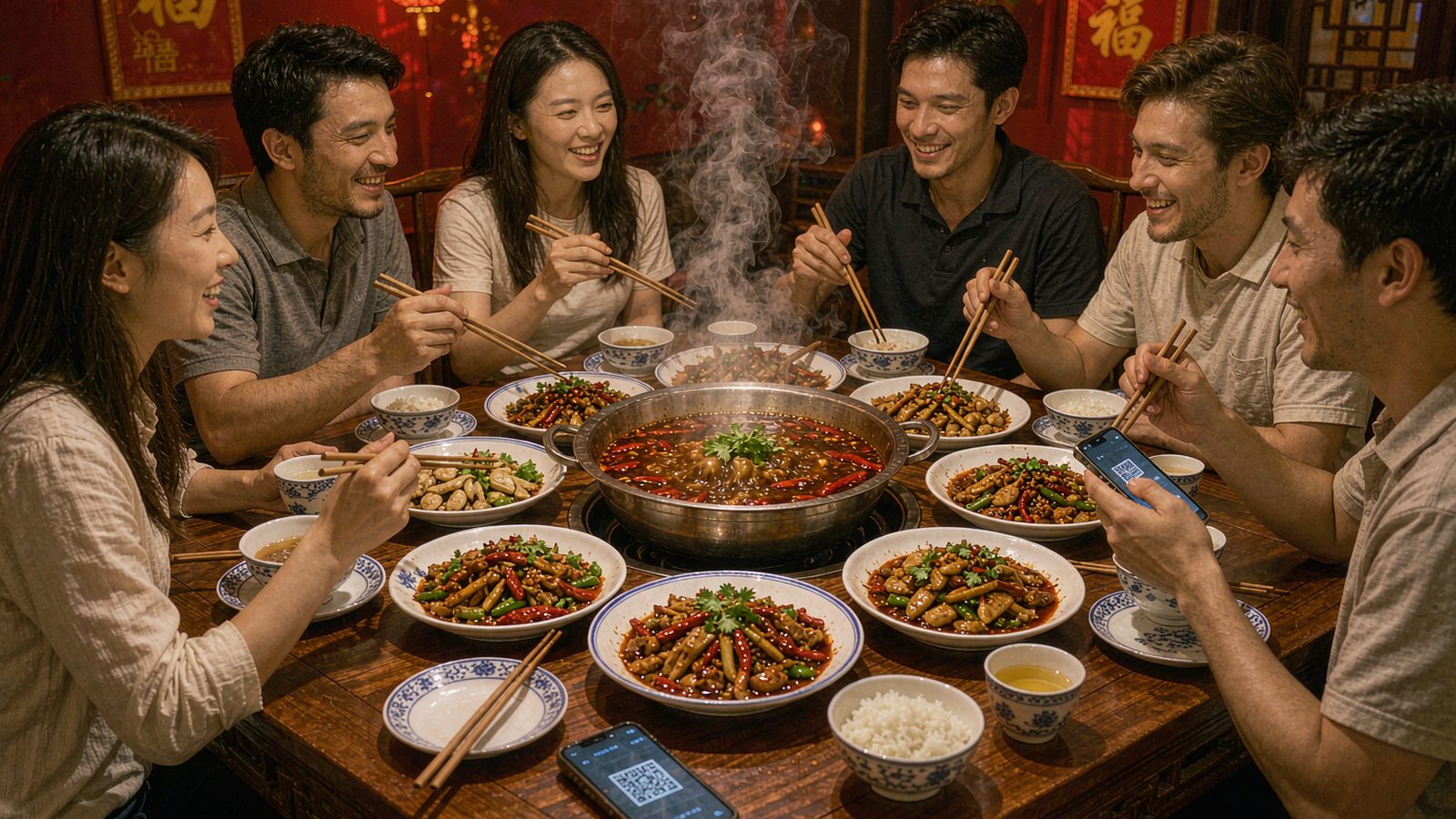
Eight regional cuisines compared, signature dishes in eight cities, five ways to find where locals eat, six-step QR ordering, western and halal options, tourist-area traps and a dietary phrase table.
Food is the least worrying and most underrated part of travelling in China. Few countries match the range of Chinese cooking: within one country, the numbing heat of Sichuan food, the restraint of Cantonese cooking, the sweetness of Jiangsu dishes and the wheat-based staples of the north-west are effectively four different cuisines. Yet the real difficulty for overseas visitors is rarely finding something to eat. It is knowing where to go, how to order, how the QR ordering system works, and whether familiar food is available when you want it.
This guide covers Chinese dining along seven lines: how the eight regional cuisines differ, the signature dishes of the main tourist cities, how to find restaurants where locals actually eat, the complete QR ordering process, western and fast food options in major cities, how to avoid tourist-area traps, and how to communicate dietary requirements.
1. Start with the cuisines: mapping the eight traditions to where you are
Chinese cooking is divided into eight regional traditions. Understanding how they differ means you are not guessing when you order. The table below sets out where each is found, how it tastes and what to order.
| Cuisine | Main region | Flavour profile | Representative dishes |
|---|---|---|---|
| Sichuan | Sichuan, Chongqing | Numbing heat, layered flavour | Mapo tofu, twice-cooked pork, boiled fish, hotpot |
| Cantonese | Guangdong, Hong Kong China, Macao China | Light, ingredient-led | White-cut chicken, roast goose, shrimp dumplings, slow-simmered soup |
| Shandong | Shandong | Savory, reliant on heat control and stock | Braised sea cucumber with scallion, sweet and sour carp |
| Jiangsu | Jiangsu | Sweet, refined knife work | Squirrel mandarin fish, lion's head meatballs, salted duck |
| Zhejiang | Zhejiang | Fresh, lightly sweet | West Lake vinegar fish, Dongpo pork, Longjing shrimp |
| Fujian | Fujian | Fragrant, soup and seafood led | Buddha jumps over the wall, lychee pork, satay noodles |
| Hunan | Hunan | Aromatic heat, richer oil and colour | Steamed fish head with chilli, stir-fried pork, spicy crayfish |
| Anhui | Anhui | Savory, mountain ingredients and braising | Fermented mandarin fish, hairy tofu, dried bamboo with pork |
In practice you will meet Sichuan, Cantonese and the wheat-based north-western cooking most often. One useful point: shopping malls in major cities usually host four or five different regional restaurants at once, so finding Sichuan food in Guangzhou is not difficult. Finding genuinely local cooking, on the other hand, means heading to the old town or a residential district.
2. Signature dishes by city: what to order where
| City | Signature dishes | How to try them |
|---|---|---|
| Beijing | Peking duck, hotpot mutton, zhajiang noodles, court pastries | Eat duck in the main dining room; one bird usually serves two to three |
| Shanghai | Local Shanghai cooking, pan-fried buns, soup dumplings | Soup dumplings suit breakfast or afternoon tea; bite a small opening first to release steam |
| Xi'an | Lamb paomo, roujiamo, biangbiang noodles, dumpling banquet | Noodle portions are large; one staple between two plus side dishes works well |
| Chengdu | Hotpot, dan dan noodles, wontons, skewers | Order a split pot, clear broth on one side and chilli on the other |
| Chongqing | Chongqing hotpot, xiaomian noodles, river-style dishes, hot and sour noodles | Local hotpot runs hot; say mild or clear broth directly when ordering |
| Hangzhou | West Lake vinegar fish, Dongpo pork, Longjing shrimp | Dishes lean sweet; mention it if you prefer less sugar |
| Guangzhou | Morning tea dim sum, roast meats, slow-simmered soups | Morning tea starts around 07:00 and is the best introduction to Cantonese cooking |
| Guilin | Guilin rice noodles, beer fish, oil tea | Rice noodles are the local breakfast staple, roughly 8 to 15 yuan a bowl |
These are the signature dishes, not the whole menu. What is often genuinely better is a neighbourhood family restaurant, well below tourist-area prices and considerably more consistent.
3. How to find where locals actually eat
Getting this right changes the whole food experience of a trip. Several workable methods:
- Look at who is queuing. A restaurant with local residents waiting usually gets both price and taste right; one with only tourists queuing usually gets the marketing right.
- Walk 500 metres away from the main street or scenic gate. Premiums near attractions are steep; two streets away prices often fall by a third.
- Use a local dining app for ratings and average spend. China's main review platforms offer Chinese and partial English interfaces. A rating above 4.0, mid-range spend and a large number of reviews is a safe combination. Be cautious with very high ratings based on very few reviews.
- Ask your hotel front desk or our accompanying staff. They know which nearby places are clean, quick and suit international tastes. This is the single most efficient way to avoid a bad meal.
- Check whether the menu has pictures and English. Restaurants serving only local diners often have no English menu, but pictures let you point and order correctly. A long-established local place without English is not a sign of poor quality.
One practical cue worth remembering: a restaurant where you can smell wok smoke and cooking oil on entering is usually a Chinese kitchen cooking over high flame to order, while a uniformly bright, near odourless space is usually a chain reheating prepared food. Both are perfectly legitimate, but if you came for flavour, the first is worth walking into.
4. QR code ordering: the complete process
This is where overseas guests most often get stuck. Most Chinese restaurants have moved to QR ordering and paper menus are disappearing fast. The sequence is straightforward once you have done it once.
- Find the QR code on the table. Usually on the table corner, the wall or a stand by the cutlery. The table number is normally printed alongside.
- Scan it with WeChat or Alipay. This opens the restaurant's ordering mini-programme, which normally detects your table number automatically.
- Browse and add dishes. Pages are usually grouped into signature dishes, hot dishes, cold dishes, staples and drinks, with prices and chilli icons shown.
- Set party size and preferences. Many systems allow notes on the order page, where you can write no chilli, no coriander or no chicken essence.
- Submit the order. The kitchen receives it and dishes usually start arriving within minutes.
- Pay. You can pay inside the mini-programme or at the counter. If you need a receipt, tell the server and give the invoice details.
Points where people get stuck, and what to do:
- The page is all in Chinese. Both WeChat and Alipay have built-in translation; press and hold the page to translate. You can also simply ask a server to order for you, which most will gladly do.
- You have no Chinese phone number. Mini-programmes generally do not require one, provided your WeChat or Alipay account is registered. This is another reason to set up payment before arrival.
- You would rather not scan. That is entirely fine. Tell the server you would like to order in person; legitimate restaurants all provide table service.
- You want to add a dish or hurry things along. Say you would like to add something, or ask them to speed it up, or scan again to add to the order.
- Some older restaurants still write orders by hand. In small local places the owner often takes notes directly. That is also perfectly normal.
5. When you want familiar food: western and fast food in major cities
On a longer trip, the options for familiar food in China's larger cities are broader than most visitors expect.
| Category | Typical options | Where you will meet them |
|---|---|---|
| International fast food | McDonald's, KFC, Burger King, Pizza Hut | In almost every city, airport and high-speed rail station; prices close to local fast food, ordering by kiosk or mini-programme |
| Coffee chains | Starbucks and major domestic chains | Dense in office and mall districts; some branches have English menus |
| Western dining | Italian, French, steakhouse, brunch | Concentrated in premium districts and hotels in Beijing, Shanghai, Guangzhou, Shenzhen and Chengdu |
| Hotel western restaurants | International restaurants in four and five star hotels | Breakfast is usually a Chinese and western buffet, the most reliable choice when language is a concern |
| Halal restaurants | Local halal canteens and north-western noodle houses | Mainly north-western noodles and grilled meat, clearly signed, and the easiest halal option anywhere in China |
A few practical observations. First, a hotel buffet breakfast is the safety net for overseas guests, combining Chinese and western items and covering everyday preferences. Second, international fast food chains are extremely dense in malls and transport hubs and make a dependable fallback on a tight schedule. Third, genuinely good western dining is concentrated in the largest cities; in second-tier cities and below, options narrow sharply, so if western food is a firm requirement, confirm availability in advance rather than searching on arrival.
One further note: western food in China may differ from the same brand at home. This reflects local adaptation rather than a quality problem. For a taste that matches home most closely, an international hotel restaurant is the safest bet.
6. Avoiding traps in tourist areas
- Check that the menu shows prices. Legitimate restaurants must display them. If the menu has no prices, or a server quotes vaguely, go elsewhere.
- Clarify the unit of pricing for seafood and speciality dishes. In some tourist areas a per-100-gram price can be presented as if it were for the whole dish. Ask directly whether the figure is for the portion or per unit of weight.
- Decline tea and wet wipes without a price list. A few restaurants serve these first and bill them at inflated rates. Saying you do not need tea on being seated is not impolite.
- Review the bill before paying. QR-ordering restaurants show every dish ordered on your phone; table-service restaurants bring a printed list. Check names and quantities, and raise anything doubtful on the spot.
- Avoid eating directly at the gate of a scenic area. For the same dish in the same city, walking 500 metres usually cuts the price by a third or more.
- Complain if something is wrong. China has national tourism service hotlines and market supervision complaint channels. Keep the bill and payment record; there is a defined process for follow-up.
7. How to communicate dietary requirements
| Requirement | What to say | Notes |
|---|---|---|
| No chilli | bu yao la; wei la | Sichuan and Hunan dishes may keep base heat even when asked; clear broth or steamed dishes are safer |
| No coriander | bu yao xiangcai | Coriander appears very often in Chinese food; always say it up front |
| Vegetarian | wo chi su | Confirm vegetarian or vegan first; vegetable dishes may still contain chicken essence, oyster sauce or lard |
| No pork | wo bu chi zhurou | Plenty of substitutes: chicken, duck, beef, lamb, fish and prawns |
| Halal | qingzhen | Look for the halal sign; not serving pork is a house rule in halal restaurants |
| Allergy | wo dui huasheng guomin; wo dui haixian guomin | Peanuts and nuts are common in Sichuan cooking and dipping sauces; say it in person and repeat it in the order notes |
Two conclusions worth keeping. First, state all your restrictions once, when ordering, rather than explaining again at each dish. Second, let our accompanying staff or guide convey them. Chinese restaurants generally respect dietary restrictions, but misunderstandings are easy across a language barrier, and a local voice is the most reliable route. If your trip involves strict vegetarian, serious allergies or religious requirements, tell us before departure and we will build the meal arrangements into your itinerary.
On the whole the barrier to eating well in China is lower than expected. Only three things really need preparing: install the payment apps, learn to order by QR code, and state your restrictions clearly. The rest is down to the restaurant. If you would like us to plan daily meals and restaurant recommendations around your route and taste preferences, send us your itinerary, group size and dietary needs and Jadetour will plan it in: plan a custom tour or contact us directly.
Need help planning this trip?
Tell us your travel dates and group size — we reply within 24 hours.
WhatsApp +86 183 1705 8017 · WeChat 18317058017
Destinations in this guide

Beijing
Imperial Capital · Great Wall, Forbidden City & Hutongs

Shanghai
China's Modern Metropolis · The Bund & Classical Gardens

Chongqing
The 8D Mountain City · Gateway to the Yangtze Cruise

Chengdu
Home of the Pandas · Gateway to Western Sichuan

Xi'an
Thirteen Dynasties of Capital · Terracotta Army & City Wall

Guangzhou
A Thousand Years of Trade · Dim Sum & Lingnan Arcades
Related Tours



More Guides
Flying with a Pet to and from China: Cabin, Hold and Quarantine in 2026
Cabin, live-animal hold or cargo, plus quarantine certificates, the 21-day rabies rule and China entry requirements.
10/17/2026
Solo Female Travel in China: Safety, Night Transport and a 2026 Checklist
Registration, late-night rides, payments and emergency numbers: a practical 2026 checklist for women travelling alone in China.
10/17/2026
Student Travel in China: 2026 Rail Fare Rules and the Best Hands-On Activities by City
A practical guide to study tours in China: 2026 rail student fare scope, visa-free basis for camps, hands-on activities by city, and group safety standards.
10/16/2026